
Outdoor Christmas Lights That Skip the Default Playbook and Still Feel Festive
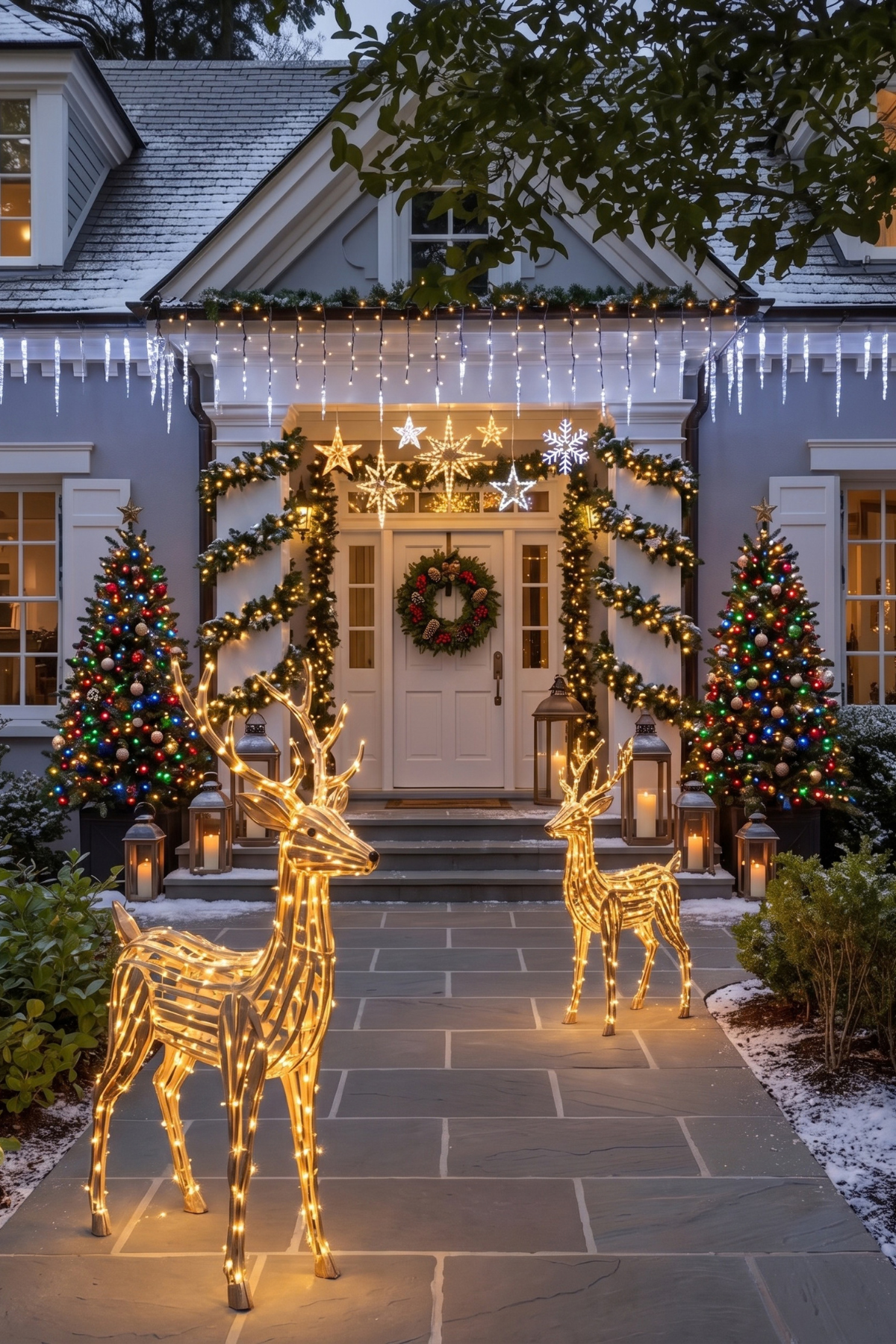
Most people treat outdoor Christmas lights as an afterthought. One strand along the gutter, maybe a wreath on the door, and the job is done by nine at night with cold fingers to show for it. But the exterior of a house is still a space with proportion, sightlines, and focal points, exactly like a living room.
The best displays borrow straight from interior design logic. Layering different light types at different heights. Framing an entry the way you would frame a mirror. Repeating a color or shape so the eye reads it as one composition instead of ten separate purchases stacked on top of each other.
Below, we pulled a range of yards that each handle this differently, from a full multi-level rooftop treatment to a single tree wrapped in ornaments no one thought to buy specifically for December. None of them rely on more lights being automatically better.
Layer Every Plane, Not Just One
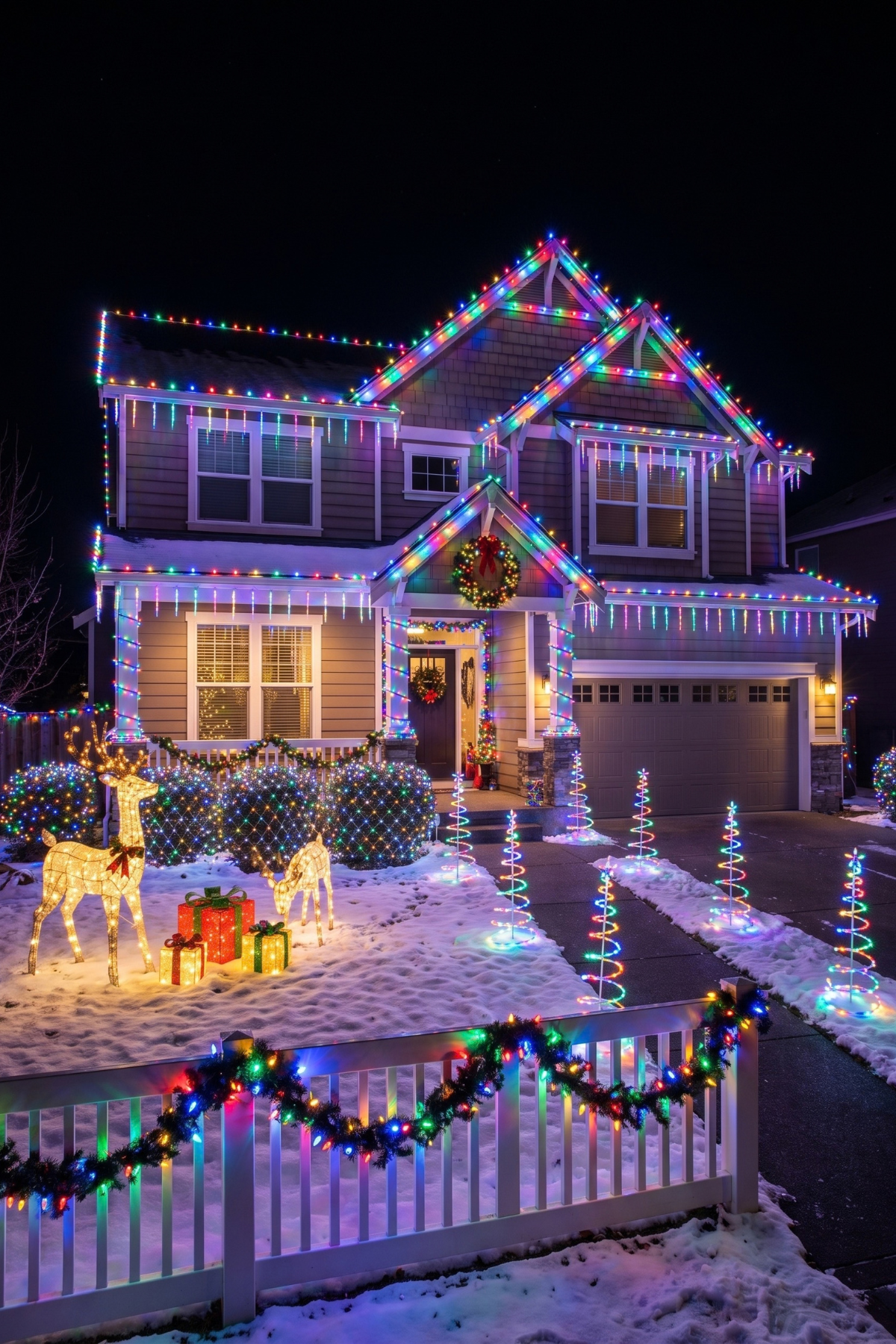
A single strand along the roofline reads as an outline. What actually makes a house glow is treating the roof, the eaves, the lawn, and the walkway as four separate layers that each get their own light story instead of one strand doing all the work.
Here, the roofline carries dense multicolor lights, icicle strands drip from the eaves for texture, and lit reindeer figures with wrapped gifts anchor the ground plane so the eye has somewhere to land besides straight up. Spiral trees repeat down the driveway, turning a walk to the door into its own lit path rather than an afterthought, and garland strung along the fence closes the whole scene off from the street.
If you’re building this at home, start at the roofline and work down one layer at a time, checking from the street after each addition. Icicle lights add movement that a flat strand can’t, and ground-level figures give the display scale and personality without needing more wattage overhead, which matters once the electric bill shows up in January.
Sculptural Shapes Beat Straight Strands
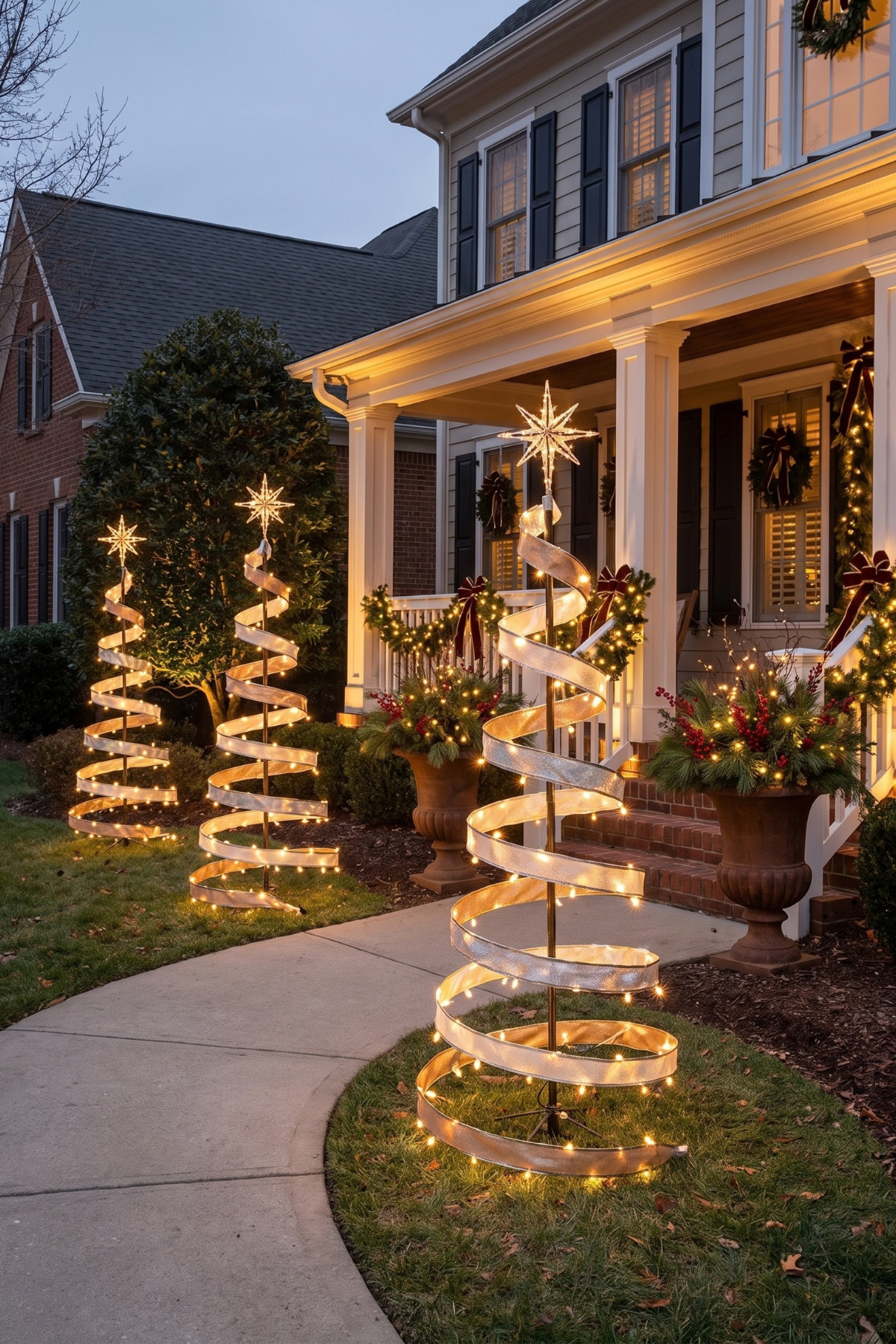
Spiral cone trees along a front walk are doing something a straight light strand never could: they read as objects, not decoration. Each one has a star on top and a shape you can see from across the street, which turns a path into a sequence of small landmarks instead of just a lit sidewalk.
We like that this yard didn’t stop at the trees. Urns filled with lit greenery flank the porch steps, and garland edges the railing, so the sculptural pieces on the lawn have something softer to answer them near the door. The porch and the path end up feeling like one continuous idea instead of two separate projects.
Space your spiral trees evenly and keep them at a consistent height for rhythm. A stake-mounted design holds up better in wind than a freestanding one, and warm white keeps the shapes readable instead of getting lost in a mix of colors.
Let String Lights Follow the Branches
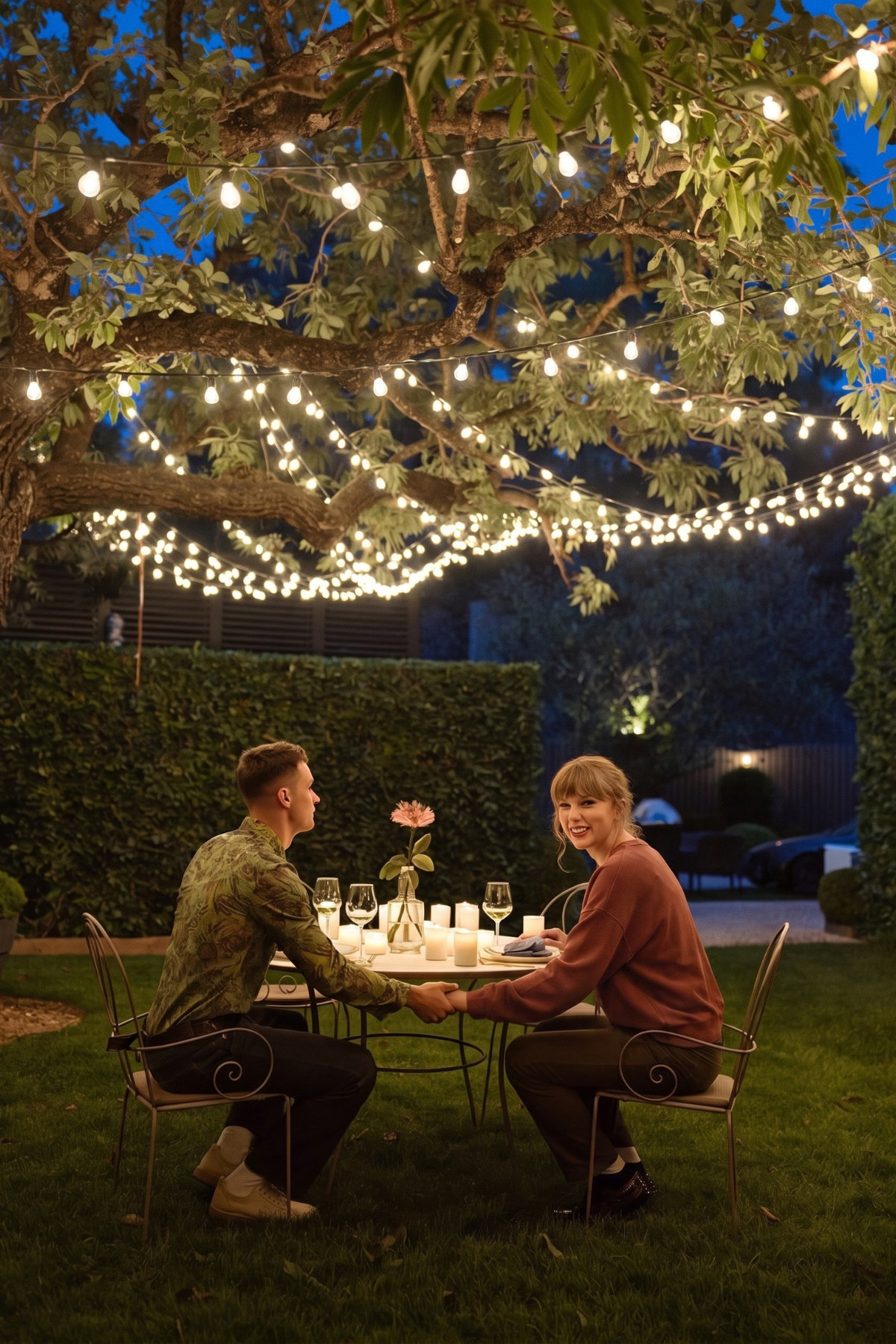
Not every outdoor lighting idea needs a wreath or a reindeer attached. Sometimes the whole trick is stringing café-style bulbs through a mature tree canopy and letting them hang exactly where the branches naturally dip, so the light looks like it grew there instead of being installed.
Spaces like this tend to feel less like a display and more like a room without walls, the kind of setup where you’d actually want to sit under it for an hour with a glass of wine and no particular agenda. Candlelight on the table below adds a second, lower layer of warmth that pulls the eye down from the canopy.
To pull this off, run multiple strands at slightly different heights rather than one continuous loop, and resist the urge to pull them taut. Loose, following the natural curve of a branch, is what makes the effect feel organic instead of engineered.
Skip the Snow-Globe Color Palette
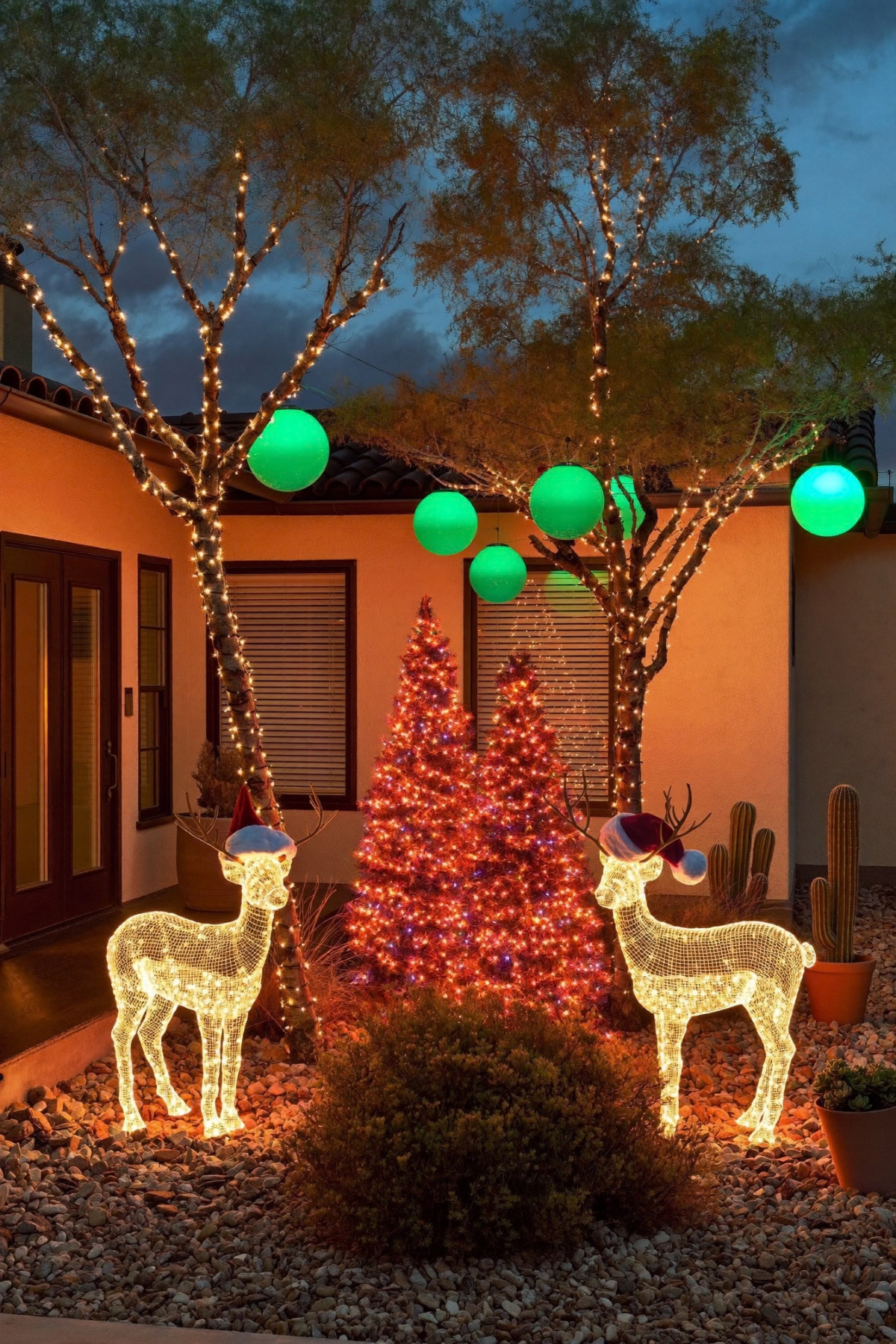
White lights and a green tree are the default, but nothing says a desert courtyard has to mimic a postcard from Vermont. Oversized green globes hang in the trees here, and the star of the yard is a tree glowing red-toned rather than the usual warm gold, which feels considered rather than random.
Reindeer wearing tiny Santa hats keep the display readable as Christmas even without snow on the ground, and that’s really the lesson: pick the two or three icons that signal the holiday to you, then feel free to build your own color story around them instead of defaulting to whatever the lighting aisle put on the endcap.
Try choosing one accent color for oversized ornaments in your trees and one unexpected tone for your main tree, then let everything else stay neutral. In gravel or rock landscaping especially, a strong color choice reads better from the street than a scattershot mix.
Build an Overhead Light Canopy
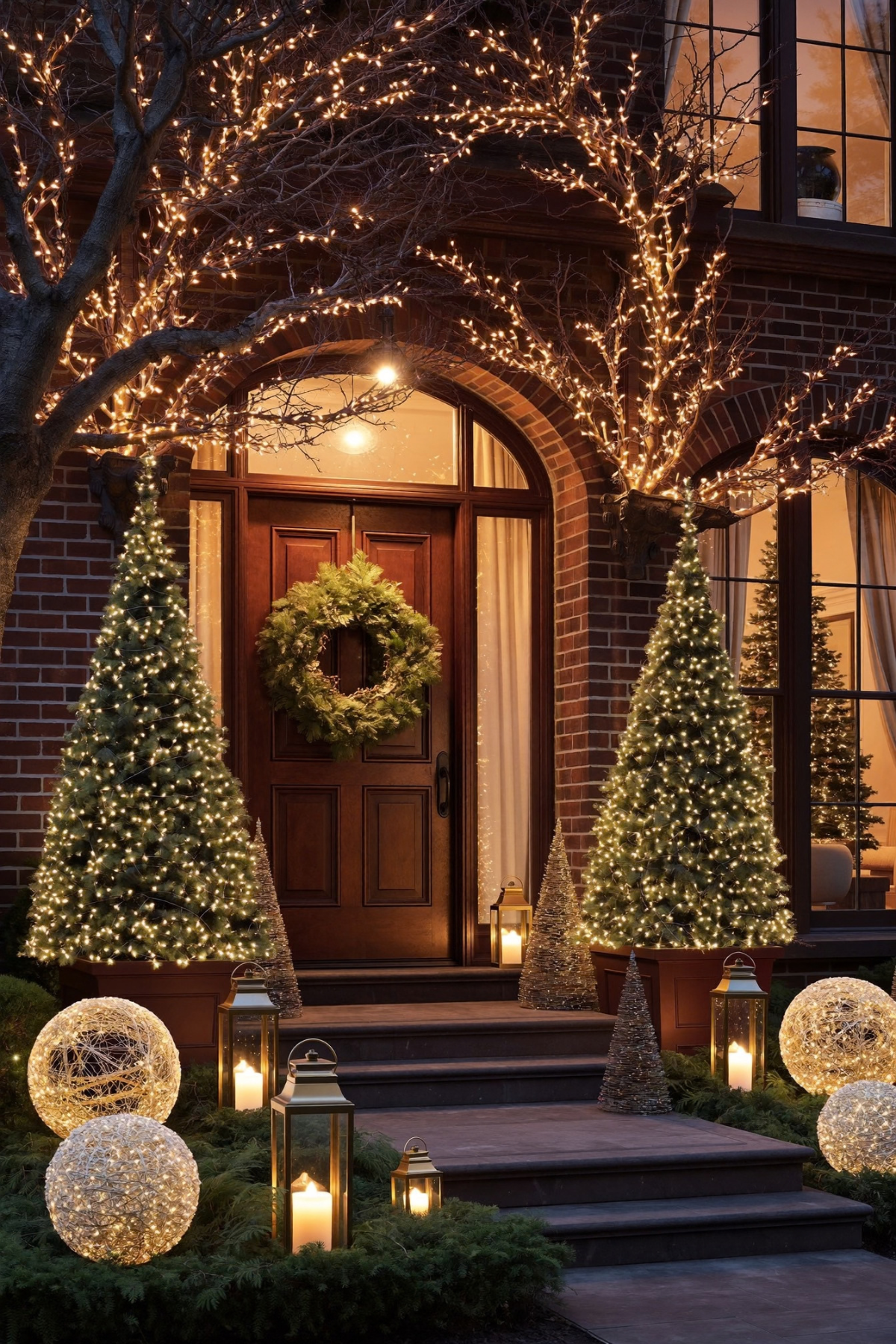
Symmetry does a lot of quiet work here. Two bare trees, wrapped branch by branch in tiny warm white lights, arch over a brick entry like a canopy, and two matching cone trees stand guard on either side of the door below them, so the whole approach feels like walking into something rather than just up to it.
Lower down, twine-wrapped spheres and lanterns line the steps, adding sparkle at ankle height that keeps the eye moving instead of stopping at the door. A simple live wreath finishes the look without competing with everything already happening above it, and the lanterns hold real candles for a softer glow than the string lights alone would give.
One thing worth copying exactly: every light here is the same warm white temperature. That consistency is what lets three or four different techniques, branch-wrapping, cone trees, sphere accents, sit together without looking like they were bought in different years, in different stores, with different ideas about what December is supposed to look like.
Treat a Window Like a Door
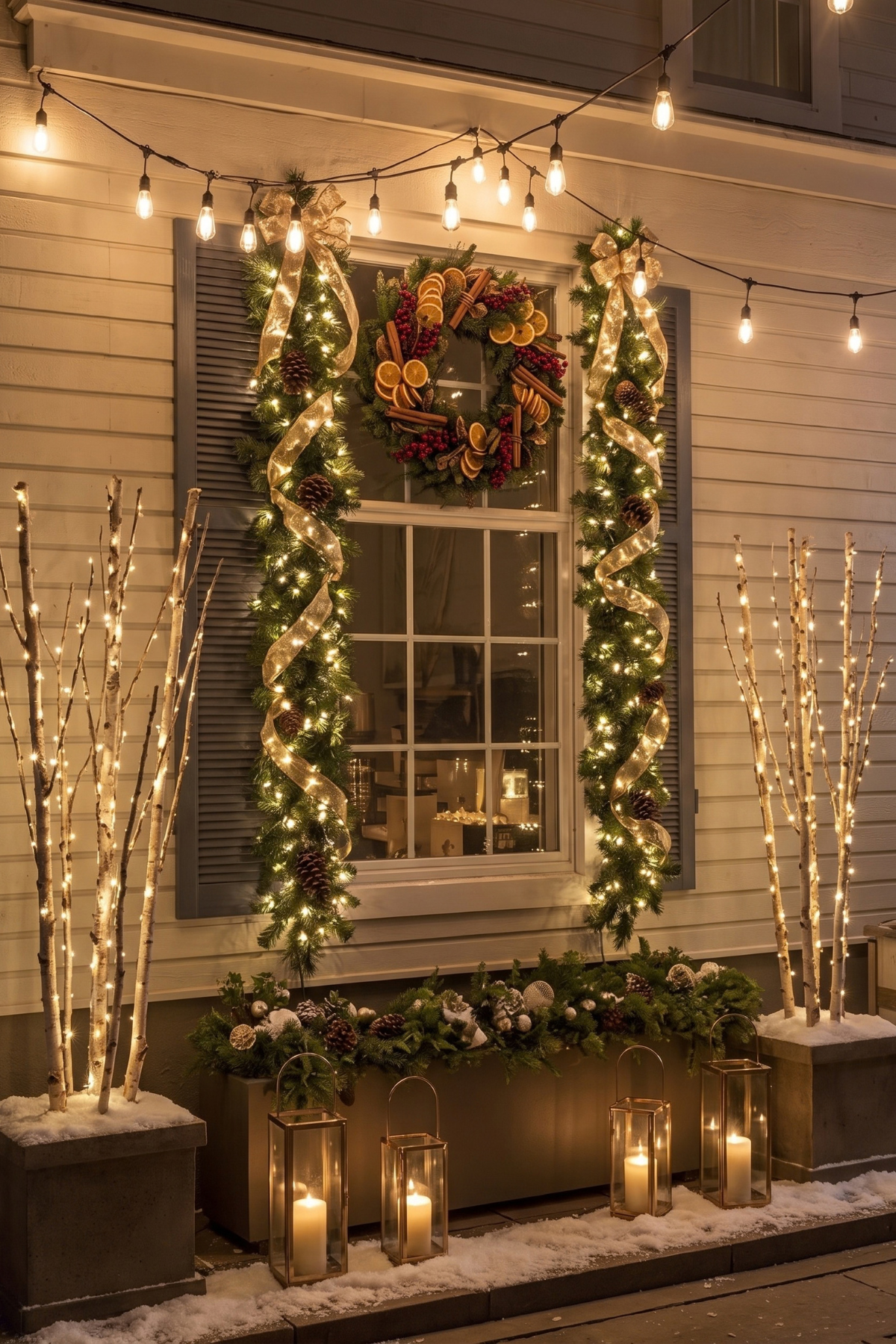
Windows get skipped constantly in outdoor decorating, mostly because they don’t have an obvious hook the way a door does with a wreath hanger. This one proves that’s a missed opportunity: garland runs vertically along both sides of the window with ribbon spiraled loosely through it, and a wreath made of dried orange slices and cinnamon sticks sits right at the center like the window itself is the front door.
Birch branches wrapped in lights stand in planters below, adding height without blocking the glass, while lanterns with real candles sit at ground level for a softer glow that doesn’t compete with the string lights overhead.
If you’re trying this, wind the ribbon in a loose spiral rather than running it straight down, since a slight irregularity reads as handmade instead of assembly-line. Dried citrus and cinnamon add scent and texture for close to nothing, which matters more than people expect once you’re standing on the porch.
Go Big, But Go Matched
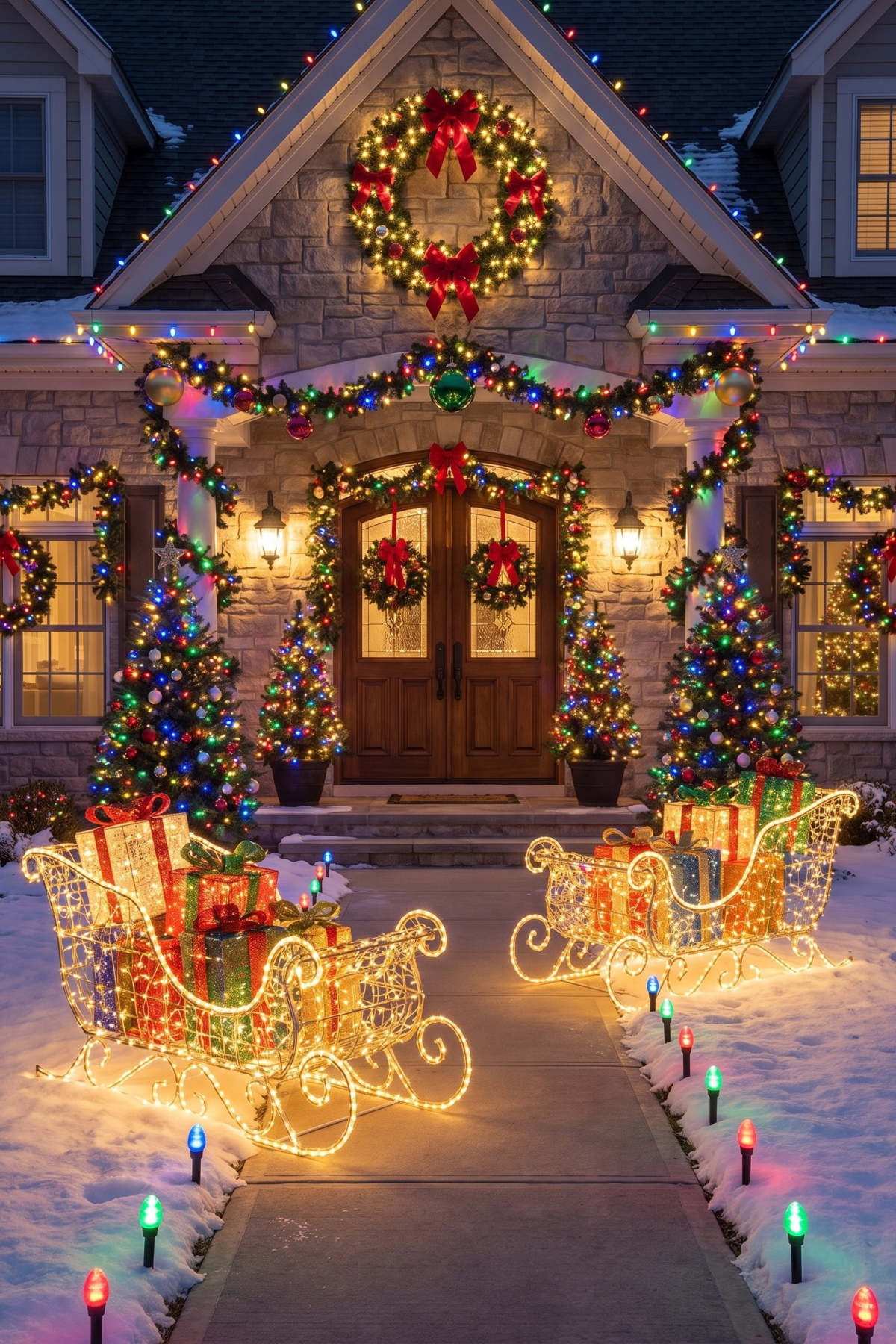
There’s a lot happening on this stone facade, and it works because everything is oversized rather than piled on. A big wreath with red bows, chunky garland strung with large ornament balls, and multicolor lights along every roofline could easily tip into clutter, but the scale stays consistent from the peak of the gable down to the door.
The real move, though, is the pair of illuminated sleighs stacked with wrapped gifts flanking the walkway. Matched props like that do more for symmetry than almost any other single choice you could make, and they give visitors a reason to slow down before they even reach the steps.
Pathway lights in shifting colors line the walk itself, guiding the eye without stealing attention from the house. If you’re going for maximalism, the rule to steal here is simple: choose fewer, larger pieces in pairs rather than scattering small ones everywhere you can find room.
Get the Close-Up Details Right
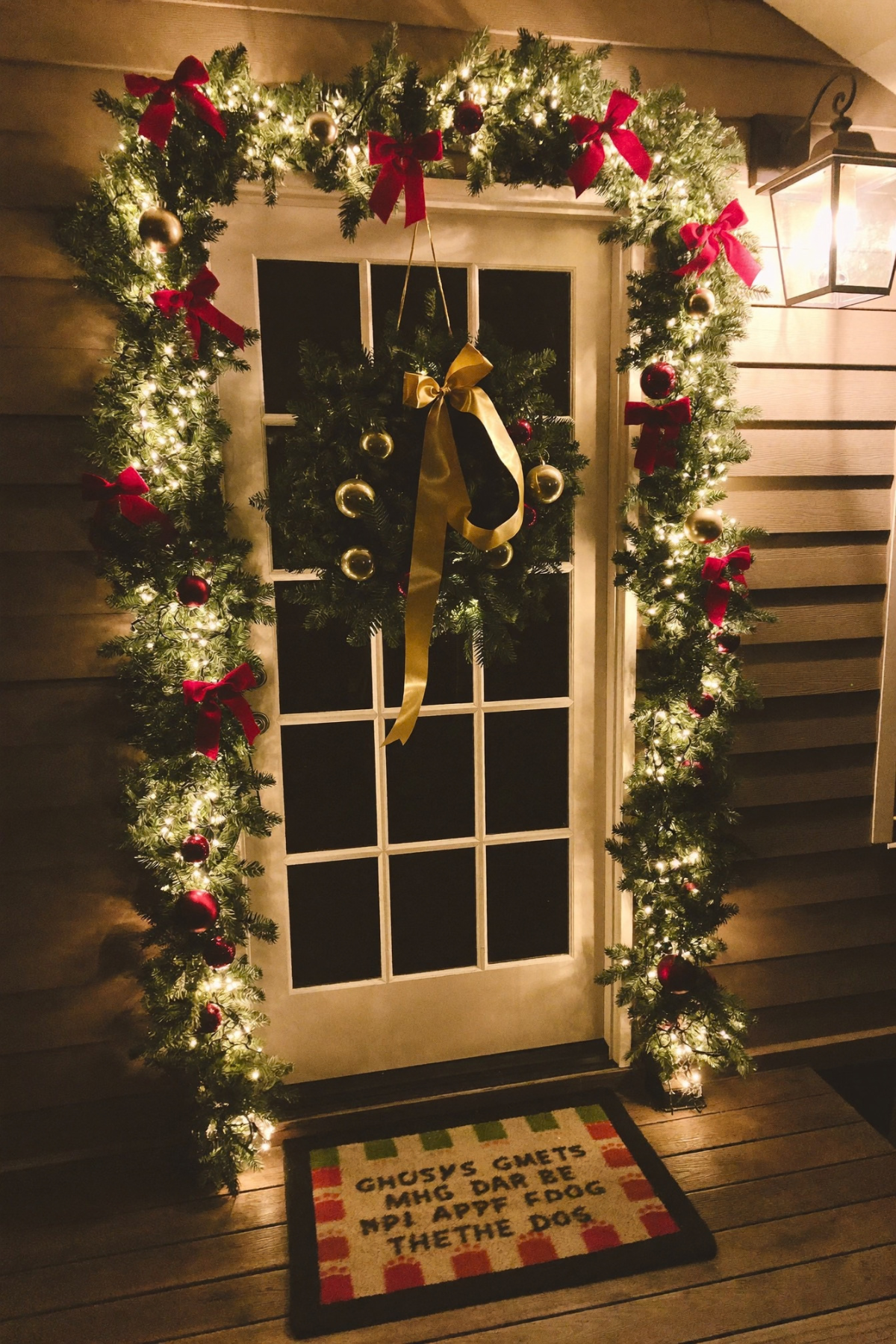
From across the street, most doorway garlands look about the same. Standing right in front of one is where you actually notice whether it was thrown up in an afternoon or thought through, and this door is clearly the second kind, with red velvet bows spaced at even, deliberate intervals down both sides.
Gold ornament balls tucked into the greenery echo the gold ribbon tied around the wreath in the center, so the whole frame reads as one connected idea instead of a garland and a wreath that happen to share a door. A patterned holiday doormat grounds the whole arrangement at floor level.
Even spacing is the detail that separates a considered doorway from a hurried one, so measure roughly equal gaps between your bows before you start wrapping. And pick your accent colors, one ribbon shade and one metallic, before you touch the greenery so they can echo each other on purpose.
Hang Lanterns at Eye Level
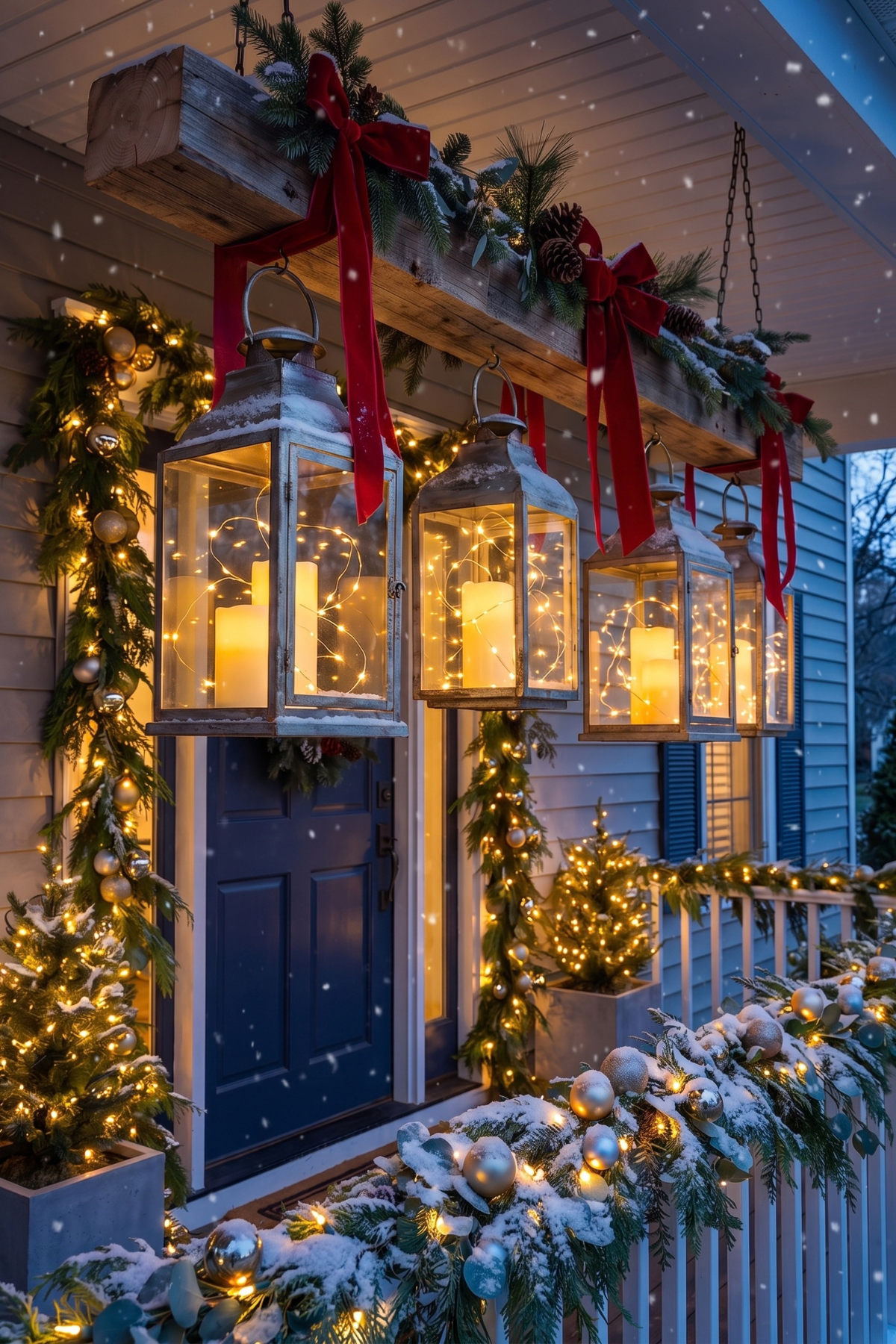
Nearly every roofline in this post pushes light up and out. This porch does the opposite: a row of lanterns hangs from a beam at head height, each one holding a candle wrapped loosely in fairy lights, so the glow sits right where people actually stand and talk instead of glowing somewhere far above them, out of reach.
Red velvet ribbon ties each lantern to the beam, unifying a row of what could otherwise be mismatched fixtures. Below, garland dusted with snow and small potted trees keep the eye moving from the lanterns down to the railing without a hard stop anywhere in between, even with snow falling through the whole scene.
Battery or LED candles make this safe to leave running all evening, and the trick with the fairy lights is to nest them loosely inside the glass rather than winding them tight, since a looser coil catches more flicker and looks closer to real candlelight than a stiff, even wrap ever could.
Add a Vertical Moment Somewhere Unexpected
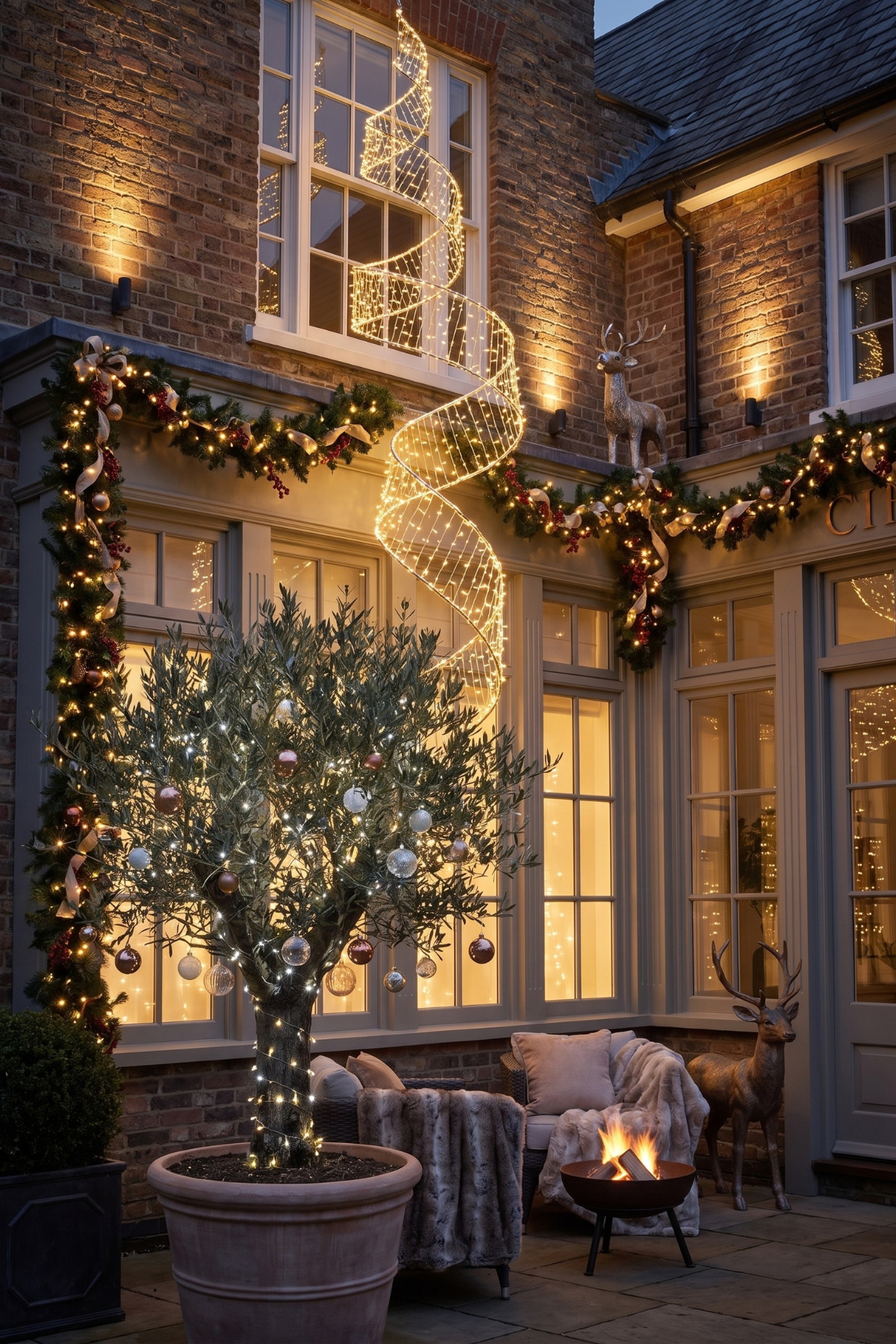
Nearly everything in outdoor Christmas lighting runs horizontally, along a roofline or across a lawn, so a tall spiral light sculpture climbing a full story up a brick corner stands out immediately just for pointing the eye somewhere else.
Below it, a potted olive tree, not anything sold as a Christmas tree, gets strung with lights and hung with mixed metallic ornaments directly on its existing branches, proving the tradition doesn’t need a dedicated fir to work. Garland with ribbon runs along the roofline nearby, and a deer figure watches over the whole scene from a ledge above.
We think the real takeaway is the seating area underneath it all, a fire pit, faux fur throws, an actual place to sit. Extend your lighting into a spot people can linger in rather than just admire from the street, and hang ornaments on whatever’s already growing in your yard before buying a tree you don’t need.
The Best Yards Pick a Story and Repeat It
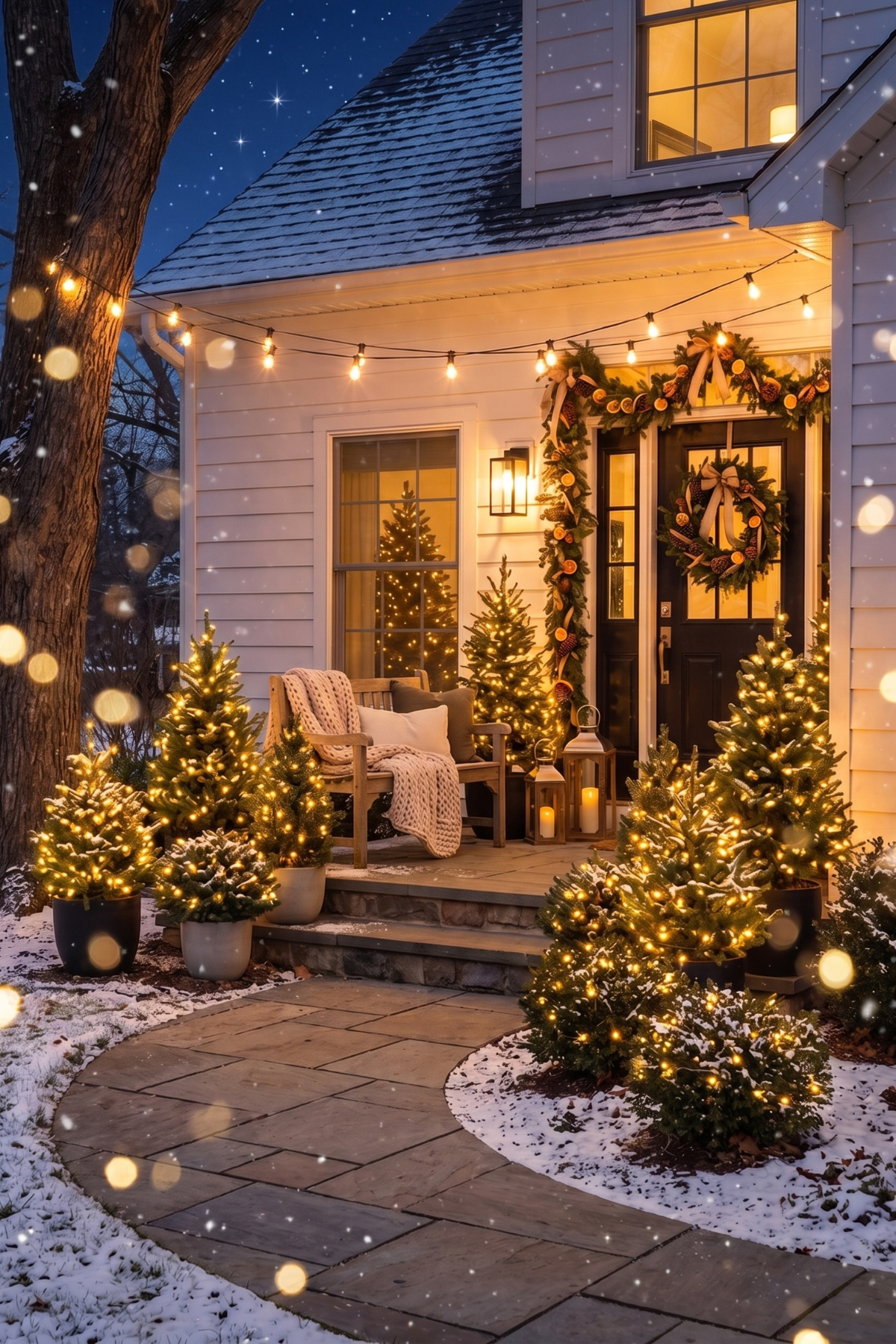
None of these yards are doing everything at once, and that’s the pattern worth taking with you. Each one picked a specific approach, layering, symmetry, an unexpected color, a canopy overhead, and repeated it consistently instead of grabbing whatever was on sale and hoping it would all look right together once plugged in.
That consistency is the actual design skill here, more than any single string of lights or figure on the lawn. A matched pair of props, one light temperature throughout, evenly spaced bows, these are small decisions that compound into something that reads as planned rather than assembled in the dark with cold hands.
Pick the approach that fits your own house and lean into it fully before adding a second one. A smaller display with a clear point of view will always beat a bigger one without one.

 Steal Our Home Styling Secrets!