
Scale Is the Cheapest Trick in Outdoor Christmas Decorating and Nobody Uses It
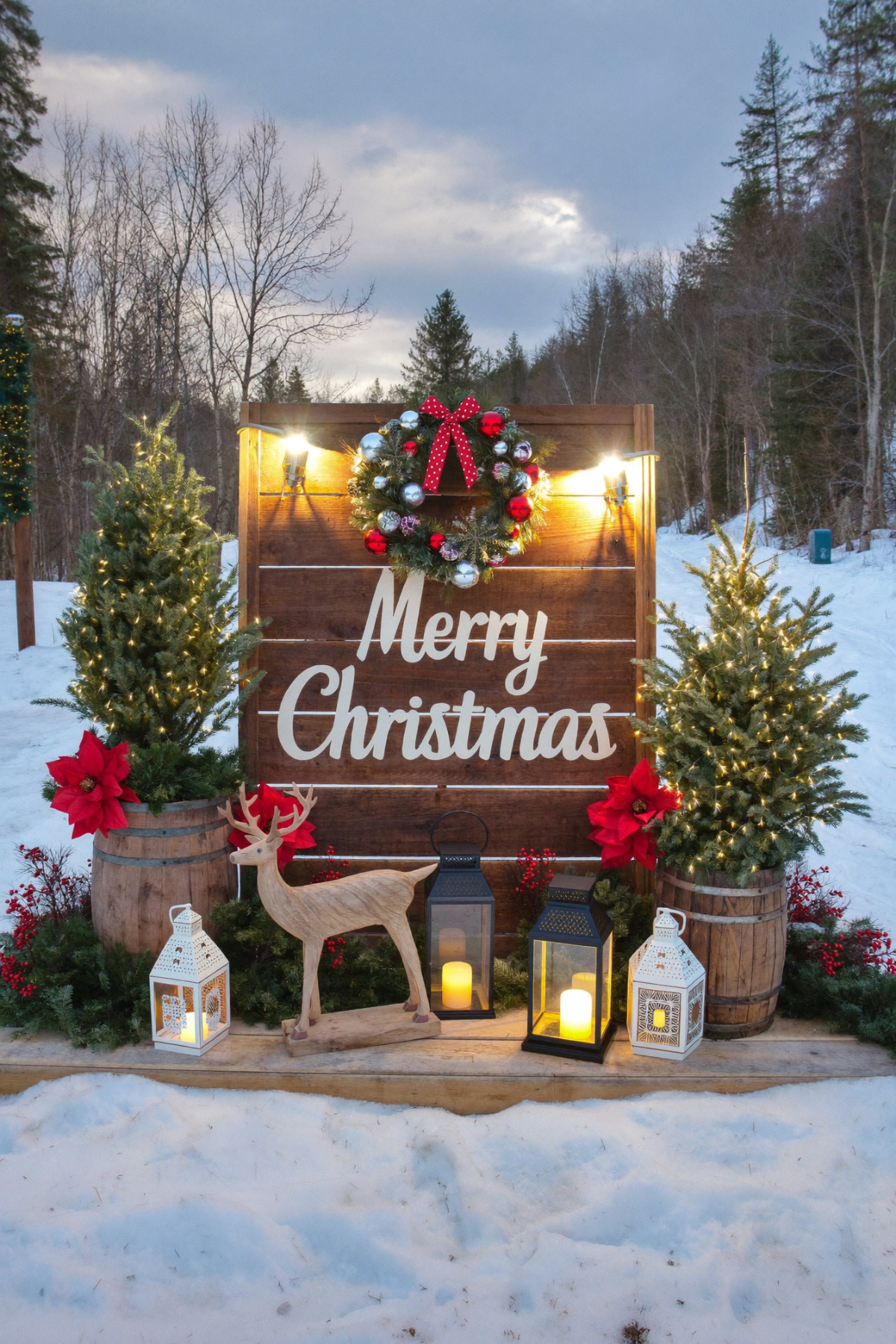
Most people plan their living room and treat the yard like an afterthought — string a few lights along the roofline, prop a wreath on the door, done before dinner. But the exterior of a house is the first impression every guest gets and the last thing they see driving away, and it holds just as much design potential as anything indoors.
The range covered here is wide on purpose. Some of these entries lean formal, built on symmetry and matched light temperature. Others go loud on purpose — oversized letters, giant ornaments set straight on open grass — because a front yard can carry a joke that a dining room usually can’t.
What ties it together isn’t one material or one color palette. It’s the decision to treat outdoor space as an actual space, not just scenery for whatever’s happening indoors.
Twin Deer Figures Anchor Entryways
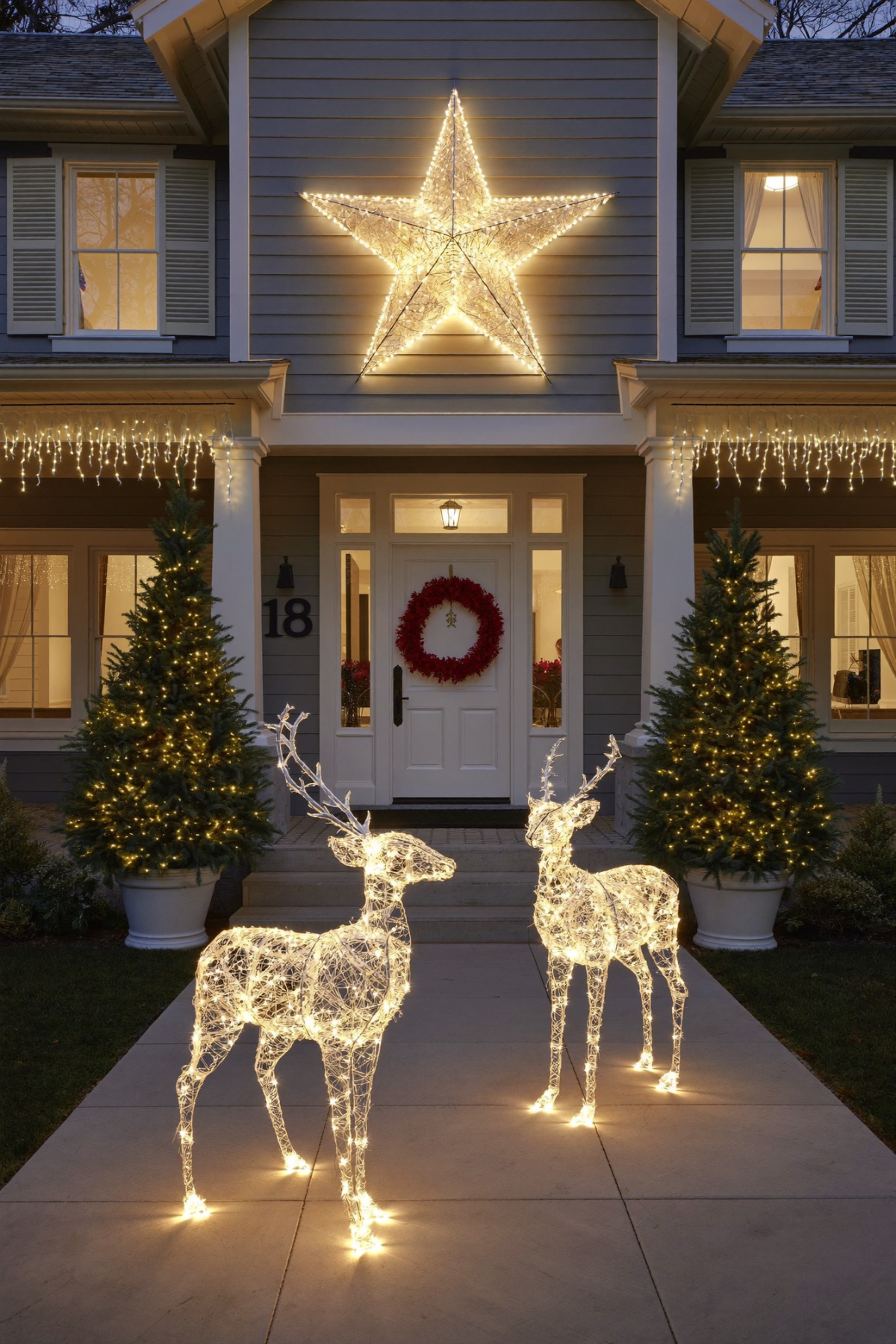
The two woven deer stationed on opposite sides of this walkway are doing more work than they look like they’re doing. Symmetry reads as put-together almost instantly — matching figures on both sides of a path pull the eye straight to the door instead of letting it wander across the yard, and the effect holds even before the lights come on at dusk.
Light temperature matters just as much as placement. Every bulb on this porch, from the star above the entry to the trees in their planters to the wire-frame deer, sits in the same warm white range. Mixing warm and cool white bulbs on one facade is one of the fastest, cheapest ways to make an otherwise nice display look unfinished.
If you’re shopping for outdoor figures, buy pairs rather than singles, and check the color temperature printed on the box before you check out. Set them a consistent distance from the walkway on each side rather than eyeballing it, since even a small gap is enough to throw the symmetry off once the lights are on.
Garland Wrapped Columns Look Formal
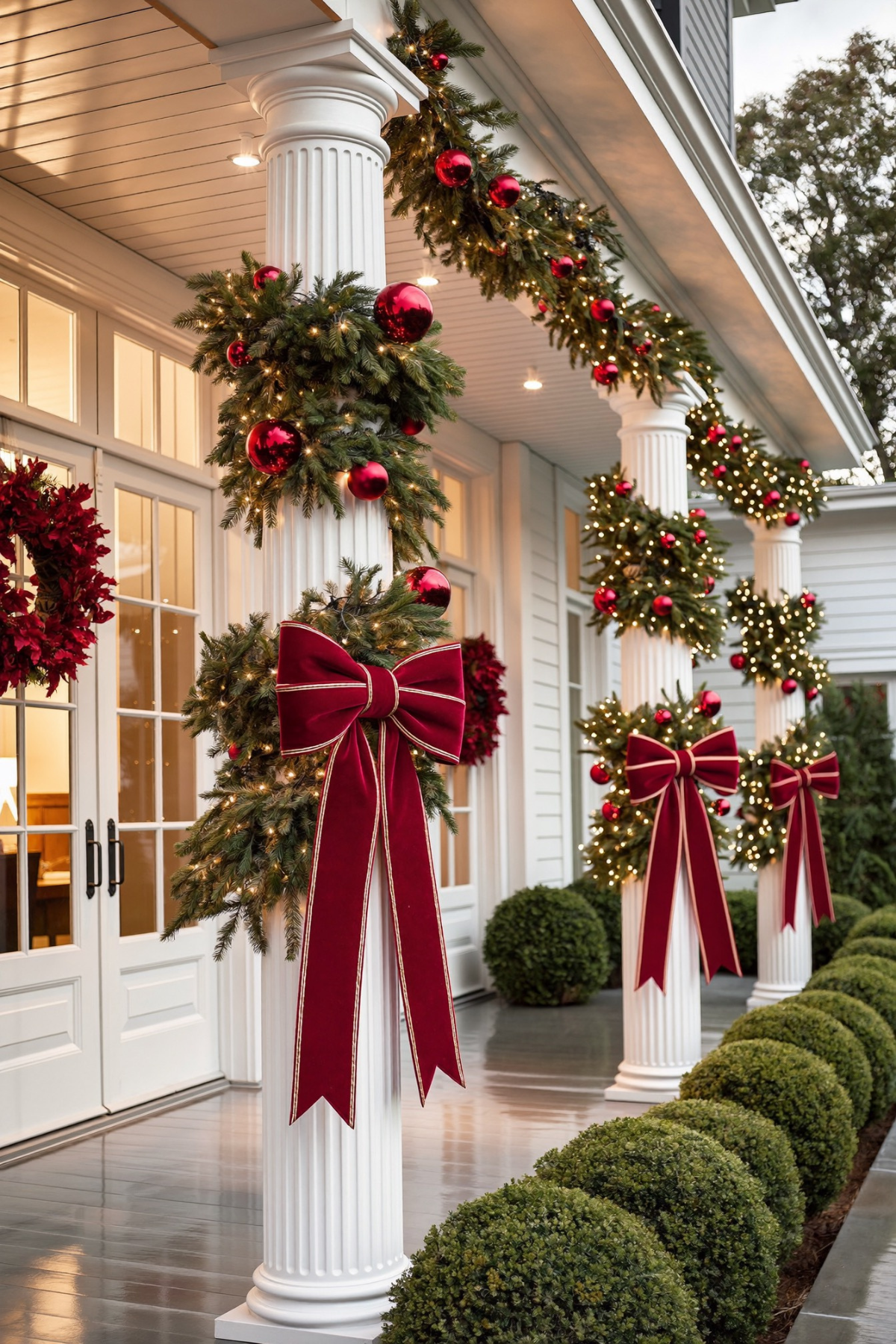
Bare white columns are handsome on their own, which is exactly why wrapping them in fresh garland feels like an upgrade rather than a cover-up. The greenery spirals up each post, catching the ornament clusters and porch lighting along the way, and the columns end up looking dressed instead of decorated, which is a harder effect to pull off than it looks.
The velvet bows are the real signature move here. Oversized, ribbed with a thin metallic edge, and tied loose enough to show movement, they read as deliberate in a way a bow from a craft-store multipack rarely does. Scale is doing most of the work — a small bow on a tall fluted column just disappears against the surrounding greenery and lights.
For your own porch, buy garland by the foot instead of guessing at a length, wind it with the greenery facing slightly outward, and size your bows up before you think you need to. Bigger reads better from the street than it does standing right next to it, which is the vantage point that actually matters most.
Ribbon Trees Bring Motion Outdoors
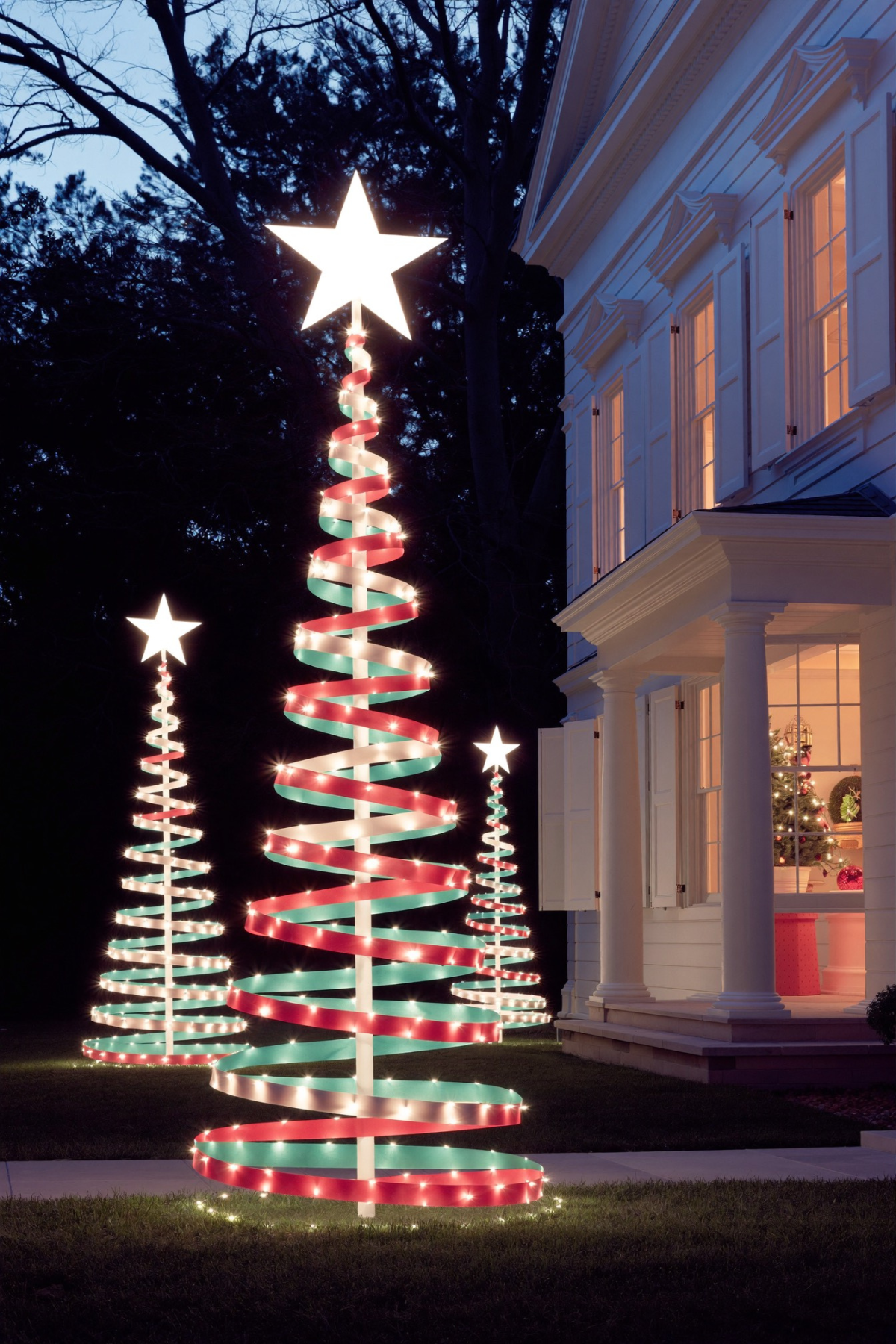
Traditional tree shapes sit still. These ribbon-form trees don’t — the spiraling stripes create a sense of movement even when nothing is actually moving, which is part of why a trio of them reads as more dynamic on a dark lawn than a single full-size lit tree standing in the same spot ever could.
Height variation is the second principle at play, and it’s just as deliberate as the ribbon itself. Grouping three trees of different sizes, each topped with its own star, builds a rhythm instead of one flat repeated shape. The tallest anchors the group from the center; the two shorter ones on either side keep it from reading as a single oversized object.
A cluster like this works best planted in an uneven triangle rather than a straight row, with a few feet of open lawn between each tree so the shapes stay legible from the street instead of blurring into a single glow once it’s fully dark outside.
Oversized Letters Turn a Facade Playful
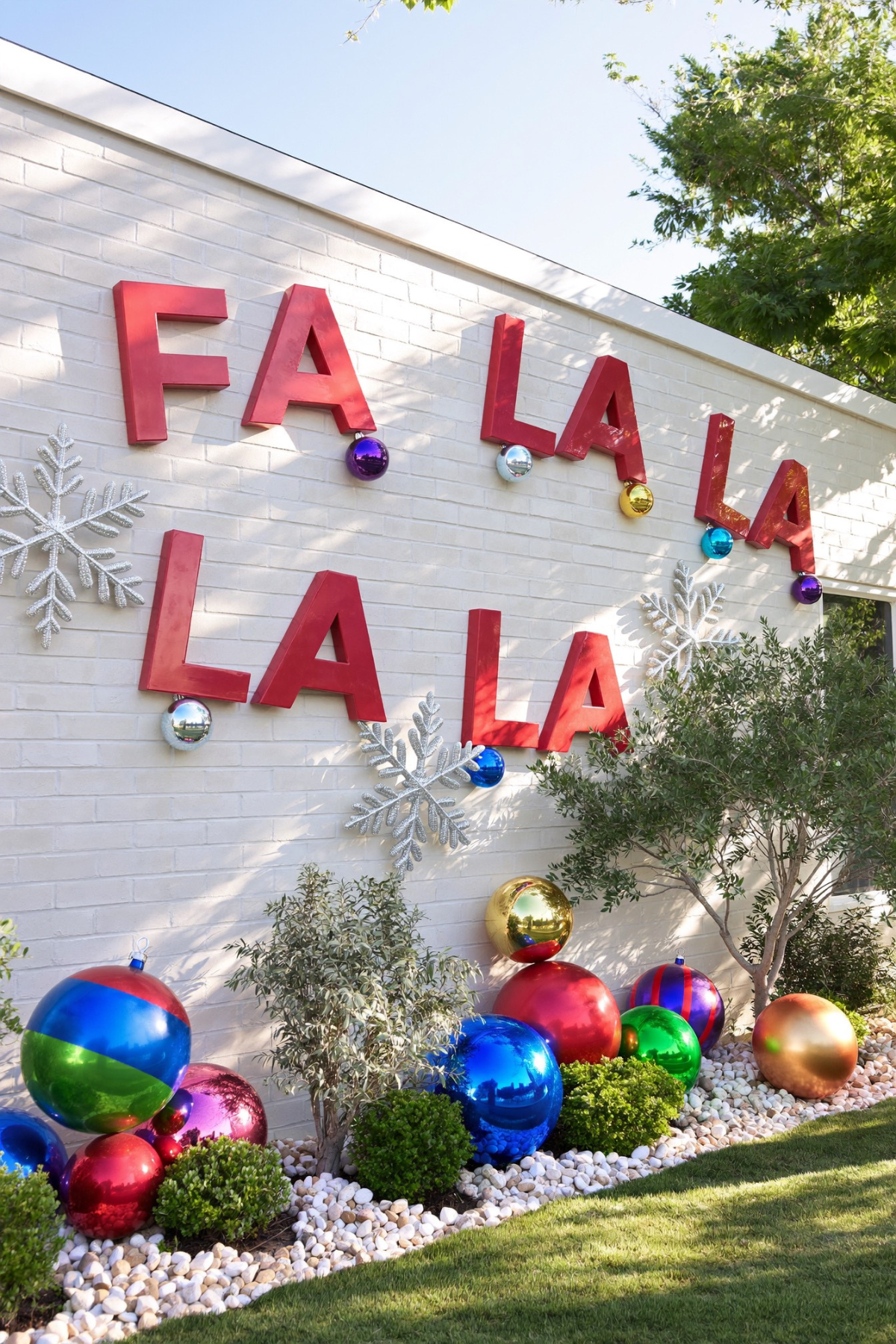
We’re fairly convinced spelling out a Christmas carol lyric in three-foot red letters is about as close as outdoor decor gets to a punchline, and it works precisely because it commits fully instead of hedging with something safer or more traditional along the same stretch of wall.
The color story is what keeps it from tipping into chaos. Red letters, silver glittered snowflakes, and a cluster of oversized ornaments in blue, green, and gold sit against a plain light-colored wall, which gives the eye a clean surface to read the joke against. Busy graphics need a quiet background behind them, or none of the individual pieces actually land.
Existing landscaping does the heavy lifting for the ornaments — they’re simply tucked into a rock bed and a few low shrubs rather than mounted or wired into place. If you’ve already got a planted border along your house, oversized ornaments are one of the lowest-effort, highest-impact additions you can make to it this season.
Driftwood and Pinecones Build Texture
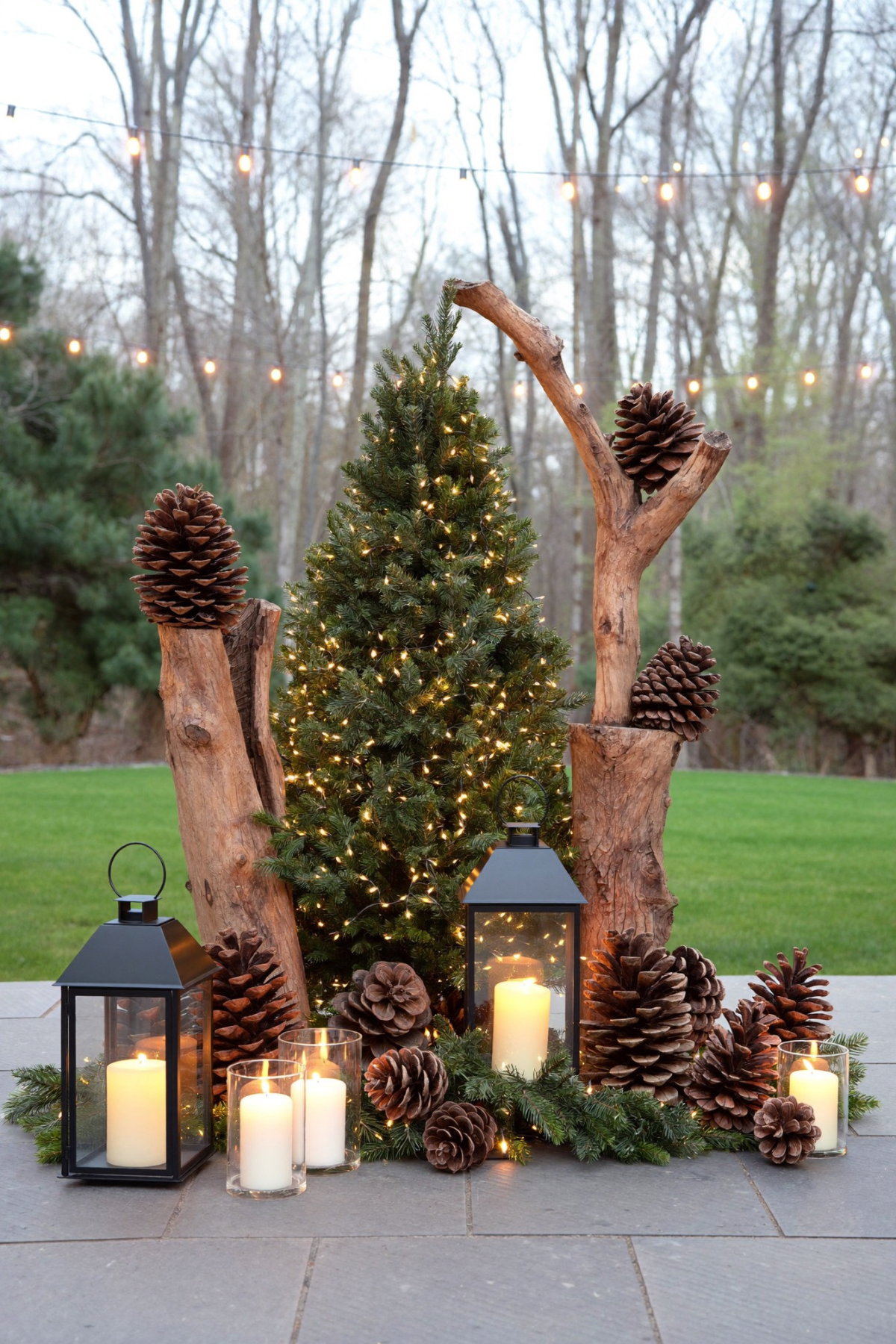
Nothing in this vignette is glossy, and that’s the point. A slim lit tree, a few pieces of raw driftwood, and pinecones in at least four different sizes are stacked together on a patio corner, and the mix of rough, matte textures does more visual work than any single glossy statement piece could manage on its own.
Scale variation matters just as much as texture does here. Small pinecones tucked into gaps between branches, medium ones balanced on forks, oversized ones anchoring the base — the eye keeps finding something new at a different height instead of landing once on the tree and moving straight on to the next thing.
Swap string lights for a few pillar candles in glass hurricanes if you want this look at home. Candlelight sits lower and warmer than string lights ever do, and it suits a display built from natural, unfinished materials far better than anything with a visible cord running through it.
Porches Can Function as Living Rooms
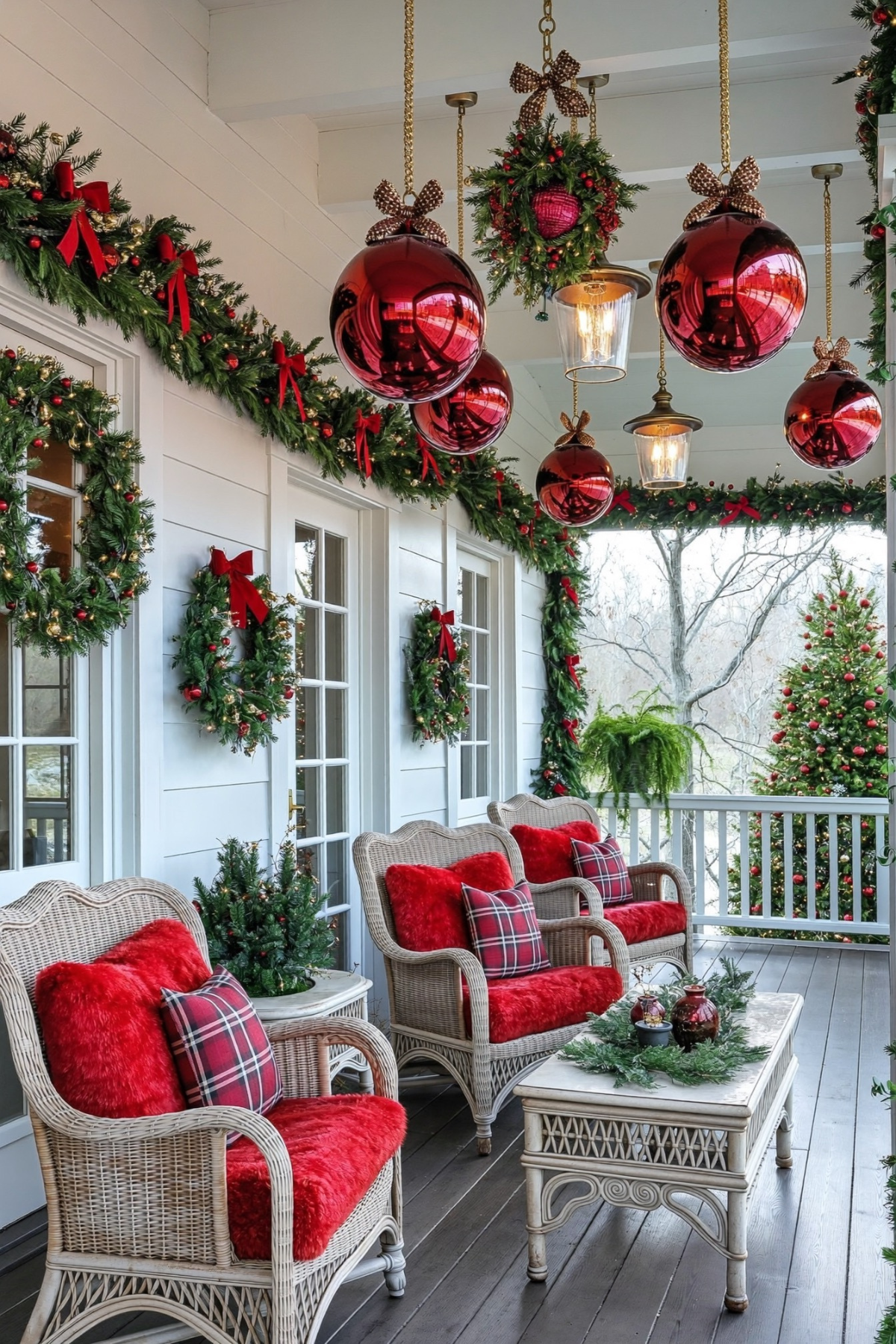
A porch with wicker armchairs, plaid pillows, and a coffee table is already a room, full stop. Decorating it for the season means treating the ceiling as fair game, not just the railing and the windows, which is exactly what’s happening here, with oversized red ornaments hung on ribbon like pendant lights over the seating area.
Layering is the other principle worth noting, and it’s happening at three different heights at once. Garland traces the beam overhead, wreaths sit on the windows behind the seating, and a smaller potted tree fills the corner — three decorative elements working three different sightlines, so no single angle of the room feels empty or half-finished.
If you’re decorating a covered porch you actually sit on, hang a few oversized ornaments at head height instead of ceiling height. From a chair, that’s the range that actually gets noticed over the course of an evening, not a beam six feet above everyone’s heads.
Candy Canes Light the Path
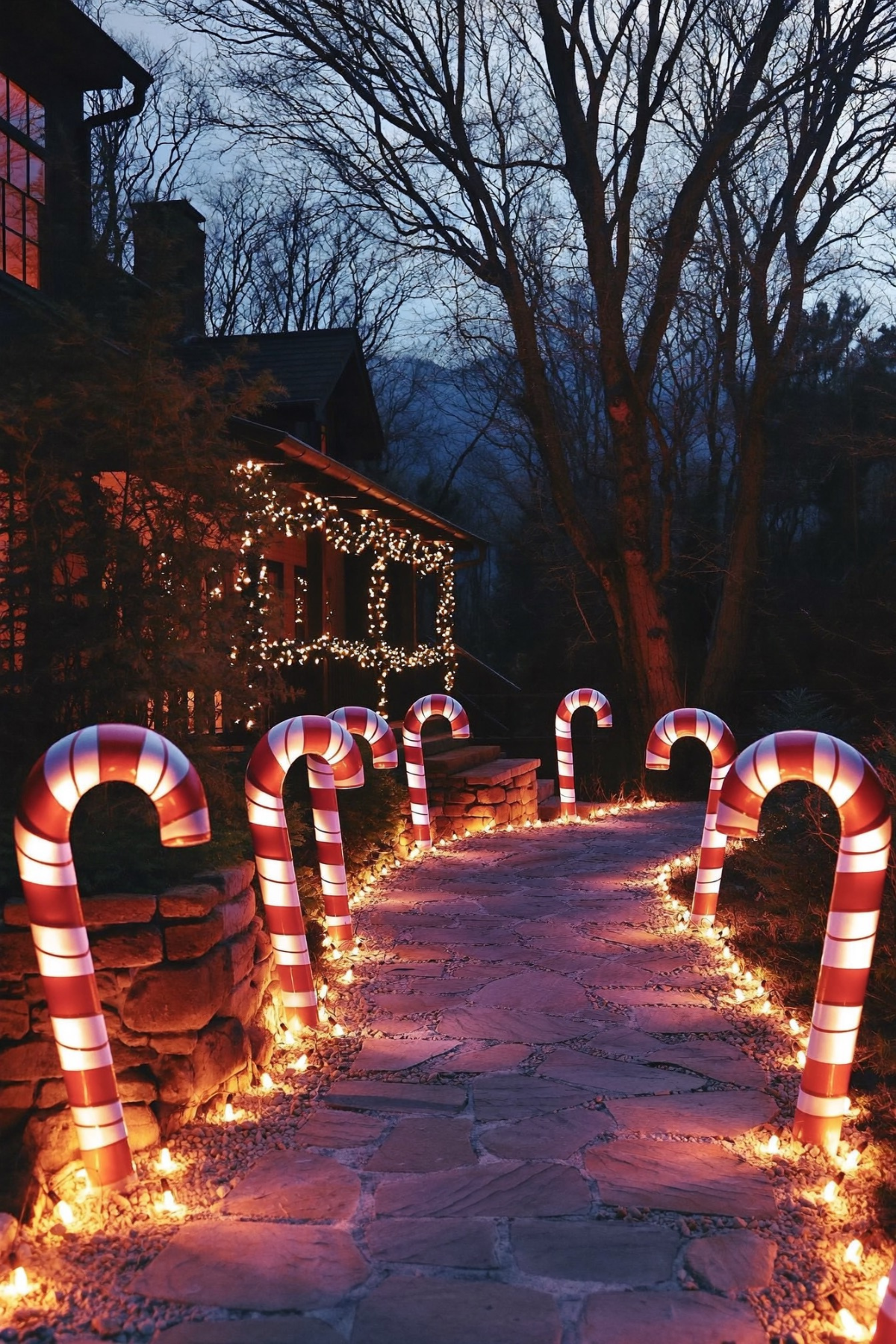
A path lit only from above tends to look flat once the sun goes down. Lining the edges instead, in this case with oversized candy cane stakes strung with small bulbs, gives the walkway its own glow and makes the whole approach to the house feel considered rather than just switched on at random along the way.
The whimsy is doing double duty here, which is what separates it from a purely decorative choice. Candy canes are an obvious, almost childlike motif, but spaced evenly along a stone path they function the same way any wayfinding light would, just with a lot more personality than a plain solar stake pushed into the dirt.
Space your markers roughly three to four feet apart on each side, and keep them low enough that they light the ground rather than compete with your porch lighting up ahead. The path should lead the eye toward the house, not steal attention away from it before anyone gets there.
This Window Became the Whole Facade
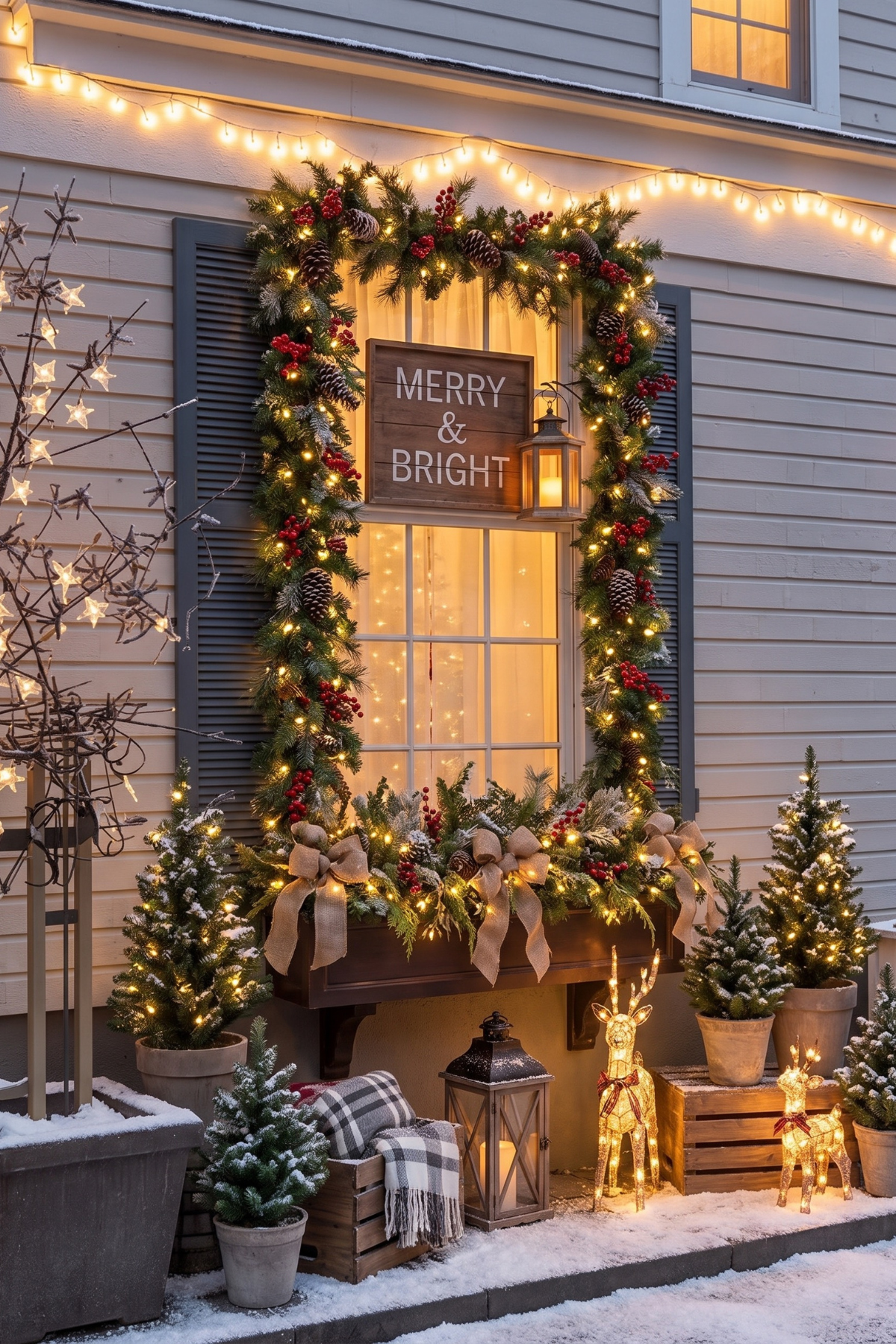
One window, framed floor-to-lintel in garland, does more for this house than decorating every window equally would have accomplished. Picking a single focal point and going all in on it, with pinecones, berries, a wooden sign, and a lantern hung at the center, reads as considered in a way spreading the same effort evenly across five windows never quite manages.
Texture mixing is what keeps the frame from going flat once you’re standing in front of it. Burlap bows, flocked greenery, smooth pinecones, and a rough wood sign are four different materials sharing one narrow border, and none of them repeat, which keeps the eye moving around the frame instead of settling.
Pick your most visible window, not necessarily your largest one, and build the frame in layers: garland first, then berries and pinecones tucked into the gaps, then a sign or lantern as the very last thing you add once everything else is in place.
Giant Ornaments Turn Lawns Whimsical
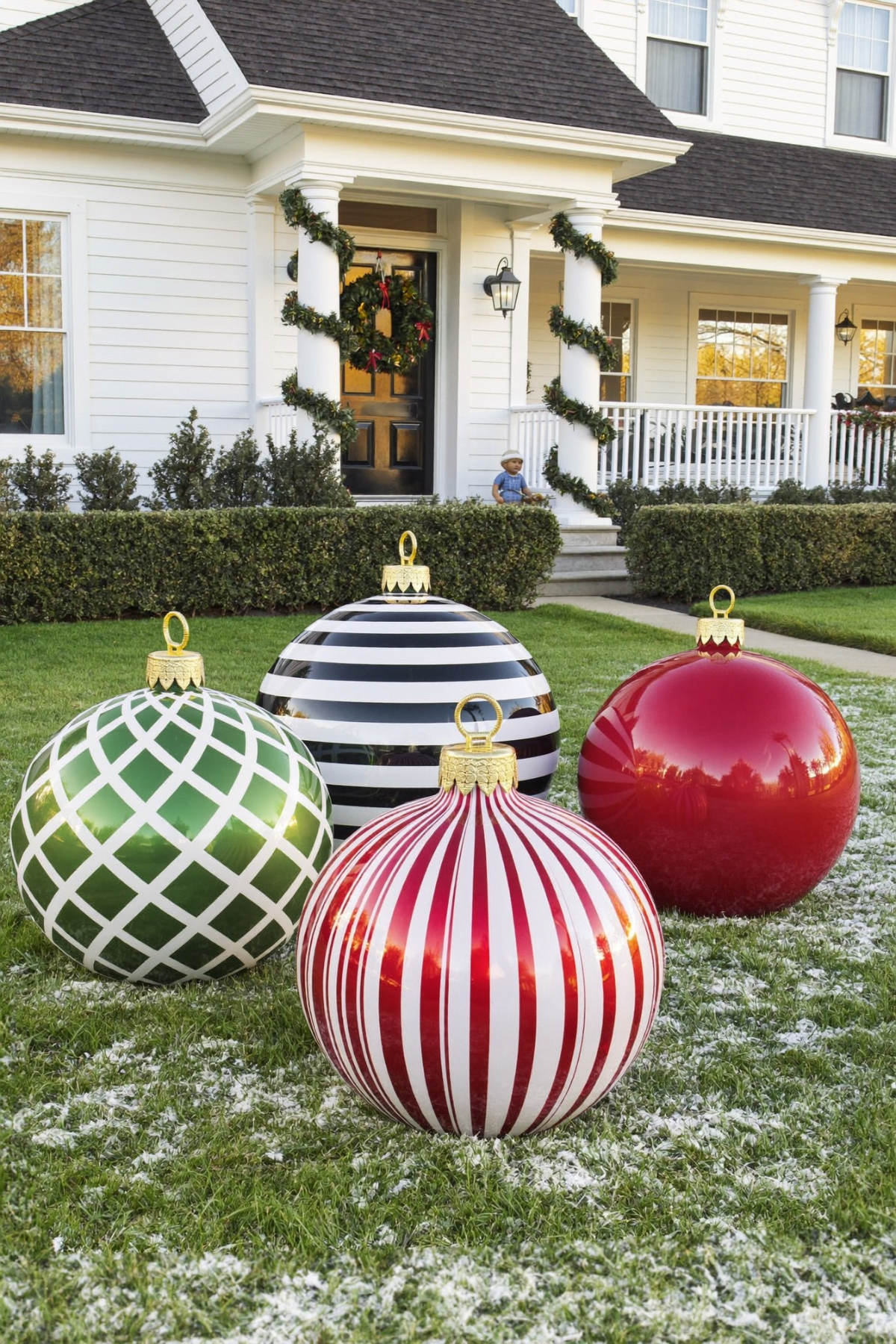
Ornaments the size of beach balls sitting directly on open grass is the kind of decor choice that shouldn’t work and somehow does anyway. Scale is the entire joke — pulling something normally three inches wide out to three feet forces a double take from anyone walking past on the sidewalk, kids included.
Pattern variety keeps four giant spheres from reading as one blob of color once they’re grouped together. A lattice, a wide stripe, a swirl, and a solid finish sit side by side, but they all stay inside the same red, green, black, and white palette as the garland on the house behind them, so the yard and the porch still read as one connected display.
Cluster them in odd numbers directly on open lawn rather than lining them up in a neat row, and keep the pattern count to three or four so the eye doesn’t lose track of which sphere it’s already looked at as it moves across the display.
Brick Porches Take Garland Well
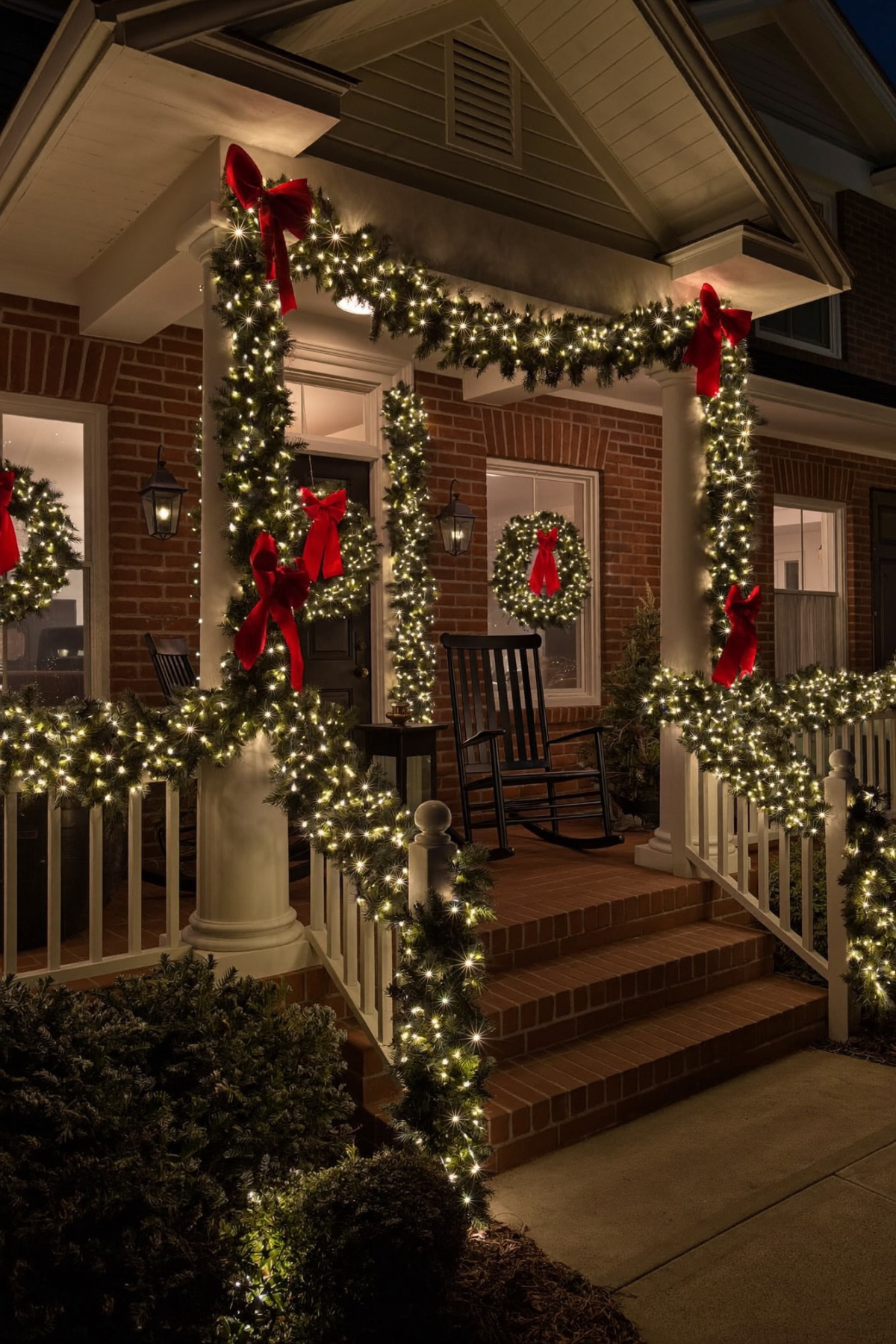
Warm-toned brick and deep green garland were made for each other, and this porch leans all the way into that pairing, wrapping every column, railing, and roofline in lit greenery instead of picking just one surface to decorate and leaving the rest of the porch bare.
The bows are doing precision work rather than decoration for its own sake. Each one marks a transition point — where a column meets the roofline, where the railing turns a corner — so they function almost like punctuation, telling the eye where one decorated surface ends and the next one begins.
Follow the architecture you already have instead of adding shapes that aren’t there to begin with. Wrap garland along the real lines of the porch — columns, railings, door frames, the underside of the roof — and save the bows for the exact spots where those lines change direction or meet another one.
A Good Display Tells You Where to Look
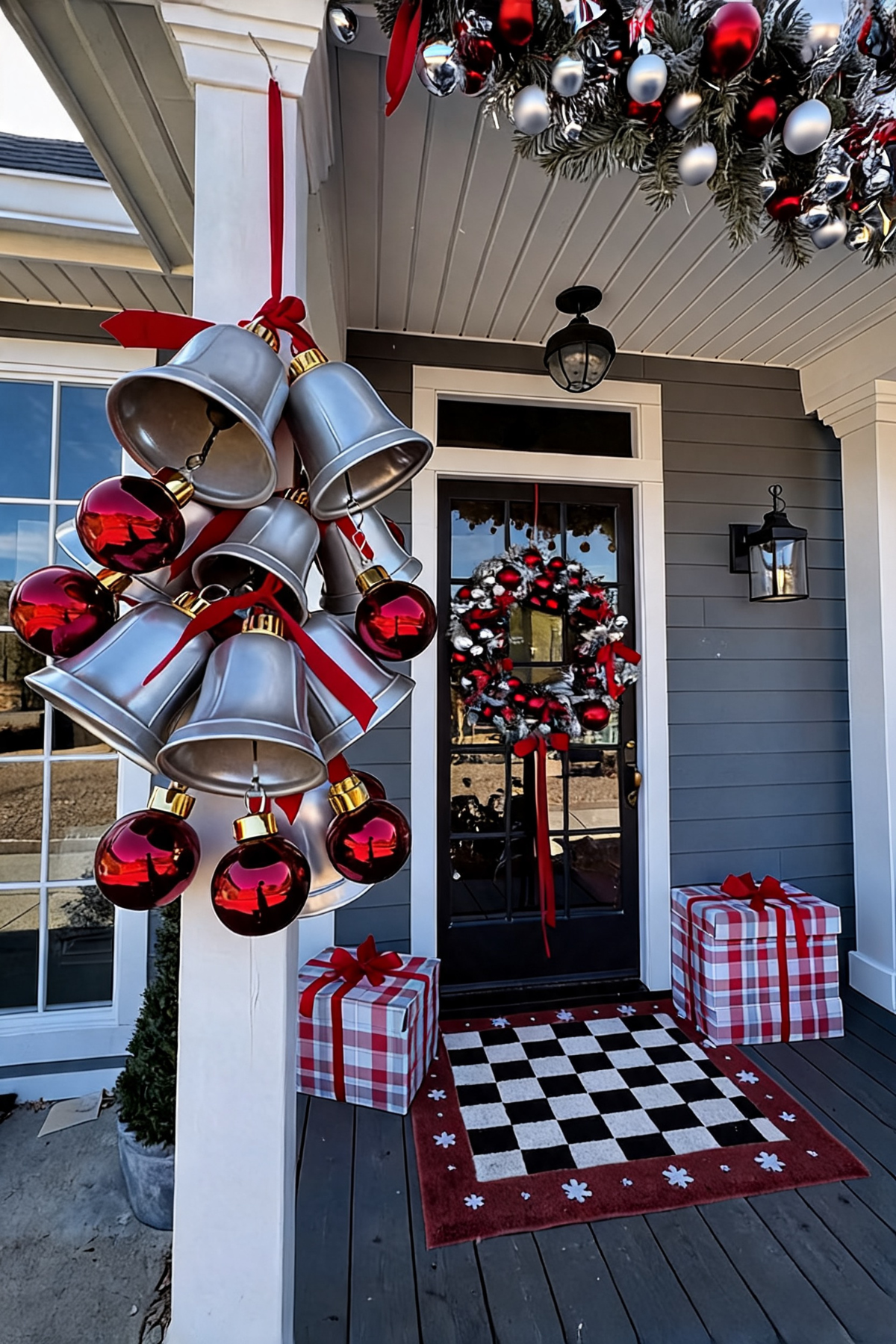
None of these approaches call for the same budget or the same amount of yard. A pair of woven deer and a lit star costs a fraction of what a garland-wrapped column setup does, and both hold up fine entirely on their own.
What separates a display that works from one that just exists is usually restraint somewhere — a single focal window instead of five decorated equally, one color story instead of four competing ones, matched light temperature instead of whatever bulbs happened to be on sale.
Pick the version that matches how you actually use your outdoor space, whether that’s a porch you sit on all December or a lawn people only see driving past, and build from there instead of trying to fit everything in at once.

 Steal Our Home Styling Secrets!