
The Small Chrome Details Making Ordinary Rooms Look Considerably More Expensive
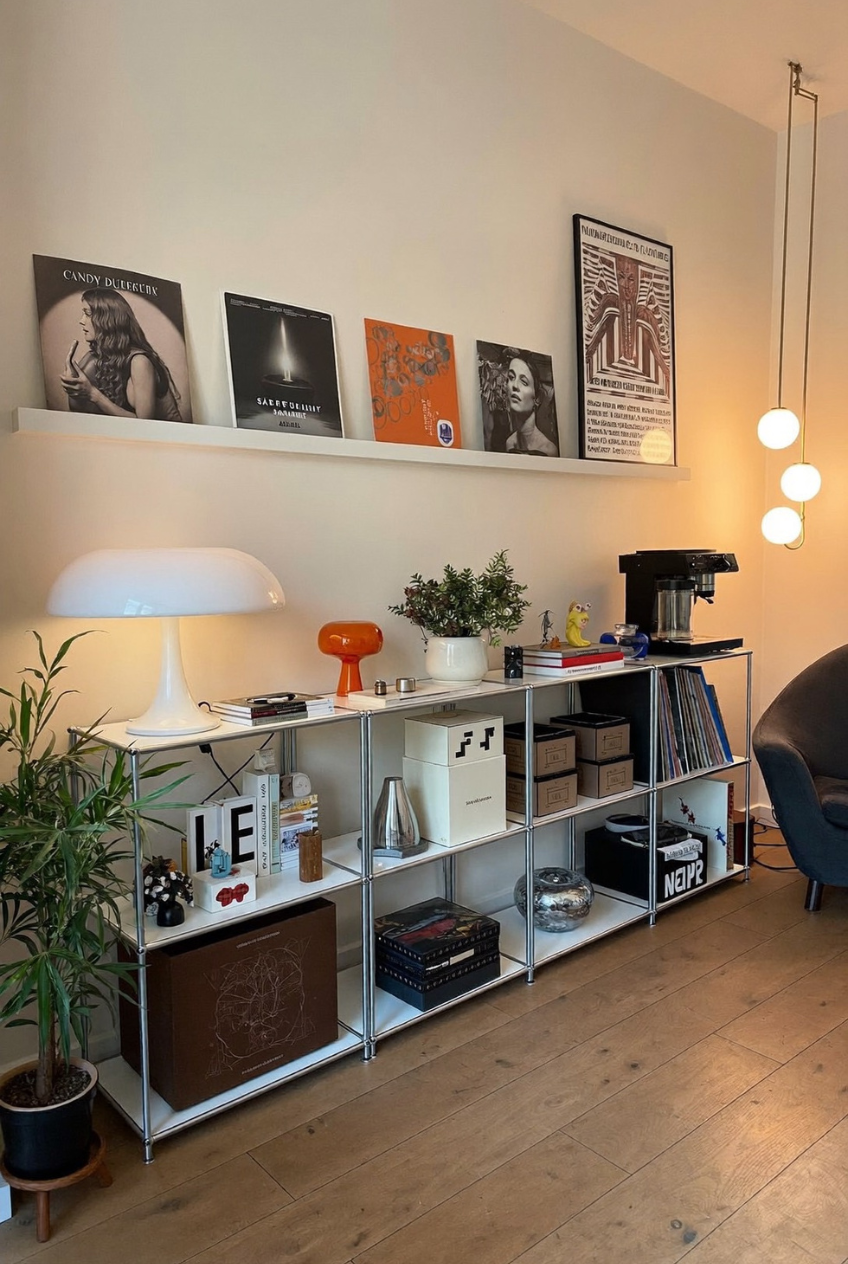
Matte black and warm brass had a long run as the default finish for pretty much everything, and for a while, anything shiny got filed under dated or trying too hard. That is changing, room by room, in a way that has nothing to do with covering your kitchen in stainless steel.
The rooms doing it well are not going all-in. It shows up as one object doing the reflecting: a lamp base, a mirror frame, a cup that catches the light differently than everything sitting next to it. That restraint is basically the whole trick.
We pulled these examples from actual rooms, not staged sets, and each one leans on chrome or a mirror finish in a slightly different way. Some lean warm, some lean cold, and a few make the case that shiny metal can sit next to houseplants just fine.
Let Your Magazines Sit Out
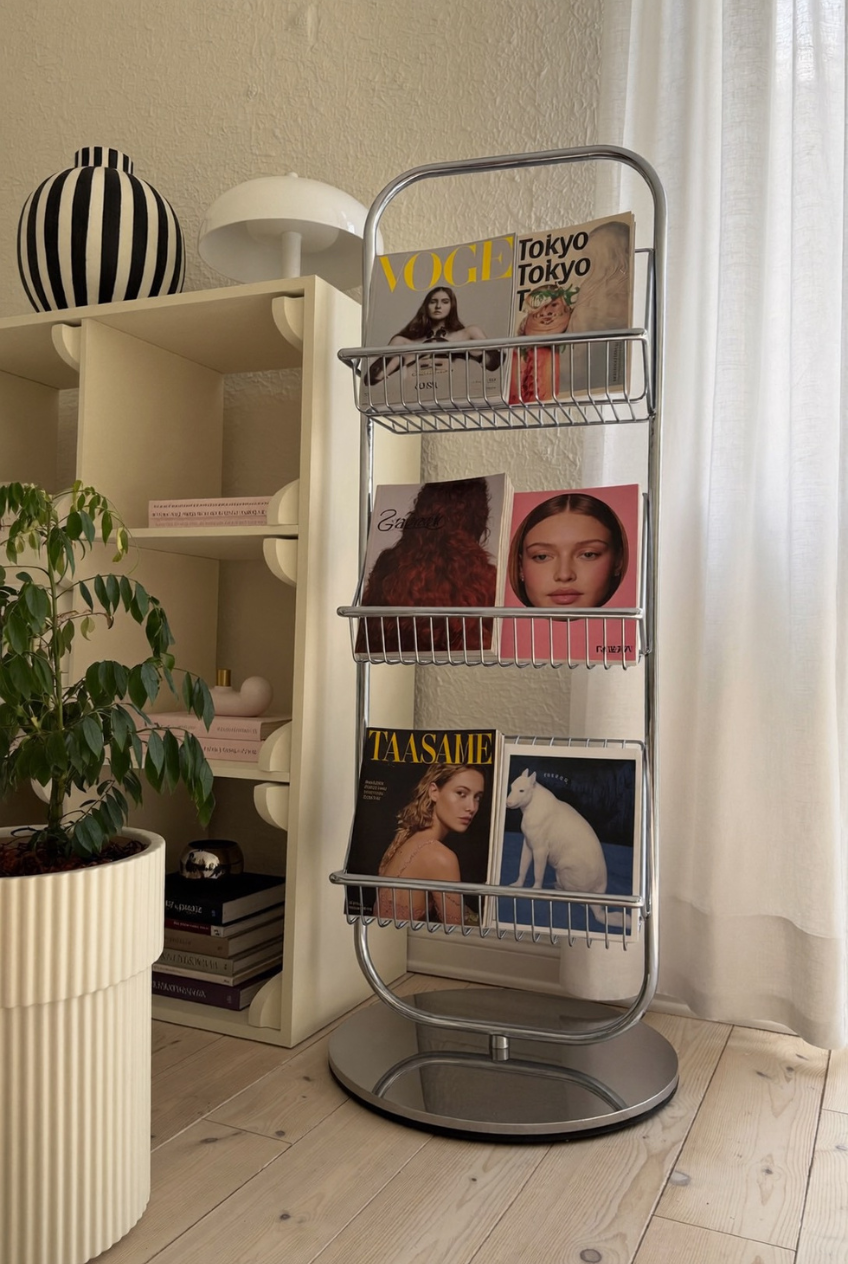
Most people store magazines flat in a basket, spines up, covers hidden. A tiered rack flips that entirely: everything tilts forward so the covers face you like a tiny newsstand, and suddenly a stack of paper you meant to read becomes part of the decor instead of clutter waiting to be dealt with.
Chrome works especially well here because the shape does a lot of the talking. A wide, curved base and thin wire tiers read almost like a sculpture when there is nothing else metallic competing for attention nearby. Pair it with a plaster-toned wall and a plant with big leaves, and the reflective surface becomes the one hard, bright thing in an otherwise soft corner.
If you are shopping for one, skip anything boxy or enclosed. The whole appeal is in the open wire structure and the way light moves through it. Rotating bases are worth the extra cost too, since you will actually want to spin it toward you instead of walking around a piece of furniture to grab your magazine.
A Nightstand That Is Basically Sculpture
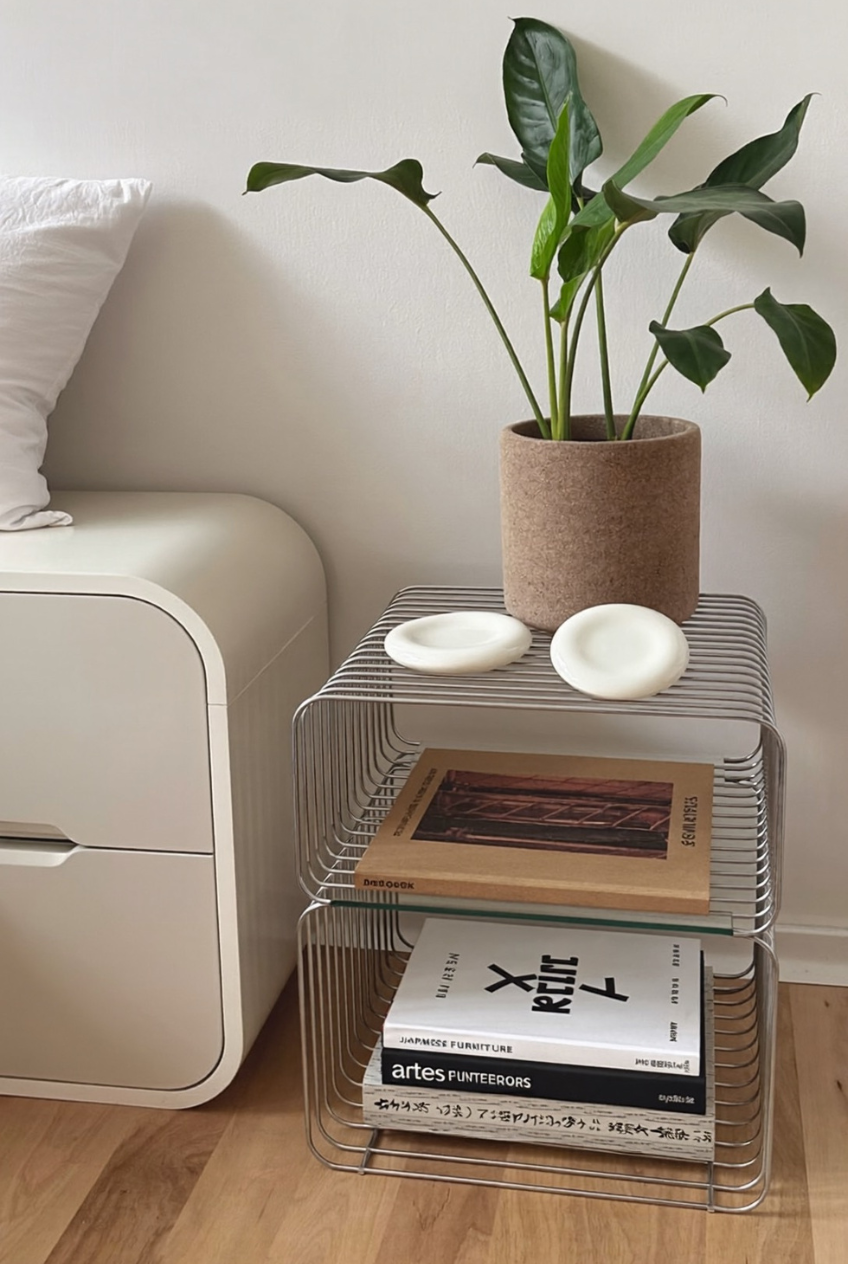
A solid nightstand blocks light and visually adds weight to a small bedroom. A wire-frame one does the opposite. Because you can see straight through the coils, the piece barely registers as furniture, even though it is doing the same job: holding your books, your plant, your bedtime everything.
The stacked-shelf version photographed here works because it splits duties. The open top holds the plant and a couple of trinket dishes, while the lower tier hides the actual clutter, the books you are mid-way through and keep meaning to finish. Chrome wire also happens to be one of the few finishes that looks like a choice whether your stack of books is neat or a mess.
This is a good pick if your bedroom already leans soft, think a rounded upholstered bed frame or a plaster-finish dresser, because the wire cuts through all that roundness with something sharper. One plant, two small dishes, a short stack of books. That is the whole formula, and it barely takes an afternoon to pull off.
Steel Shelves For Your Everyday Glassware
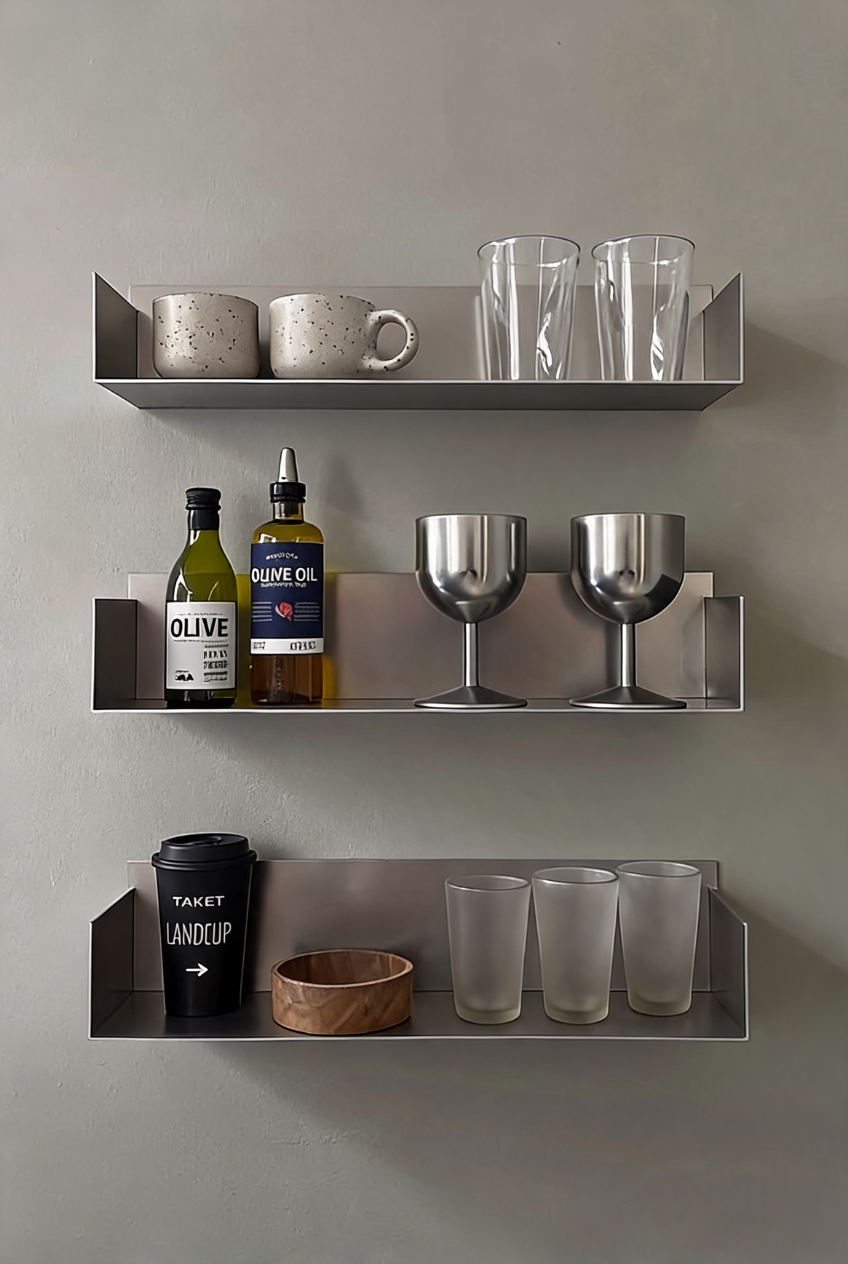
Open shelving gets risky fast because everything on it is visible, all the time, including the ugly stuff. The fix in this kitchen corner is picking one material family and sticking to it: brushed steel shelves holding glassware, metal goblets, and just two labeled bottles, nothing plastic, nothing mismatched in color.
Grouping by height helps more than people expect. Tall glasses in the back, shorter mugs and bottles up front, so nothing blocks anything else, and the whole shelf reads as a single considered grouping instead of a random collection of stuff you happened to own. The steel shelf itself, with its slightly raised lip, keeps that grouping from looking like it could slide off at any second.
Three items per shelf tends to be the ceiling before it starts looking cluttered. If you only have mismatched glassware right now, start smaller: pick your two best mugs and a single olive oil bottle you do not mind looking at daily, and build outward from there once you see how much room you actually have left.
Mix Chrome With Warm Wood Tones
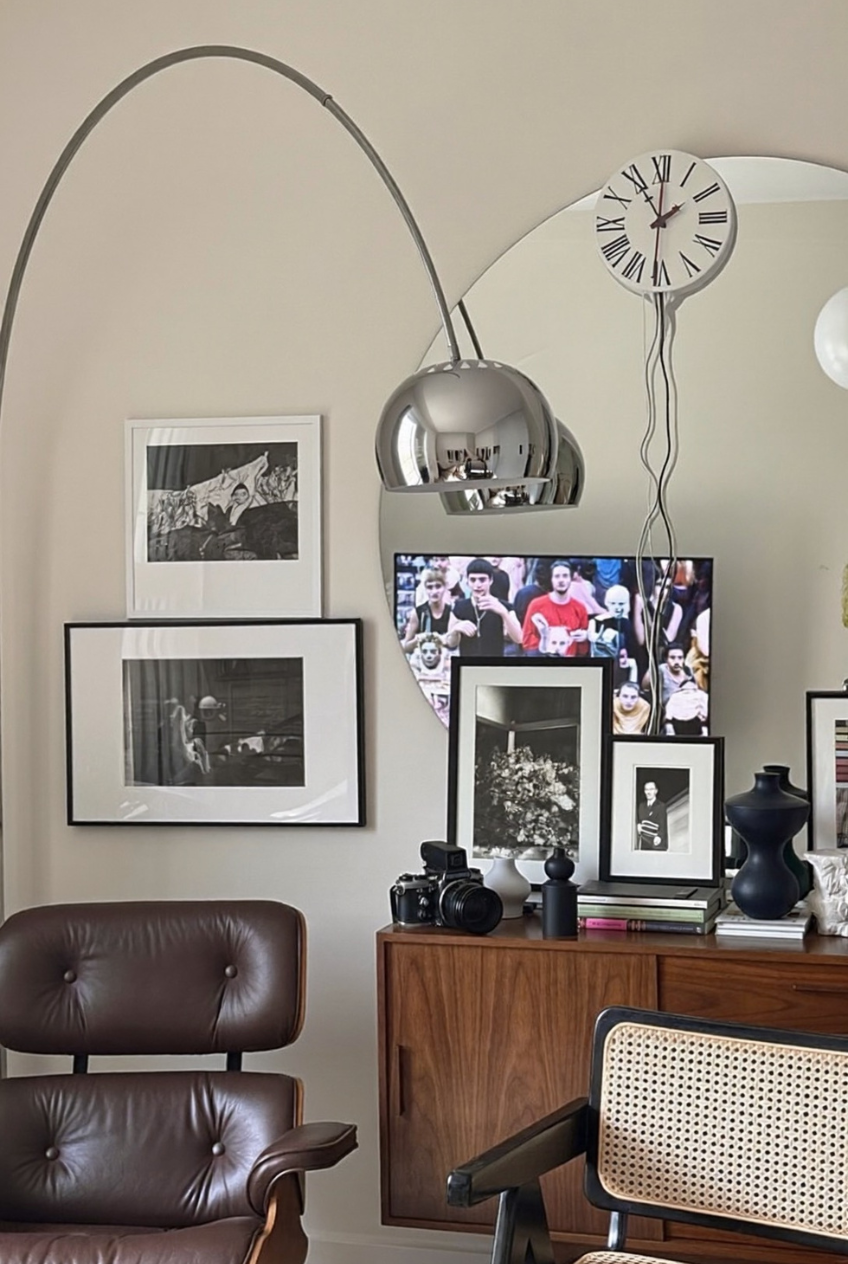
Chrome next to warm walnut sounds like it should clash, and in a lot of rooms it does. Here it works because there is only one big chrome piece doing the job, an arcing floor lamp, and everything else in the vignette, the wood credenza, the leather chair, the cane seat back, is warm by comparison.
The lamp earns its spot because of scale, not because chrome is trendy. Its curved arm crosses over the whole gallery wall, which means your eye follows the shape of the metal before it even registers the black-and-white photos underneath. That is doing a lot of visual work for one object.
We would not add a second reflective piece here. One chrome lamp against a rounded mirror already gives the wall two different reflective moments, and any more would start competing with the black-and-white prints for attention. If your room is already busy, this is proof that one bold metal piece can be enough.
Small Chrome Details In Small Spaces
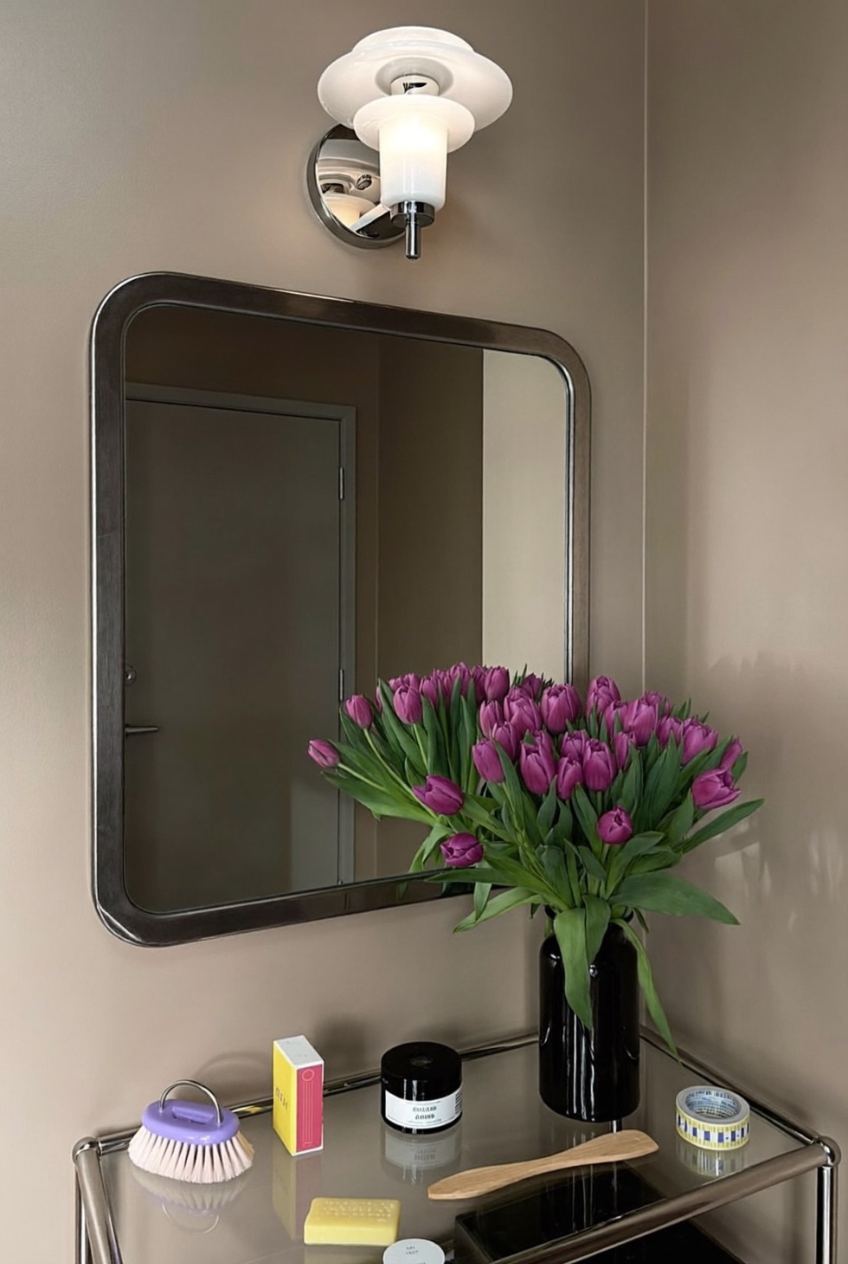
Bathrooms and entryways tend to be the smallest rooms in a house, which is exactly why a little shine goes further there than anywhere else. A chrome-framed mirror and a matching wall sconce, both catching the same light source, make a narrow wall feel considered instead of just functional.
The glass-and-chrome cart underneath does double duty, holding grooming basics and a vase of tulips, and it is worth noticing that nothing on it is fully opaque. Glass shelves, a black glass vase, chrome legs. Even the flowers get to be the only solid color in the whole setup, which is why they stand out instead of blending into a busy countertop.
A single mismatched item can throw the whole thing off, so if you are copying this, keep the finishes tight: one metal tone, mostly clear or reflective surfaces, and let a bunch of fresh flowers be the one spot of real color. It is a small space rule that works even if your bathroom looks nothing like this one.
One Big Mirror Doubles Your Room
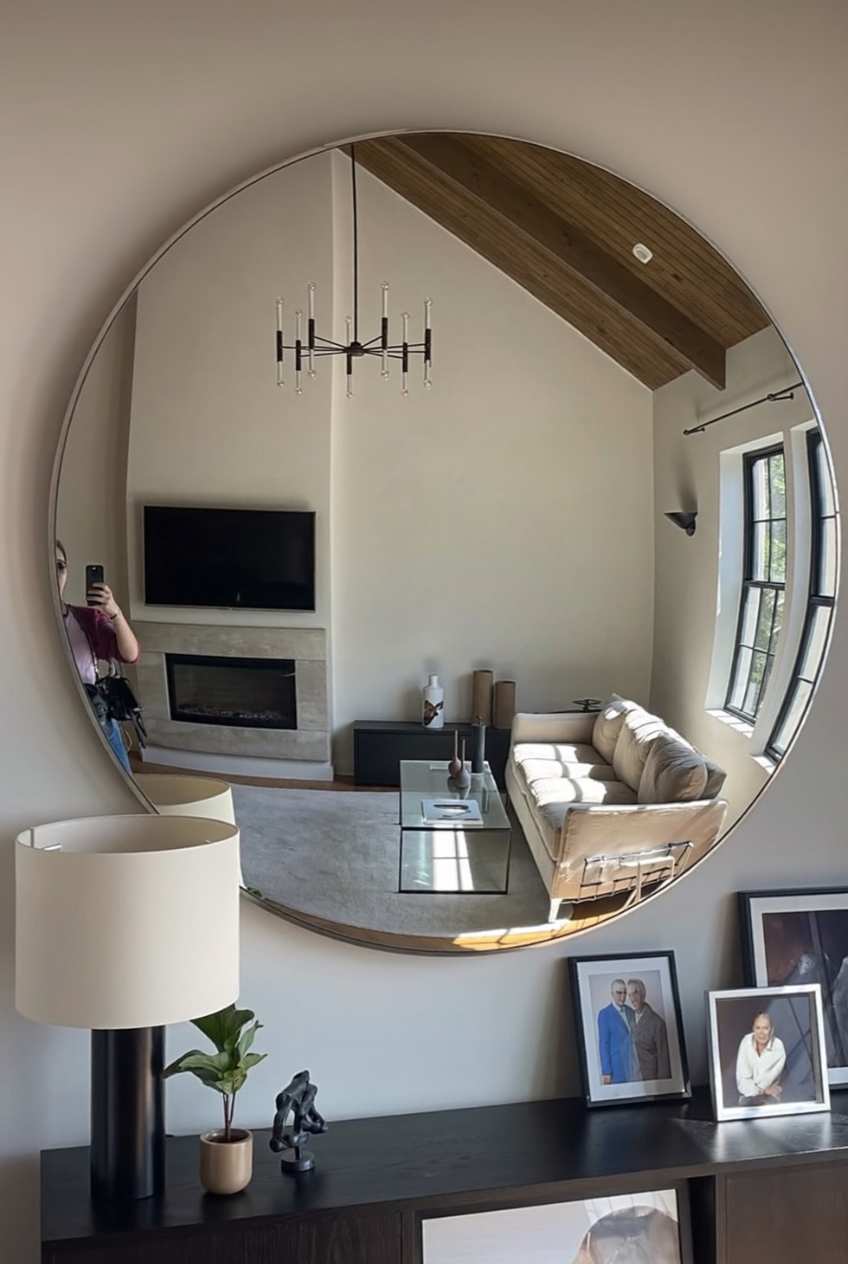
A mirror this size is basically a second window. It is not hung to check your outfit on the way out the door, it is hung because it grabs the entire opposite wall, fireplace and beamed ceiling included, and folds that whole view back into the room you are standing in.
Scale is the entire lesson here. A small round mirror above a console just reflects a slice of wall. This one is large enough to catch the chandelier, the window, and half the sofa, which means it is doing real work for how big and bright the room feels, not just filling blank wall space.
If you want this effect, measure twice before you buy. You want a mirror that lines up with a real focal point across the room, a window, a light fixture, a piece of art, rather than one that just reflects a blank wall back at you. An oversized mirror pointed at nothing interesting is a wasted opportunity.
Chrome Plays Well With Bright Color
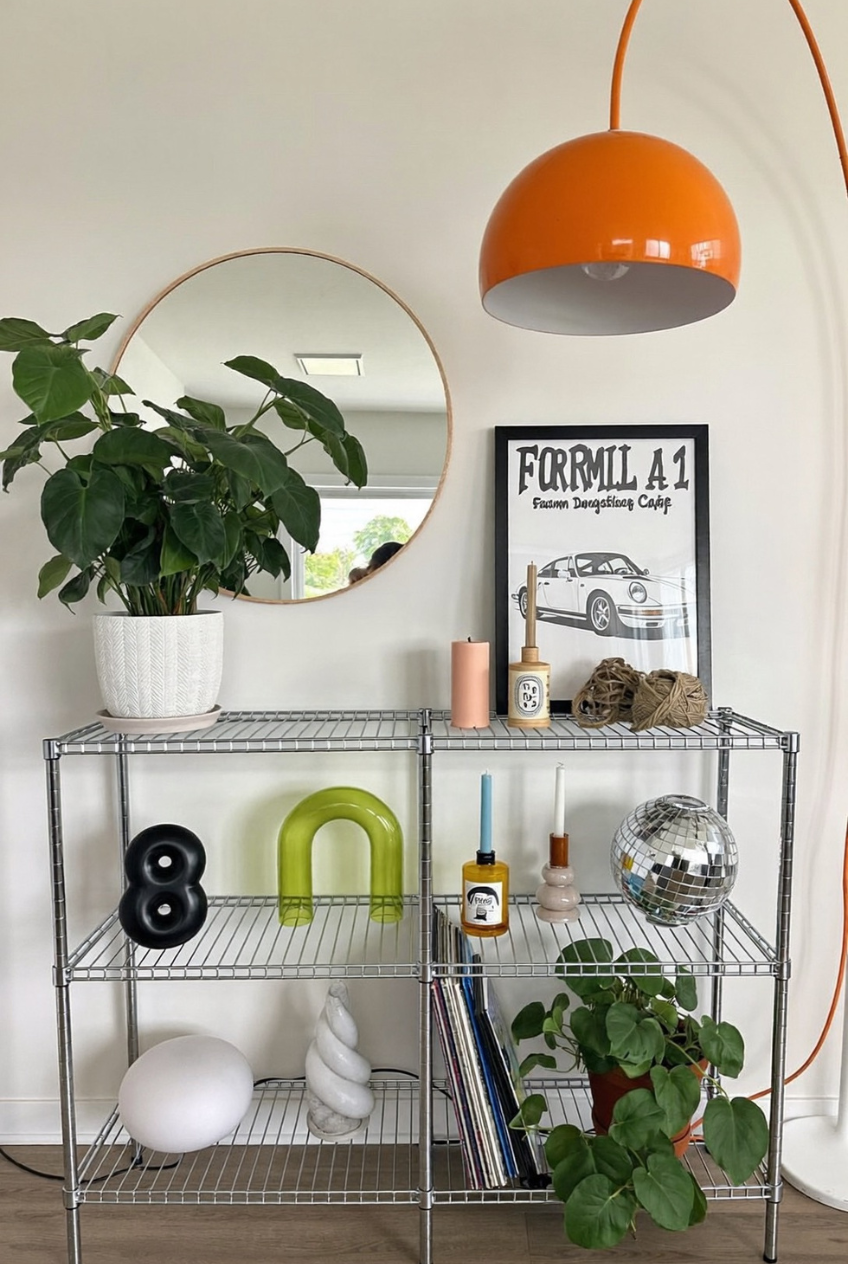
This shelf has an orange pendant lamp, a lime green sculpture, a disco ball, and a stack of records underneath, and none of it should work together, and yet it does, largely because the wire shelving unit holding it all is plain, industrial, and completely uninterested in competing for attention.
A busy, maximalist collection needs a boring frame around it, and chrome wire shelving is about as boring as furniture gets, in the best way. It disappears visually the moment you load it up with color, which means every loud object on it, the disco ball, the neon-green shape, gets to actually be the star instead of fighting the furniture underneath it.
If your own collection of odd little objects has nowhere to live, this is the move: buy the plainest, cheapest wire shelf you can find, resist the urge to dress it up, and let it fade into the background on purpose. Save your money for the stuff that actually sits on top of it.
Even A Coffee Cup Can Shine
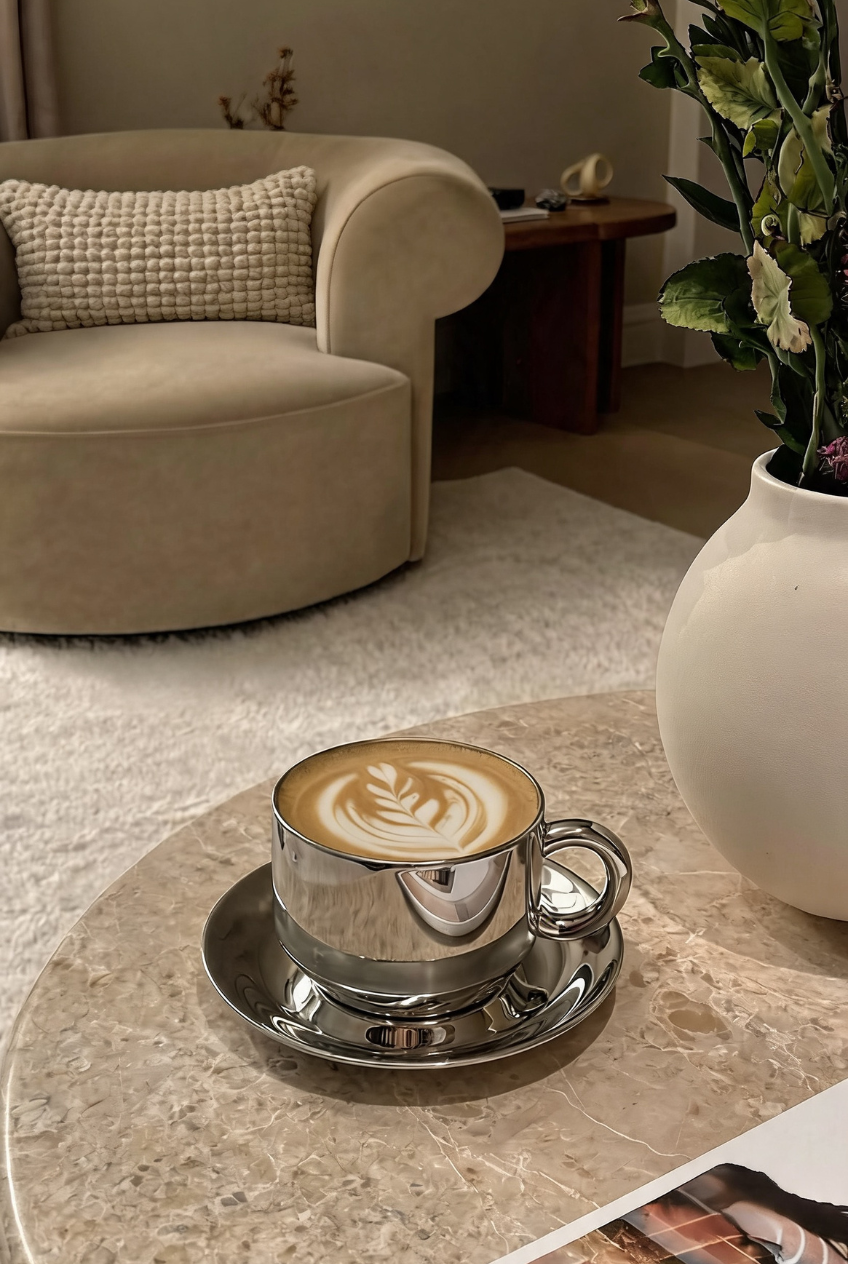
Nobody plans a room around a coffee cup, but this one almost makes the case for it. A mirror-finish cup and saucer on a marble table does something a plain white mug never will: it catches every warm light source in the room and throws it back, so the whole coffee-table setup ends up looking staged even on a random Tuesday.
It works partly because everything else in the vignette is soft. A boucle swivel chair, a thick rug, a rounded ceramic vase. The cup is the only hard, shiny object in the frame, which means it does not have to fight anything for attention, it just gets to be the one bright spot your eye lands on first.
You do not need to overhaul your dinnerware to borrow this idea. One metallic cup and saucer, kept out on a tray instead of buried in a cabinet, can do the same job. Small objects with a reflective finish punch well above their size, especially sitting on stone or marble that already has its own shine.
Frame A Busy Room In Chrome
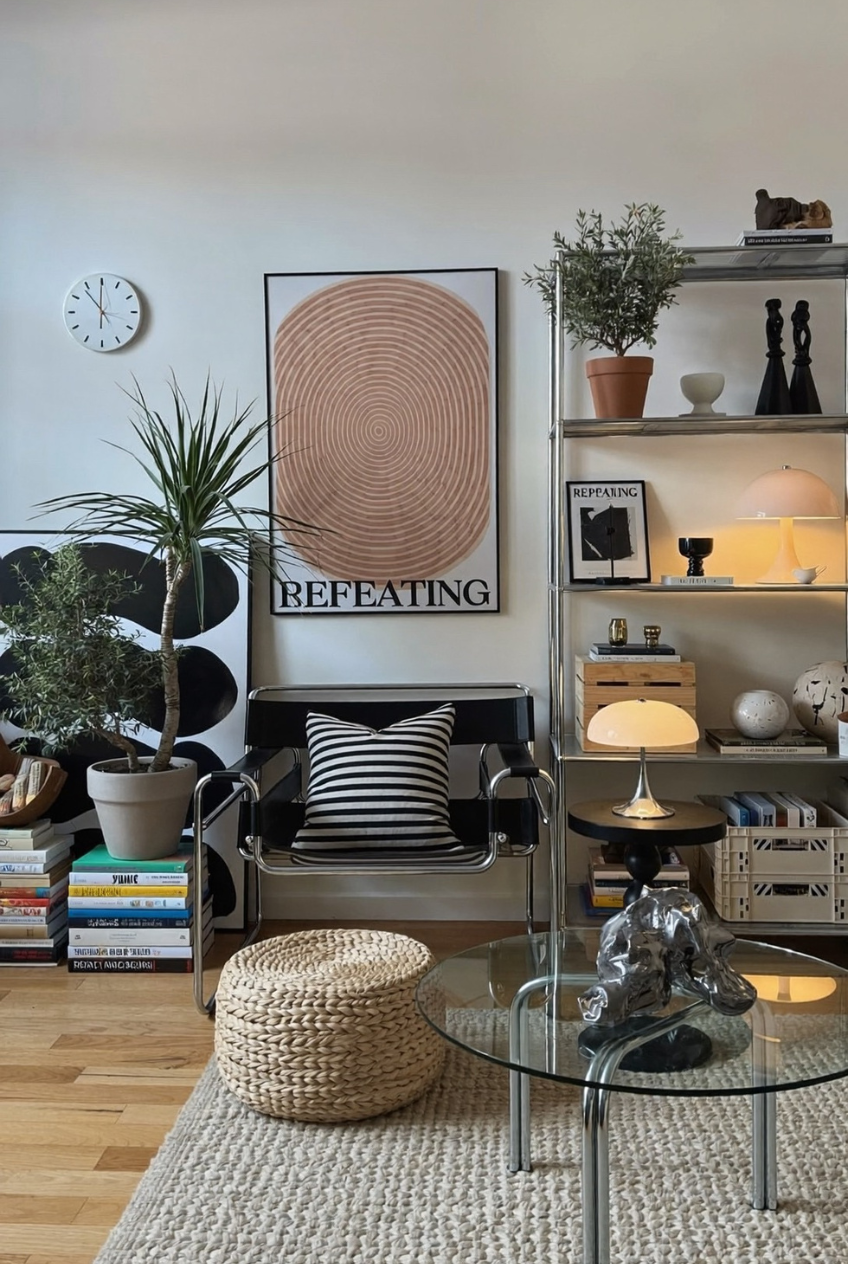
A room this layered, plants, art prints, patterned pillows, glass and stone objects everywhere, needs some kind of visual thread pulling it together, or it just reads as clutter. Here that thread is metal: a chrome-and-glass shelving unit, a chrome-framed sling chair, a glass coffee table with slim chrome legs, all echoing the same finish at different heights around the room.
None of those three pieces are especially loud on their own. It is the repetition that makes them register as a decision instead of a coincidence, three separate chrome accents scattered through one room, all quietly agreeing with each other while the jute rug and black-and-white pillow add texture underneath.
Repetition is the easiest version of this to steal. Even two pieces in the same metal finish, spaced across a room instead of side by side, will read as deliberate in a way that one lonely chrome lamp in the corner never quite manages. Aim for at least two, on opposite sides of the room if you can.
Chrome Belongs On The Countertop Too
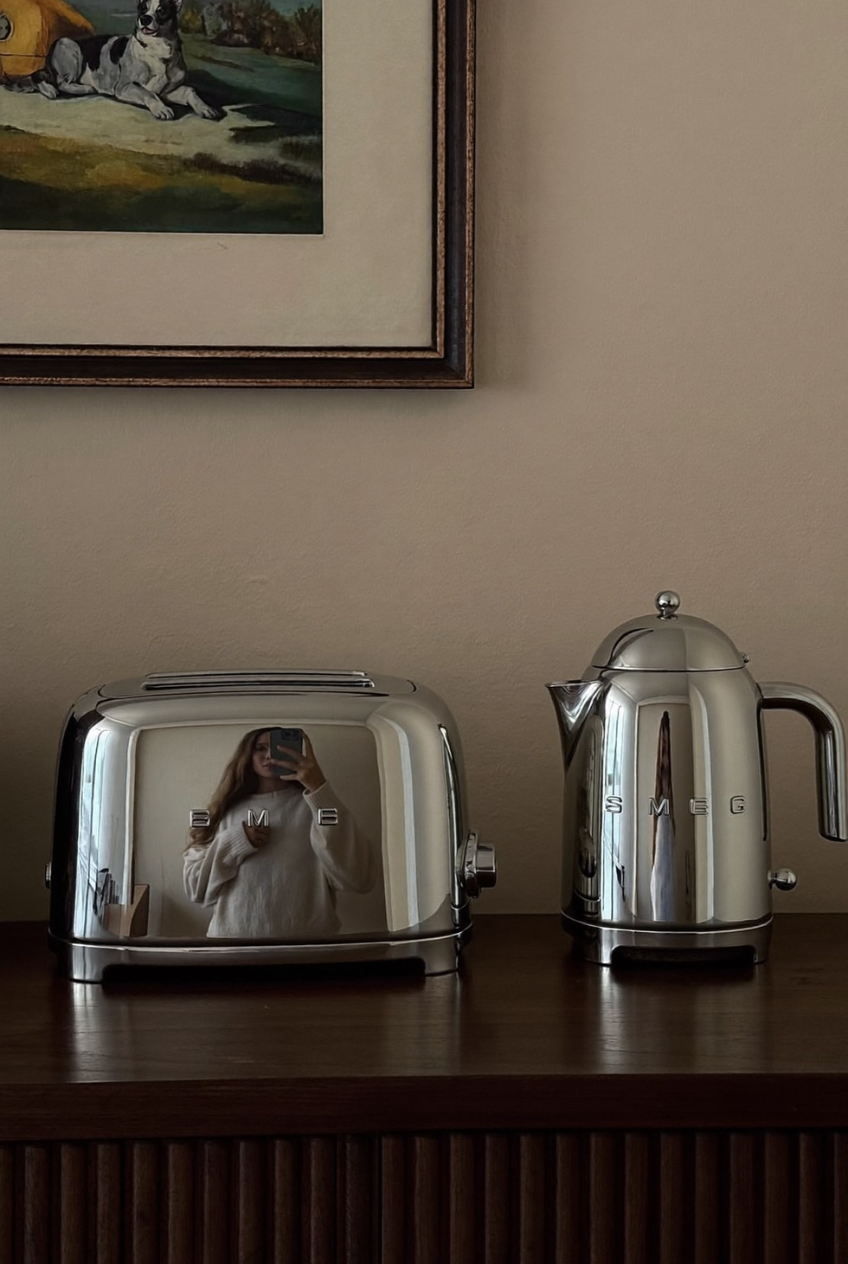
Small kitchen appliances rarely get treated like decor, mostly because most of them are beige plastic boxes nobody wants to look at. A mirror-finish toaster and kettle flip that completely, they reflect the room around them so well that they barely read as appliances at all, more like a pair of oversized decorative objects that happen to make breakfast.
Set against a dark wood credenza and a framed vintage painting, the pair works because the reflection does something interesting: it picks up whatever color is nearby and bounces it back distorted, almost like a fisheye photo. That is a level of visual interest a matte black kettle simply cannot offer, no matter how good the design is.
If your counter is due for an upgrade anyway, this is one of the lowest-effort ways to bring chrome into a kitchen without committing to steel appliances or a full renovation. A single mirror-finish piece sitting on open counter space does more visual work than three matching matte ones ever will.
Chrome Works Best When You Use It Sparingly
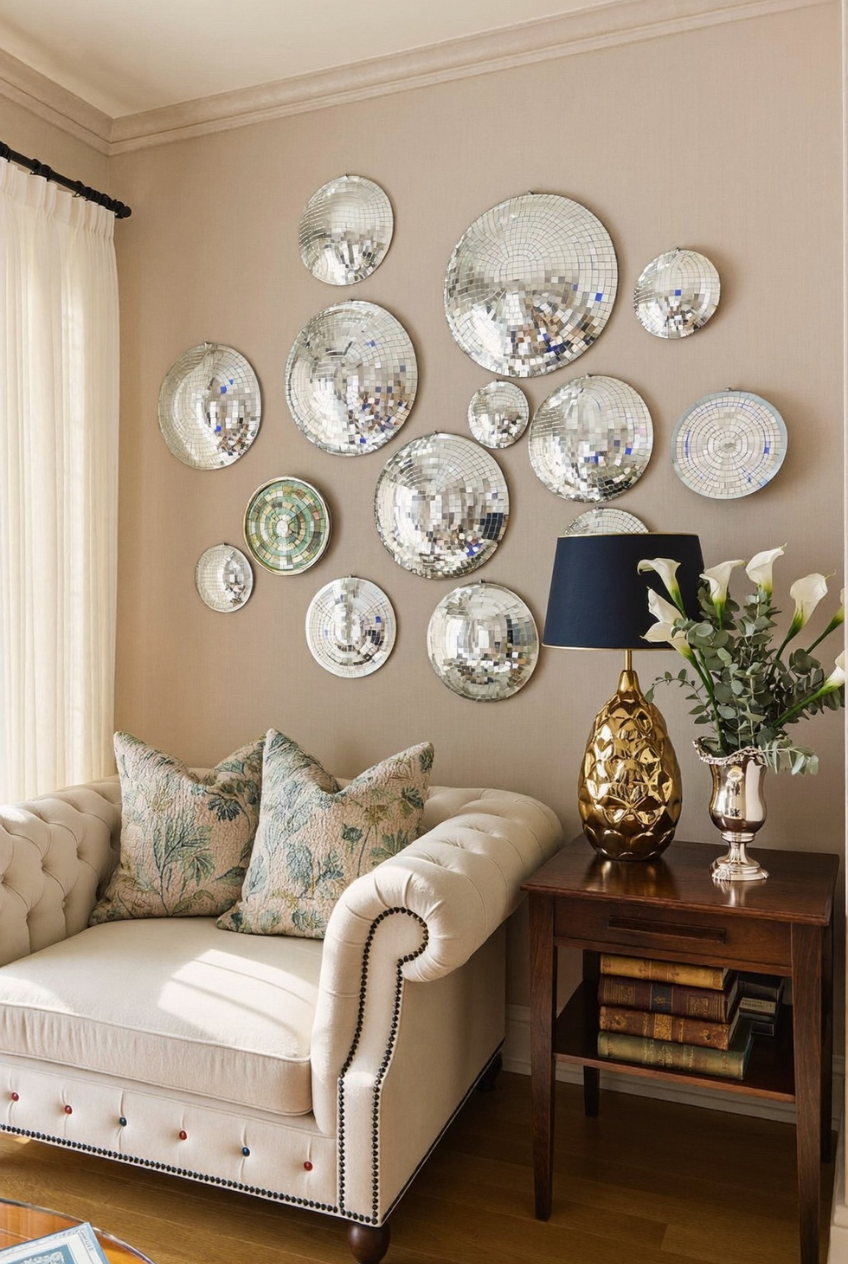
Across every room here, the pattern holds: chrome shows up once, maybe twice, never as the whole point of the space. A lamp, a mirror, a cup, a shelf. The material does its job precisely because it is outnumbered by wood, fabric, and plants.
That is really the only rule worth remembering. Reflective metal reads as sharp and a little cold in large doses, but as an accent, it does something warm materials cannot: it bounces light around a room and gives your eye a bright spot to land on.
Start with one piece. A mirror, a lamp base, even a cup on a tray. See how it sits against what you already own before buying anything else metallic. The rooms that pulled this off best all started small, and it shows.

 Steal Our Home Styling Secrets!