
Toddler Girl Bedroom Choices That Still Make Sense Once The Toys Take Over
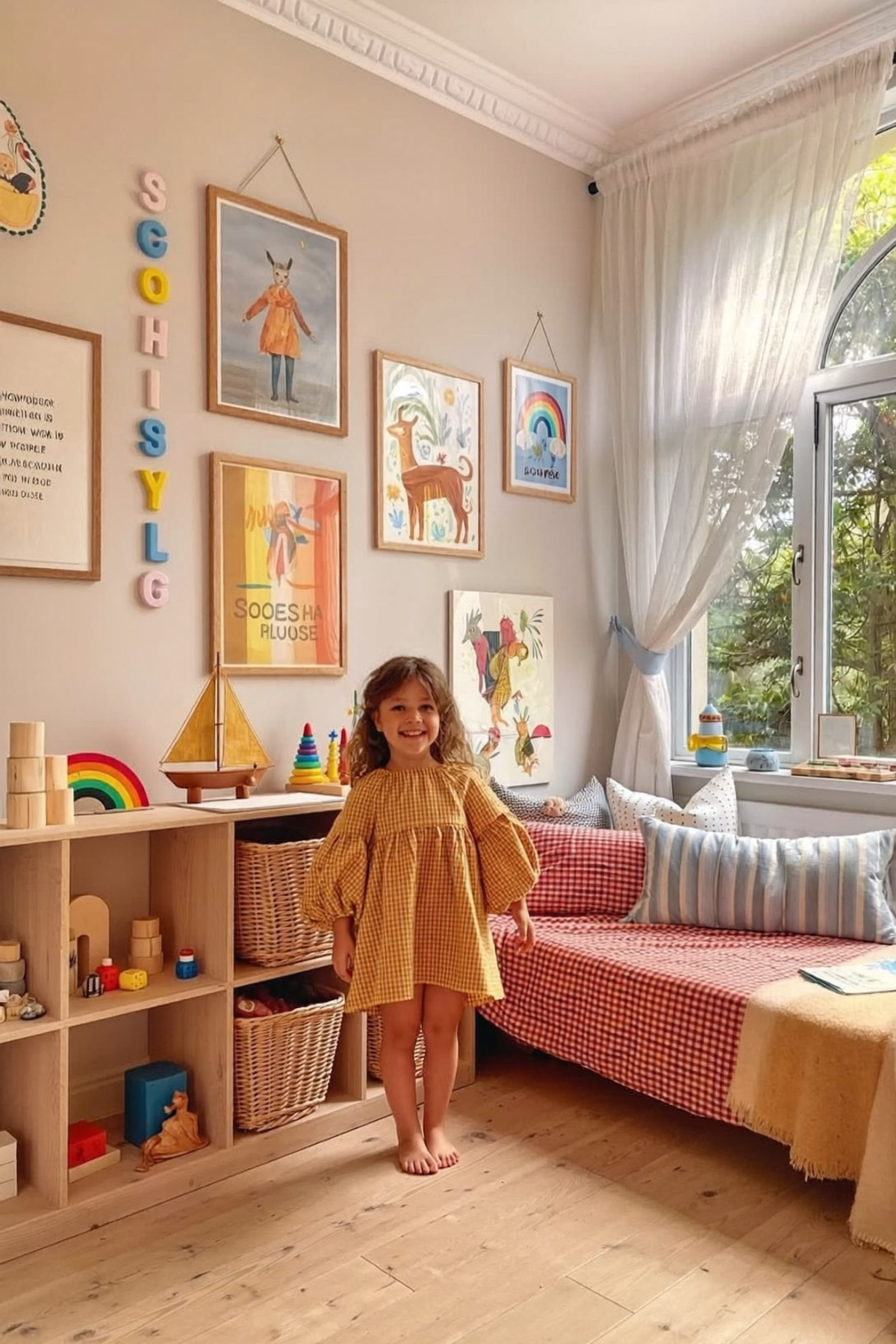
Somewhere between the crib and the big kid bed, a toddler girl’s room turns into its own tiny world. She isn’t choosing fabric swatches, but she already has opinions about which stuffed animal goes where, which corner is for reading, and which one is for hiding.
The rooms that actually work tend to pick one big move, a canopy, a mural, a wall of color, and let everything else stay simple around it. Pile on too many statement pieces at once and a small space starts to feel busy instead of playful.
We pulled together real bedrooms that each lean on a different trick, from book nooks to name signs to a wall of daisies. None of them require a full renovation. Most started with something small a parent already owned, and grew from there.
A Reading Nook Worth Fighting For
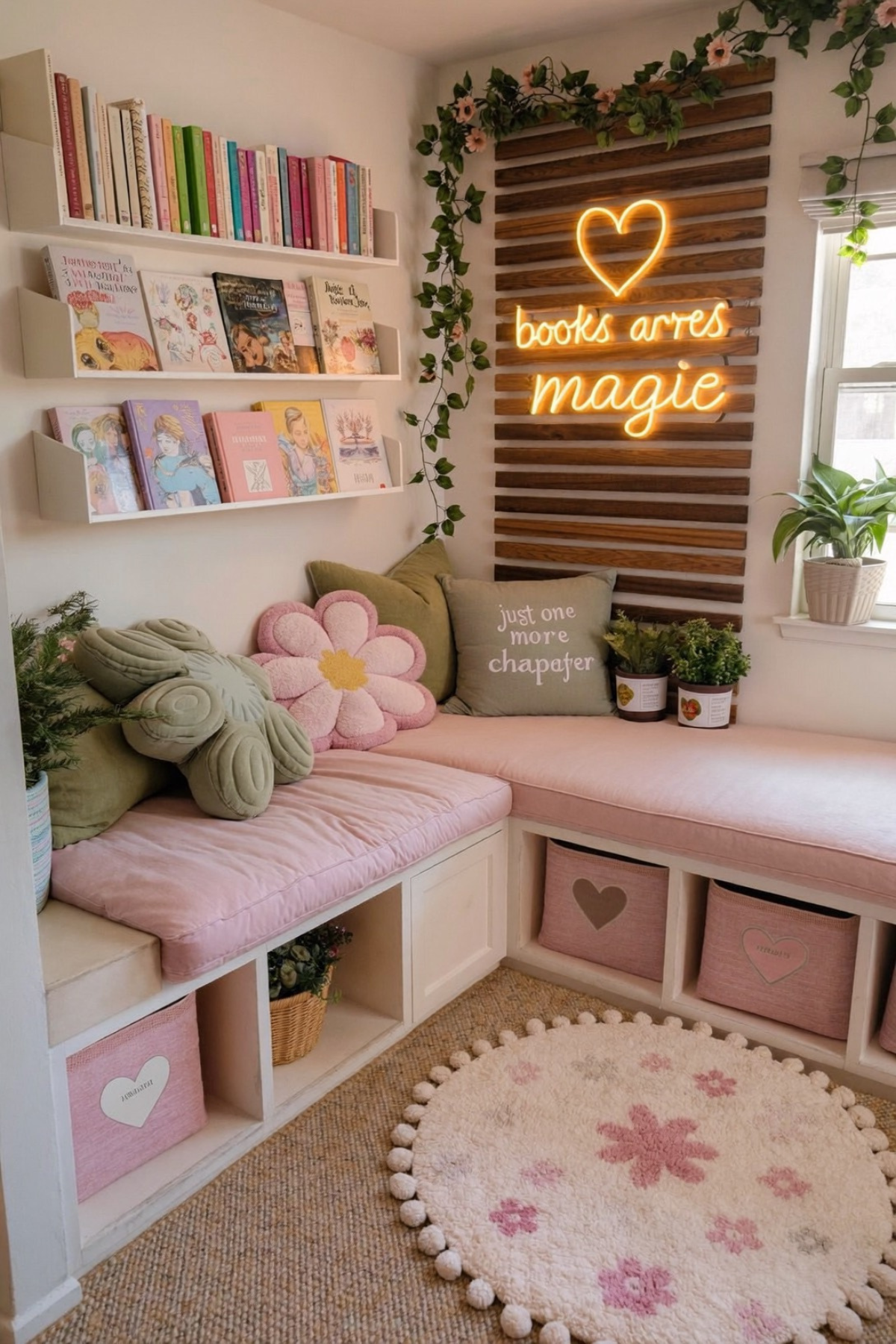
Corner window seats do double duty in a small bedroom, because they turn dead space into the most-used spot in the room. Here, a wraparound bench takes the place of a chair nobody would sit in anyway, topped with a mismatched pile of pillows soft enough for a toddler to actually flop into after storytime.
Books are shelved cover-out instead of spine-out, which sounds small but changes everything about how a two or three year old interacts with them. She can see the whole cover, recognize a favorite by its colors before she can read a single word, and pull it down herself instead of asking for help every time.
A soft neon sign above the nook gives the corner a focal point without taking up any floor space, and the trailing greenery threaded along the wood slats keeps things from feeling too polished. If you’re recreating this on a budget, secondhand floating shelves and a single vine of faux ivy get you most of the way there for very little money.
Let Dresses Double As Wall Art
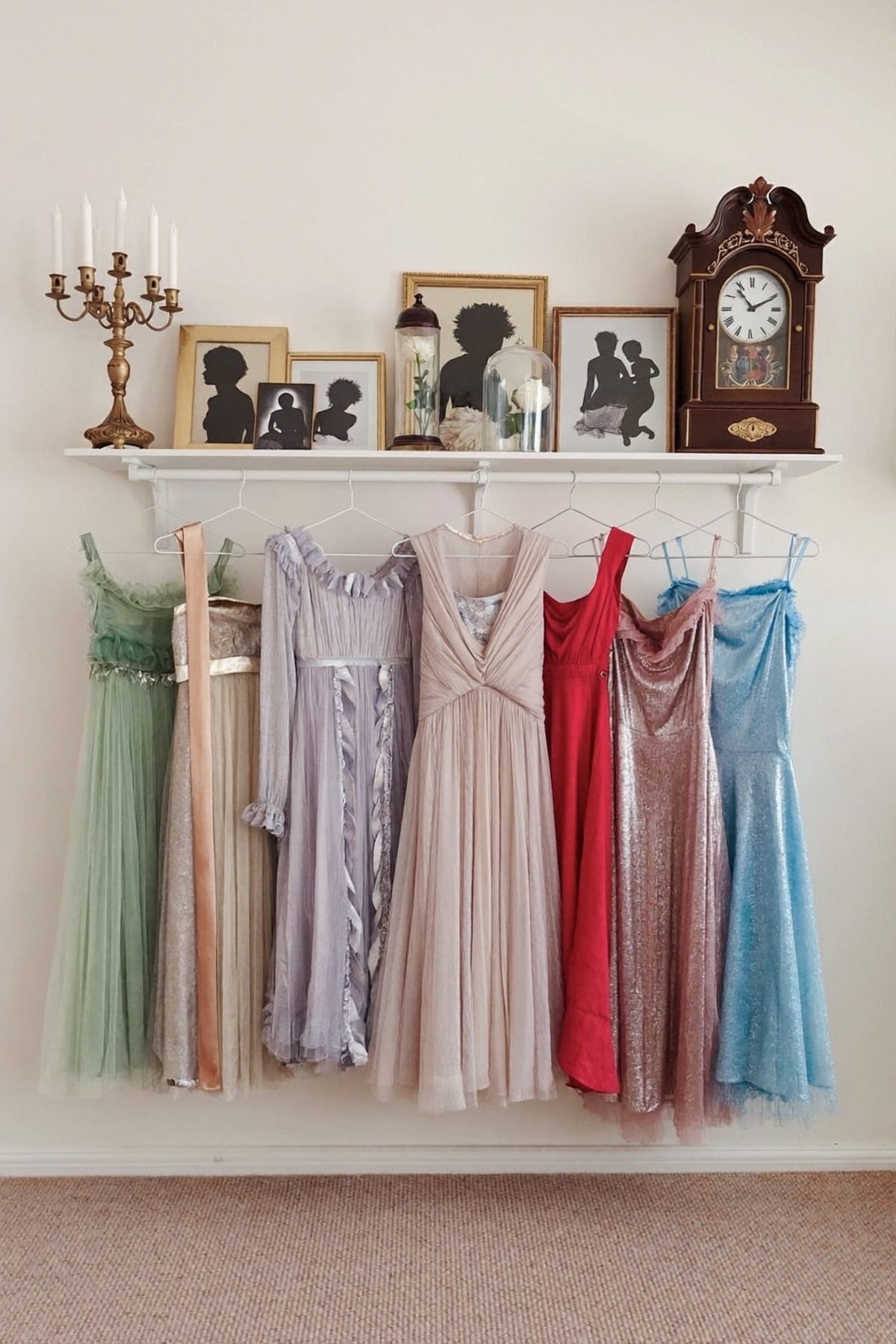
Not every decor choice in a girl’s room has to come from a home store. This wall treats a row of special-occasion dresses like a piece of art, hanging them shoulder to shoulder in a loose color gradient from green through cream, lavender, red, rose gold, and blue.
Above the rail, a small shelf holds a tighter, more grown-up vignette: silhouette portraits, a brass candelabra, a glass cloche with a single flower inside, and an old clock. The contrast between the formal shelf and the playful rainbow of dresses below is what keeps the whole wall from feeling like a boutique display.
For a toddler’s room, you can borrow this idea at a much smaller scale: a short rail with three or four twirl-worthy dresses does the same job as a full gallery wall, and it gives her something to touch and choose from instead of clothing hidden away in a closet where she’ll forget it exists.
A Little House Bed For Dreaming
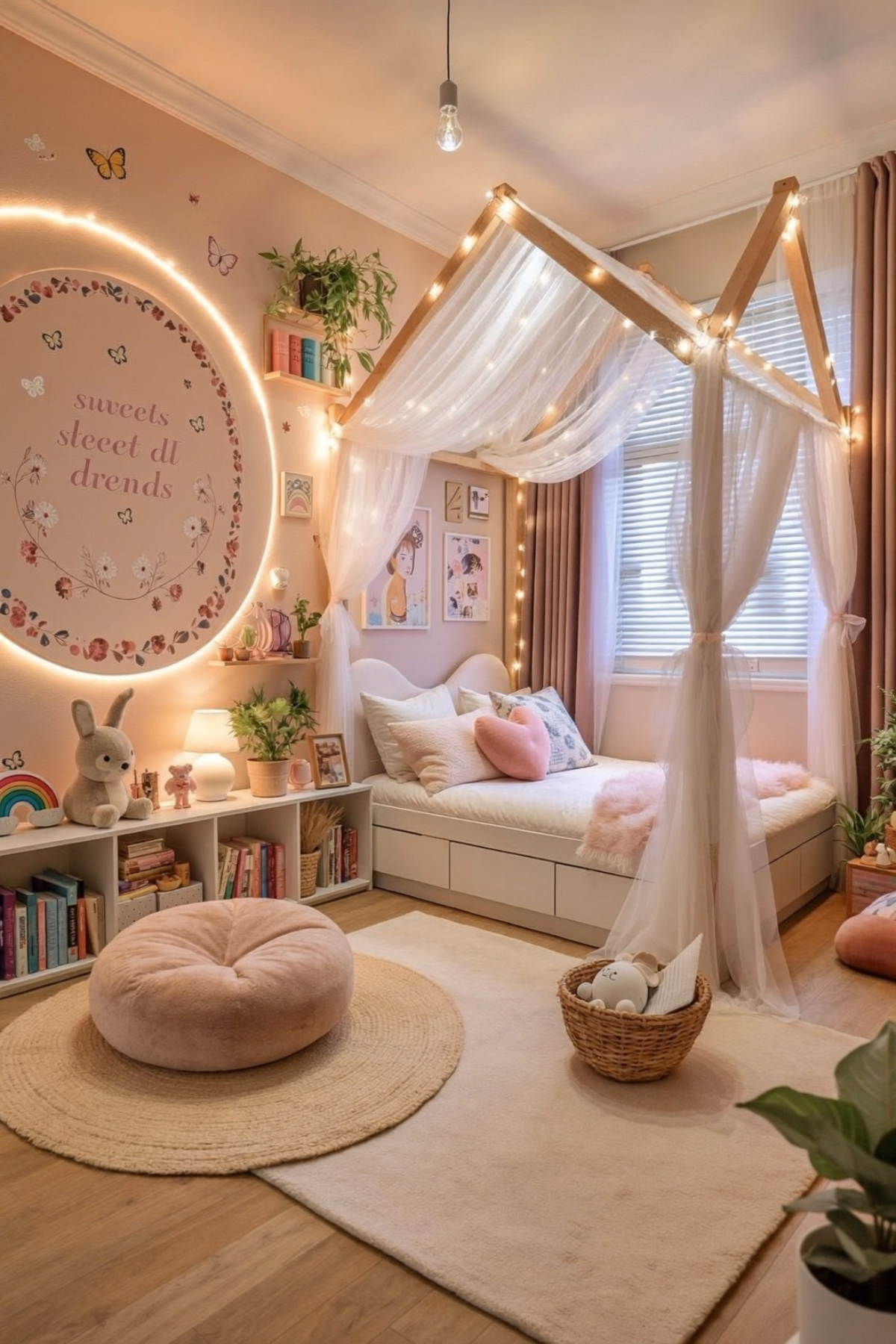
A wooden A-frame built right over the bed reads like a playhouse and a canopy at the same time, and that dual identity is exactly why it works so well for this age. Sheer curtains are draped loosely over the frame rather than fitted tight, so the whole structure still feels soft instead of architectural.
String lights woven along the beams do a lot of the emotional work here, turning what could be a plain wood frame into something that glows at bedtime. A round wall decal with a floral border and a hand lettered phrase fills the blank wall beside it without needing a full framed print.
The bed itself sits low, with drawers built into the base for storage instead of a separate dresser eating up floor space, and a plush pouf nearby gives a second seat for reading time. Layer a woven rug under a softer one, the way this room does, for texture that a plain single rug can’t offer.
A Tent Corner Built For Naps
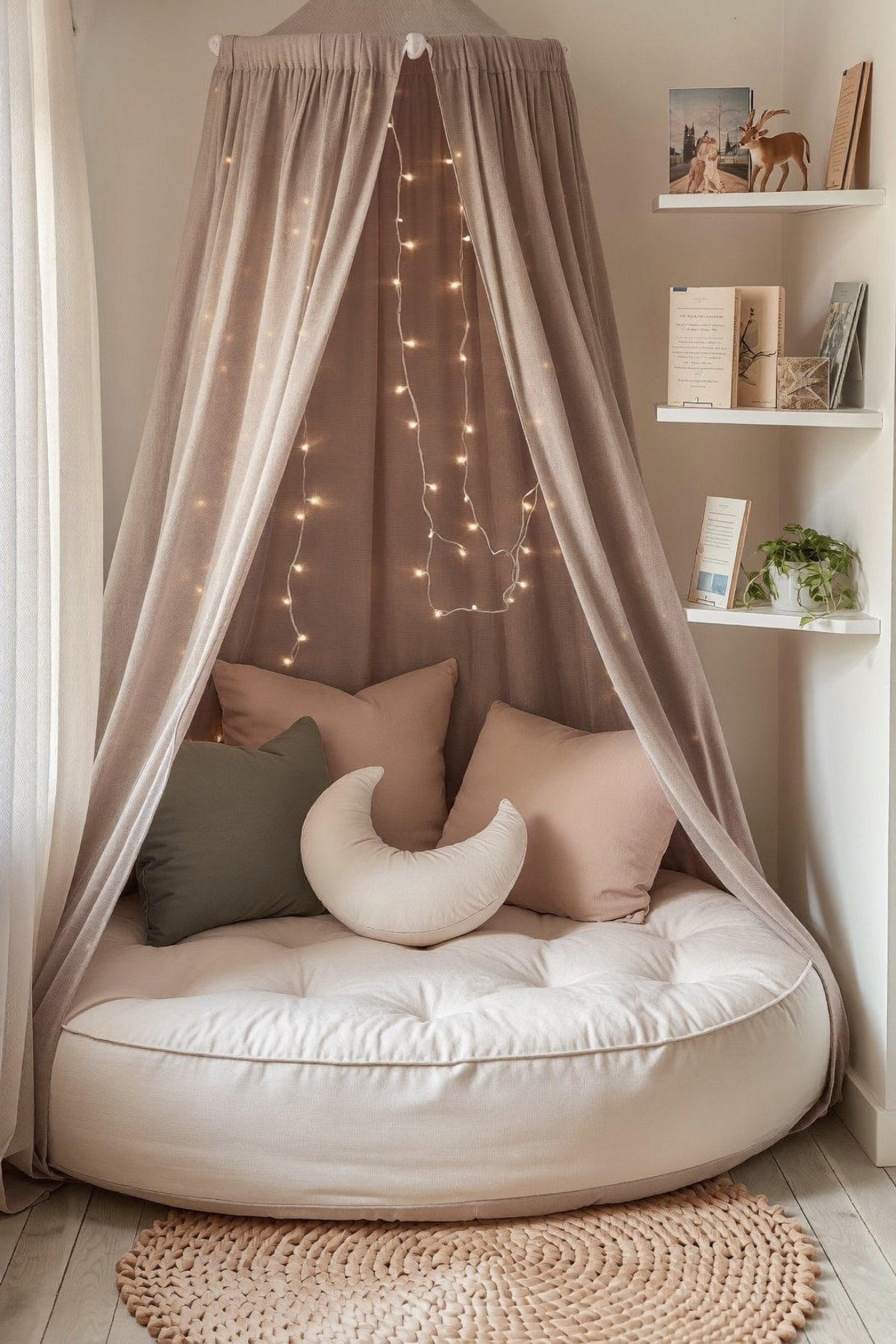
Forget a full canopy bed. A cone-shaped tent hung in a corner over a single oversized cushion gives the same cozy, enclosed feeling in a fraction of the footprint, and it works in rooms where a real bed frame simply won’t fit.
The round tufted cushion is doing more than it looks like at first glance, since its shape softens every hard edge in the corner and gives a toddler a spot to sprawl sideways instead of sitting upright the way a chair would force her to. A crescent moon pillow and a mix of blush and olive cushions keep the palette calm.
Fairy lights run down the center seam of the tent instead of around the edges, which reads as more deliberate than a string wrapped haphazardly around the frame. Corner shelves just outside the tent hold books and small keepsakes within easy reach, so the whole nook functions without a single extra piece of furniture.
Give The Canopy Bed A Name
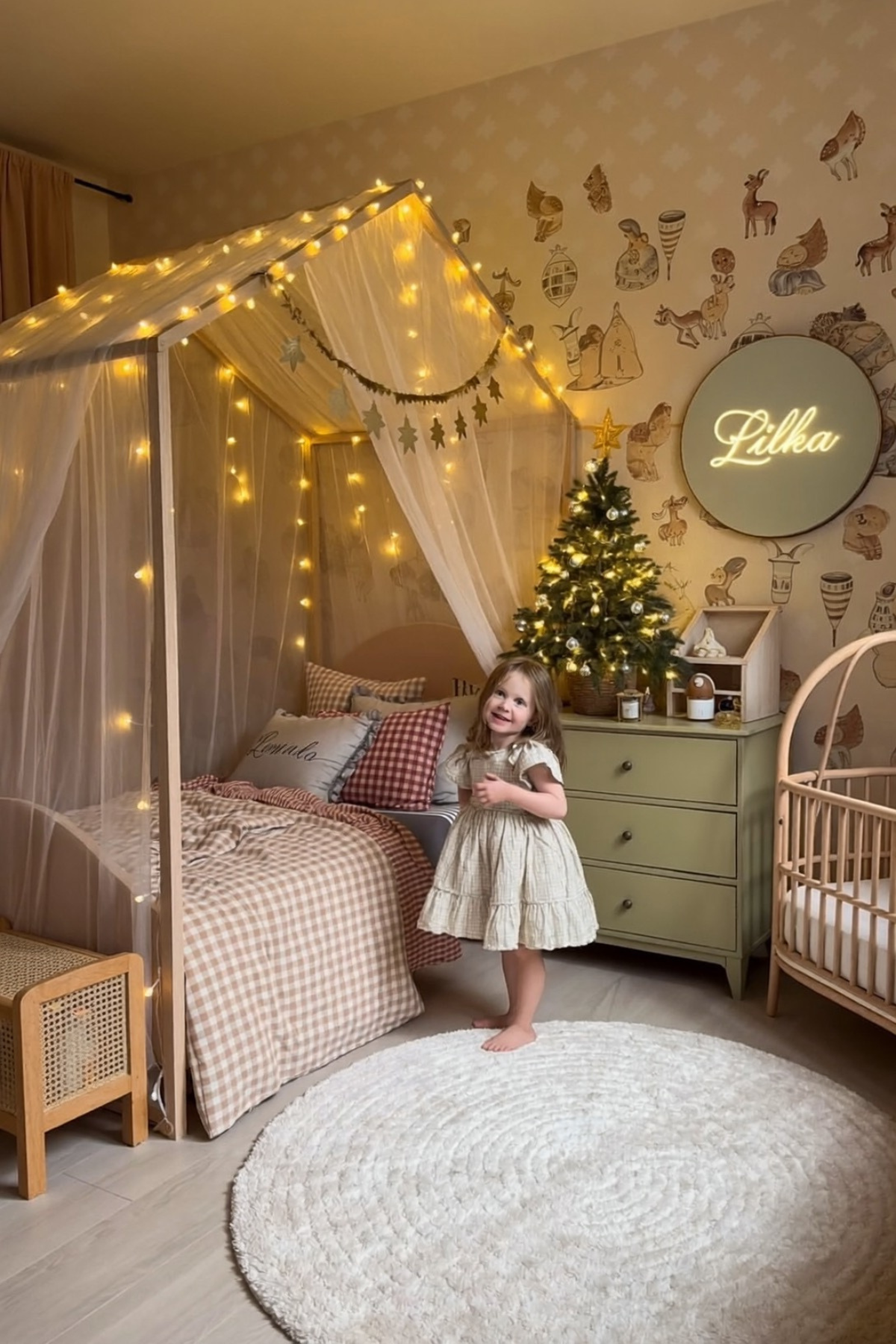
Personalization does a lot of heavy lifting in a shared or transitional room, and a soft neon name sign mounted above the dresser is one of the simplest ways to mark a toddler’s corner as unmistakably hers, even next to a crib for a younger sibling.
The same wood A-frame and sheer curtain combination shows up here in gingham instead of plain white, proving how flexible the structure is. Swap the bedding and the whole canopy takes on a completely different mood, from the softer dreamy version we saw earlier to something a little more farmhouse.
A green dresser breaks up what could easily become an all-neutral room, and it doesn’t need to match anything else exactly, just to share a similar depth of color. Seasonal touches like a small tabletop tree show how easily this kind of setup adapts through the year without a full redecorate. A rattan bassinet tucked into the same corner is a reminder that this layout can flex for a growing family without anyone needing to start over from scratch.
A Gallery Wall Full Of Character
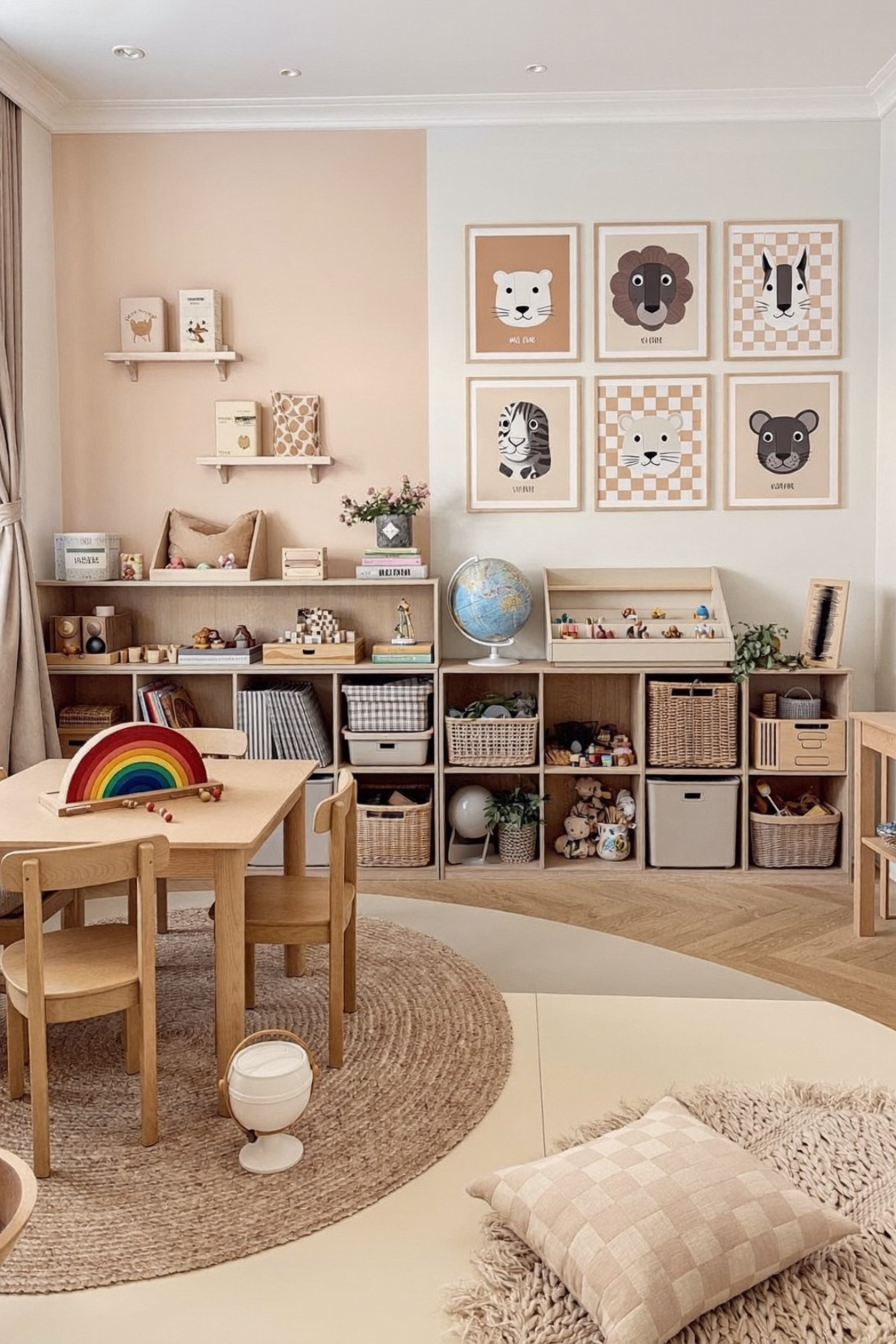
Six identical framed animal portraits, hung in two even rows, turn a practical storage wall into the visual centerpiece of the room. The trick is repetition: same frame, same size, same checkerboard border on every print, so the eye reads them as one collection instead of six separate purchases.
Underneath, open cube shelving keeps toys sorted by type rather than shoved into one bin, with baskets doing the job of hiding the messier categories while books and figurines stay visible. A globe sitting among the toys signals that this is a room meant for exploring, not just for sleeping.
A two-tone wall, blush on one half and white on the other, gives the gallery a backdrop without committing to color across the whole room. A low table and chair set finishes the space as a genuine play zone, proving a toddler’s room can hold a workspace long before she needs a desk for homework.
Room For A Swing Indoors
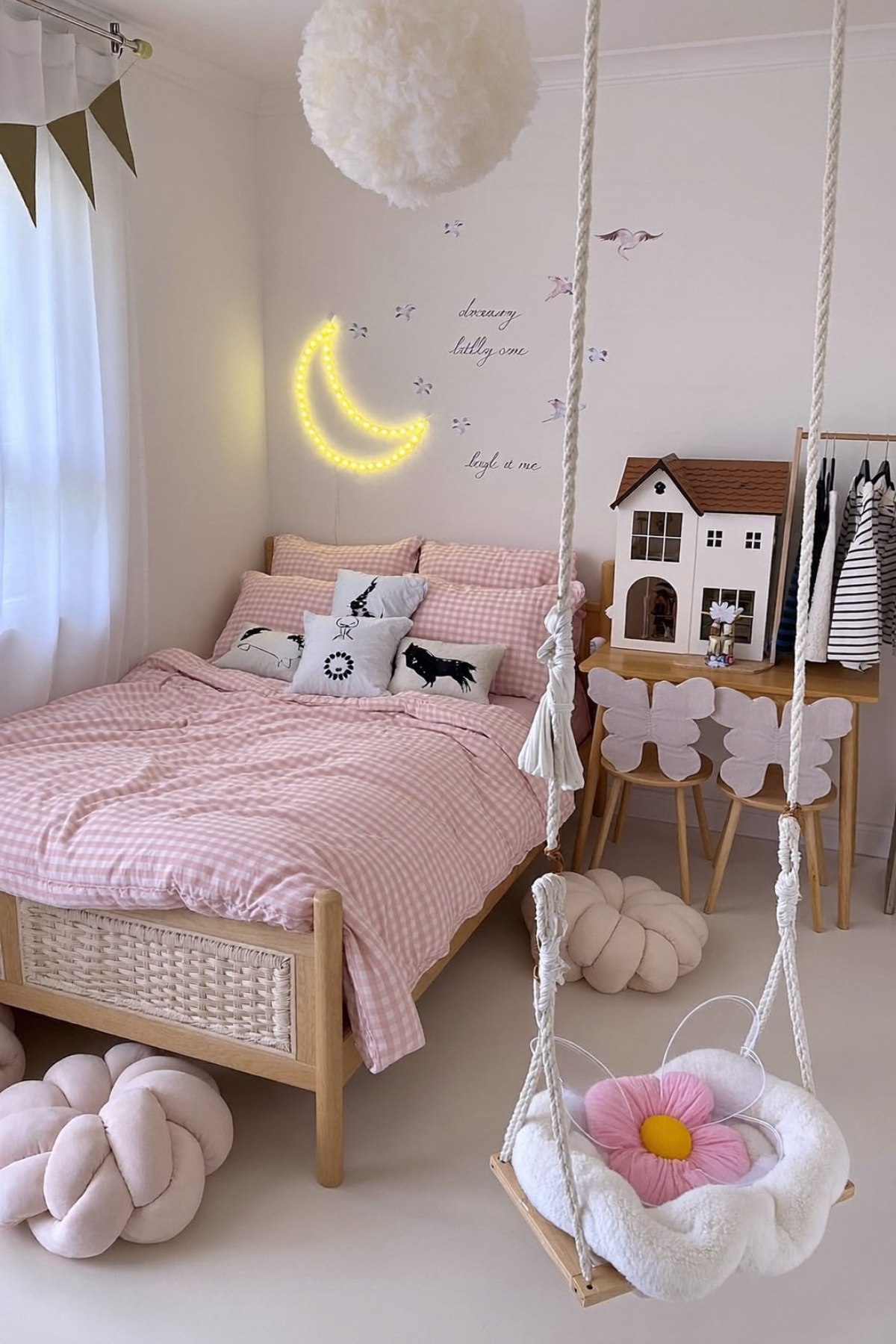
A hanging swing chair suspended from the ceiling is the kind of detail that turns a bedroom into a place a toddler begs to play in during the day, not just sleep in at night. Here it sits right beside the bed, upholstered in faux fur with a plush flower cushion tucked inside.
Gingham bedding and a neon crescent moon keep the rest of the room calm enough that the swing can be the loud idea in the space. Illustrated animal pillows in black and white add a graphic note against all that soft pink, which keeps the palette from tipping into saccharine.
A miniature dollhouse doubles as a desk display, and butterfly-shaped stool cushions dress up plain wooden seating without needing new furniture altogether. If a full ceiling-mounted swing isn’t possible in your space, a doorframe version offers a similar burst of play without the same commitment. Even a small changing table can double as this kind of display surface, so almost nothing in the room has to serve only one purpose.
A Corner Dressed Up In Bunting
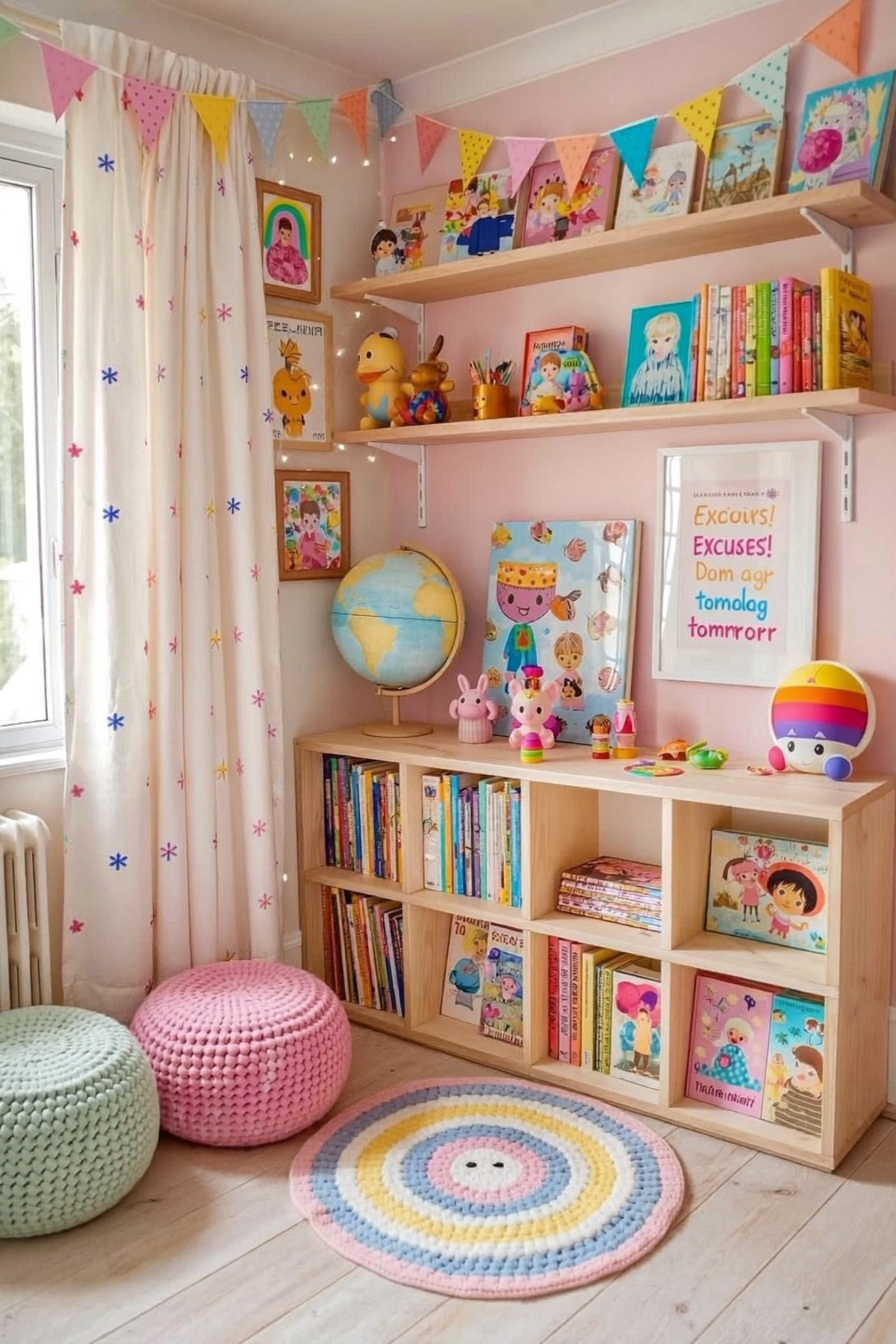
Triangle bunting strung along the ceiling line is an easy, temporary way to add movement to a room without touching the walls, and it reads as festive rather than themed, which means it won’t feel dated in six months the way a full party motif might. It’s also one of the few choices here a parent can swap out on a whim, since none of it is permanent or particularly expensive.
Open shelves mix framed illustrations with stacked picture books, letting art and reading material share the same real estate instead of separating them into different zones. A floor globe and a run of colorful figurines sit at exactly toddler height, low enough to reach without climbing.
Two poufs, pink and sage green, offer flexible extra seating that can be dragged anywhere in the room, and a round crochet rug in concentric rainbow stripes pulls every color in the space together at floor level. Patterned curtains with tiny stars repeat that same playful scale throughout the room.
Small Prints Can Carry A Room
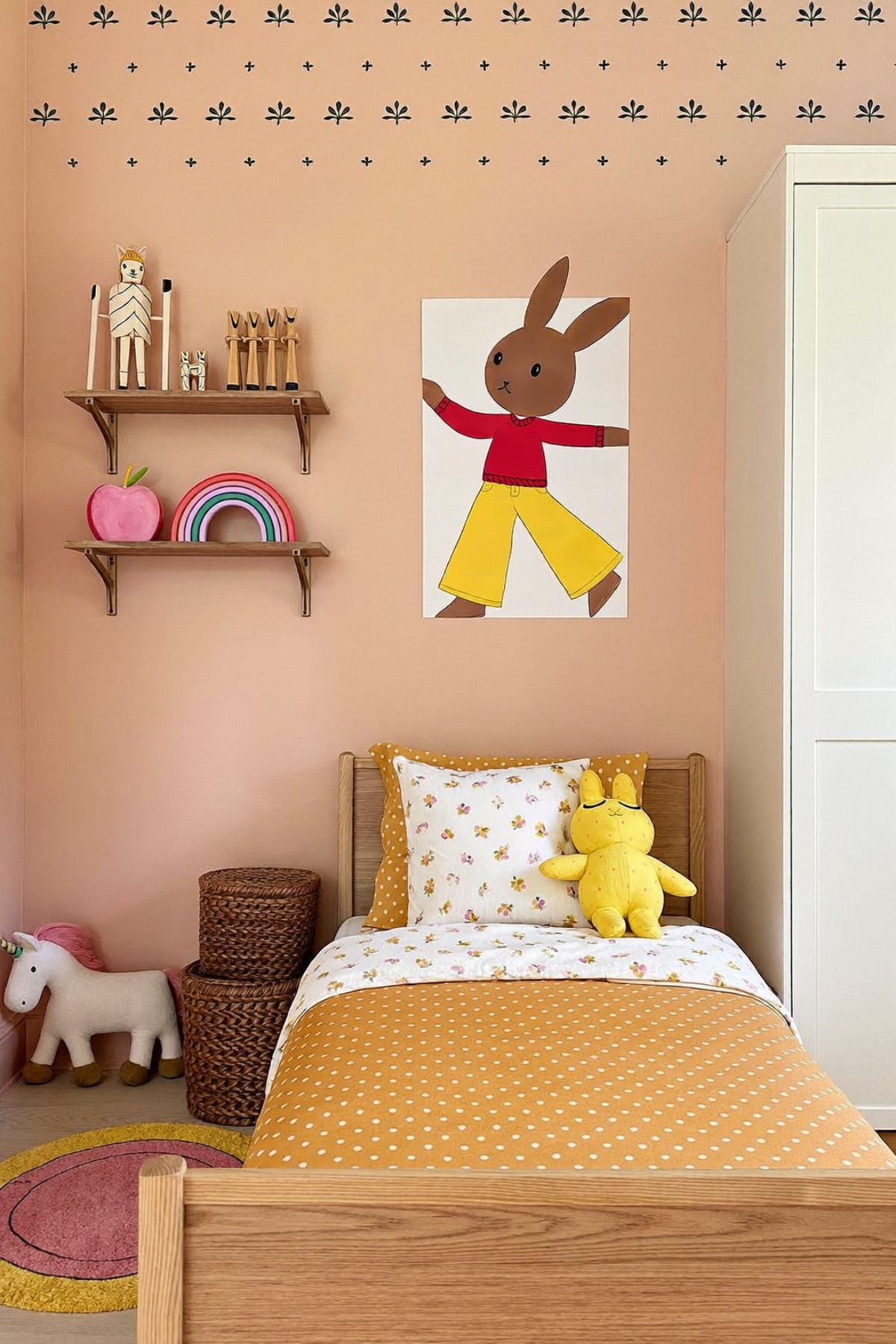
A tiny repeating wallpaper pattern, leaves and crosses scattered across a warm terracotta ground, does more to set the mood here than any single piece of furniture. Small-scale prints like this read as texture from across the room rather than pattern, which keeps them from overwhelming a compact space.
A character illustration scaled almost to bed height acts as a headboard substitute, giving the wall a focal point that costs far less than a statement bed frame would. Polka dot bedding in mustard picks up the warmth of the wallpaper without matching it exactly, which avoids a too-coordinated look.
Open wood shelves display folk-art figures and small collected objects at a height a toddler can actually study up close, while stuffed animals in contrasting yellow and white do the job of extra color. Layered rugs in pink and mustard at the foot of the bed give bare feet something soft to land on.
One Mural Sets The Whole Mood
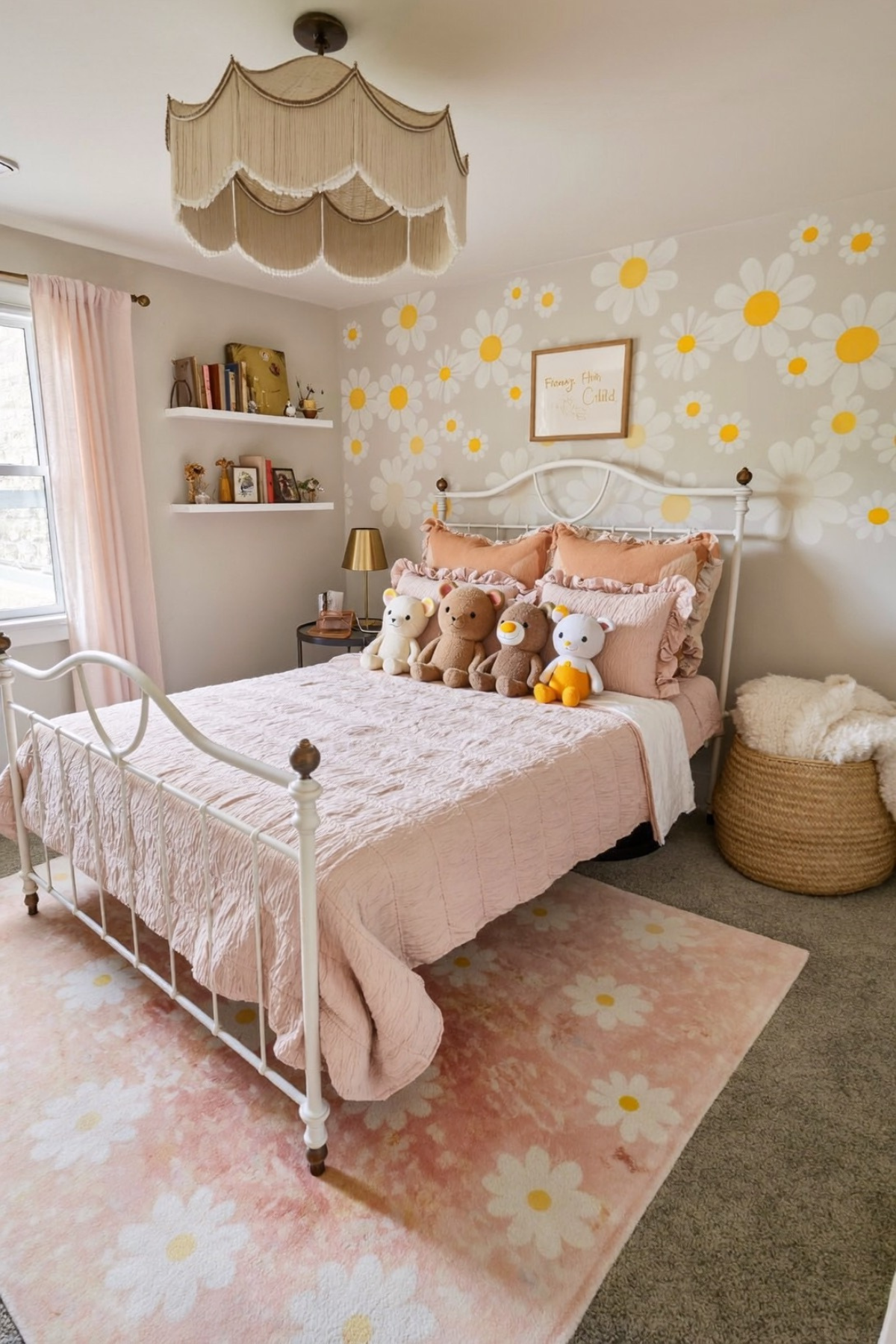
A hand-painted daisy mural covering most of one wall is the single loudest decision in this room, and it works because absolutely nothing else competes with it. The bed frame is a plain white iron silhouette, the bedding a soft blush, and the curtains match the wall almost exactly.
An oversized fringed pendant light hangs where a plainer fixture would normally go, giving the ceiling its own moment instead of leaving it as an afterthought above all that flower power. A framed print with a short, sweet phrase sits directly over the headboard as the only other wall decoration in the space.
A lineup of stuffed bears propped against the pillows adds warmth without a single extra decorative object, and a floral rug at the foot of the bed echoes the mural’s palette down at floor level. If a full mural feels like too much commitment, a single accent wall in a smaller floral pattern gets close to the same effect.
None Of This Has To Happen At Once
None of these rooms started fully finished, and none of them need to be copied exactly to work in your own space. A canopy frame, a shelf of cover-out books, or a single hanging swing can each stand alone as a weekend project.
What ties these spaces together isn’t a color palette or a specific theme, it’s restraint around one loud idea at a time. A mural gets to carry a room’s whole personality because nothing else competes with it, and a neon sign works the same way.
Start with whichever detail your toddler already gravitates toward, whether that’s a reading corner, a swing, or simply a wall in her favorite color, and build outward from there. The room will keep changing as she grows anyway, so there’s no reason to finish it in one weekend.
 Steal Our Home Styling Secrets!