
Why Plate Walls Look Expensive Even When Every Piece Was Thrifted Separately
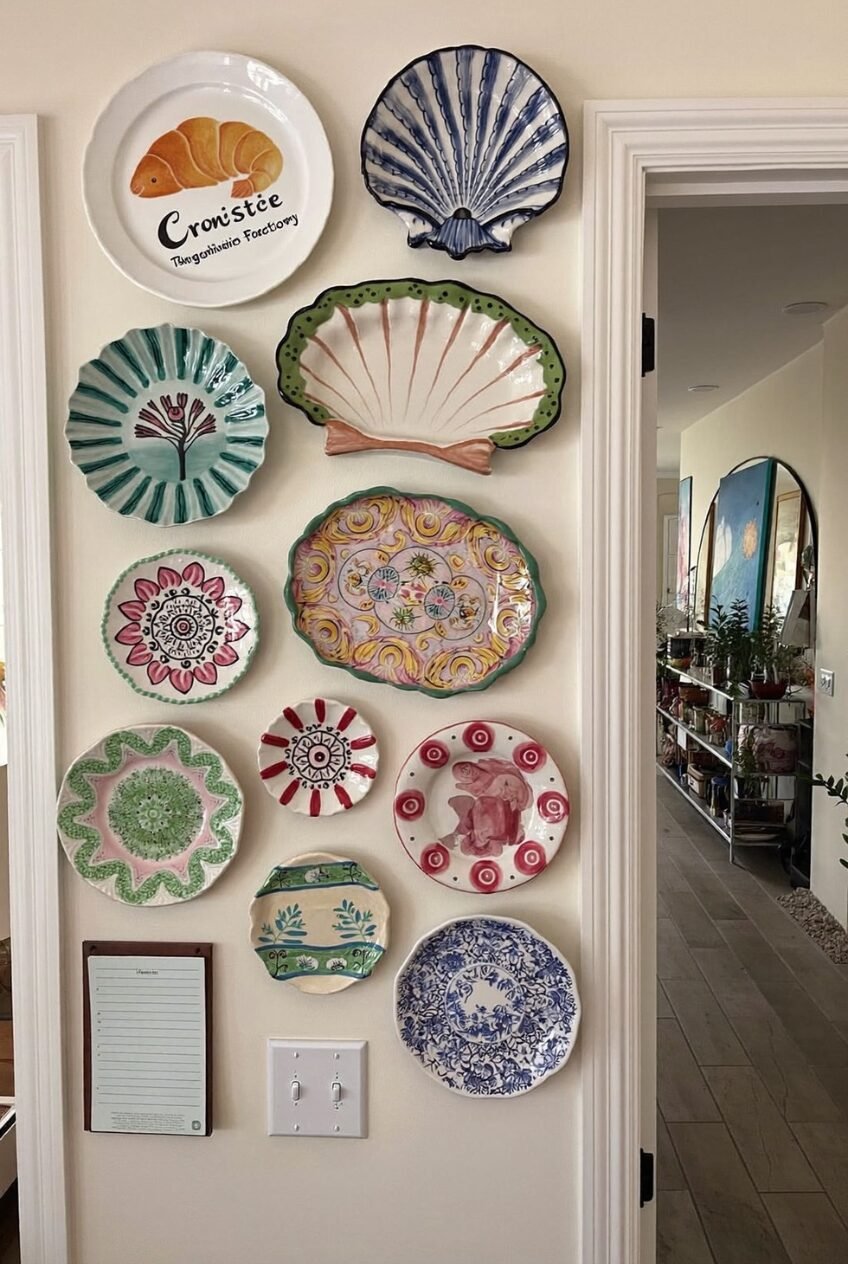
Plates spend most of their lives face-down in a cabinet, stacked and forgotten until a holiday dinner finally gets them out for a few hours. Somewhere along the way, people realized the pattern on the front of a plate is basically free art, and started hanging it on the wall instead of hiding it behind a cabinet door.
What’s interesting is how differently this can go. A wall of plates can read as tightly organized and formal, or completely loose and gathered-over-time, depending on the spacing, the color story, and how many different patterns get thrown into the same cluster.
We pulled together ten real examples that each take a noticeably different approach, some graphic, some rustic, some almost accidental-looking, because the best plate wall is the one that actually matches how a room gets used day to day.
Vintage Plates Feel Like Family History
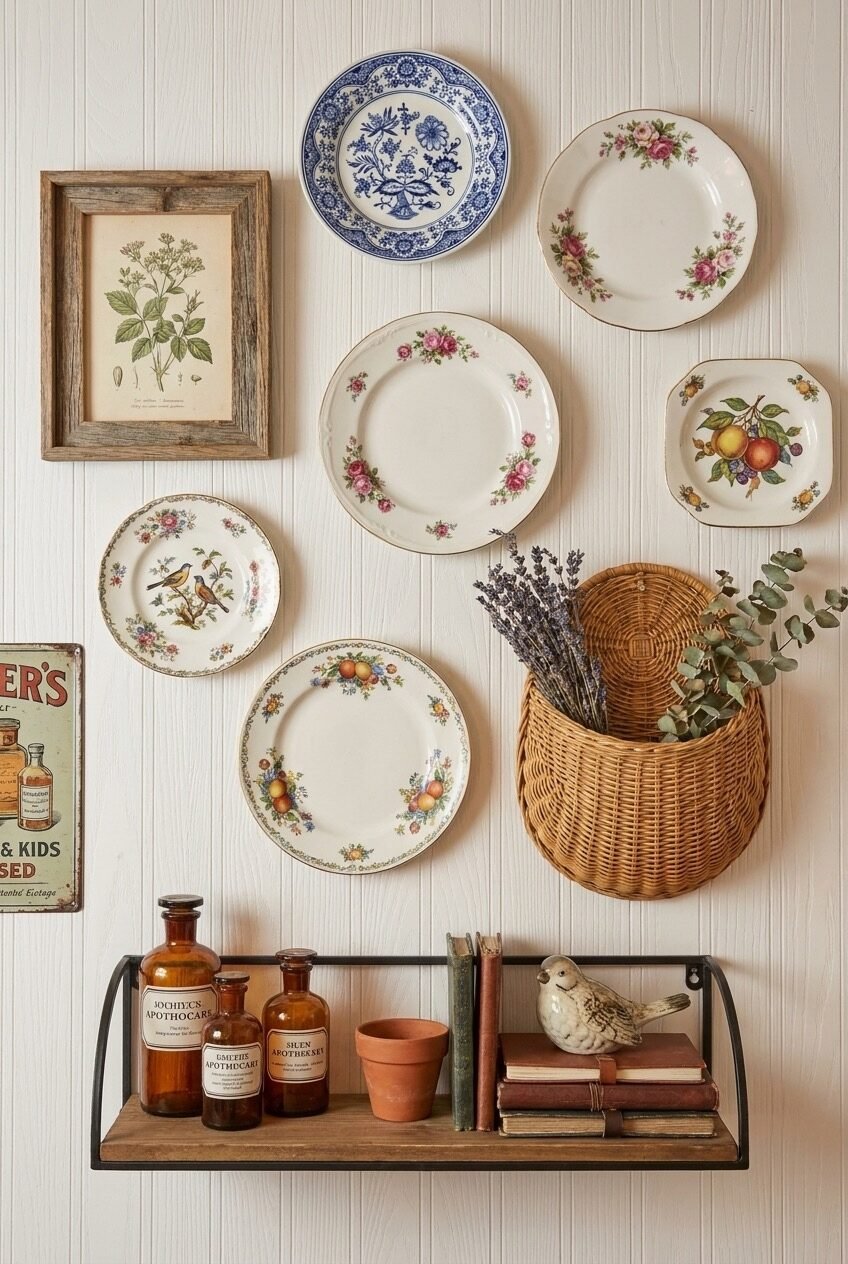
Here’s the trick with a wall like this: none of these plates match, and none of them need to. Roses show up on one, birds on another, a blue-and-white pattern sits in between, and it works because every piece pulls from the same warm, faded palette instead of fighting for attention.
A framed botanical print gets tucked in among the plates instead of hung on its own elsewhere, which is worth noting. Breaking up a plate cluster with something flat and papery, a print, a small sign, even an old postcard, keeps the wall from turning into pure pattern overload.
The wall basket filled with dried lavender does a lot of quiet work here too. It adds texture and a bit of movement along the bottom edge, and softens a wall that would otherwise be all hard ceramic edges. The little shelf underneath, stacked with old apothecary bottles and a couple of worn books, keeps the corner from feeling like decor for decor’s sake.
Leaf Plates Turn Into A Grid
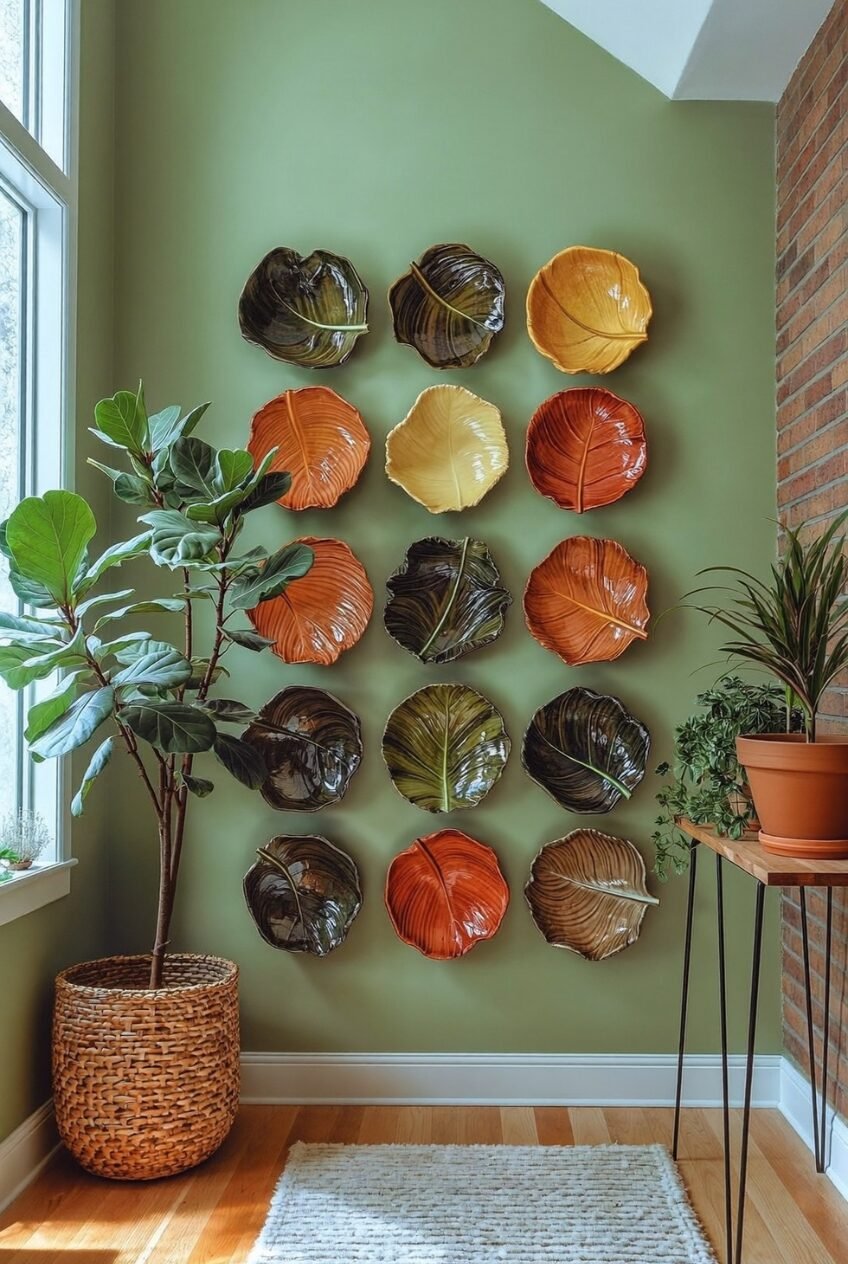
Fifteen leaf-shaped dishes, one shape, fifteen different glazes, and that repetition is what makes this wall feel graphic instead of cluttered. When every piece shares the same silhouette, color gets to go a little wild without the whole arrangement turning chaotic on you.
The color story leans hard into rust, mustard, and deep olive, which happens to be almost the exact same family as the wall paint sitting behind it. That’s the actual move worth stealing: pick a plate collection in tones that already exist somewhere else in the room, and the display stops looking like an afterthought tacked onto a finished space.
Real plants nearby do something a printed leaf never could, since they move, they catch light differently throughout the day, and they keep the whole wall from feeling static or frozen. A fiddle leaf fig or anything with oversized leaves in the same green family will echo the shapes on the wall without competing with them for attention.
Kitchen Plates Work Above Open Shelves
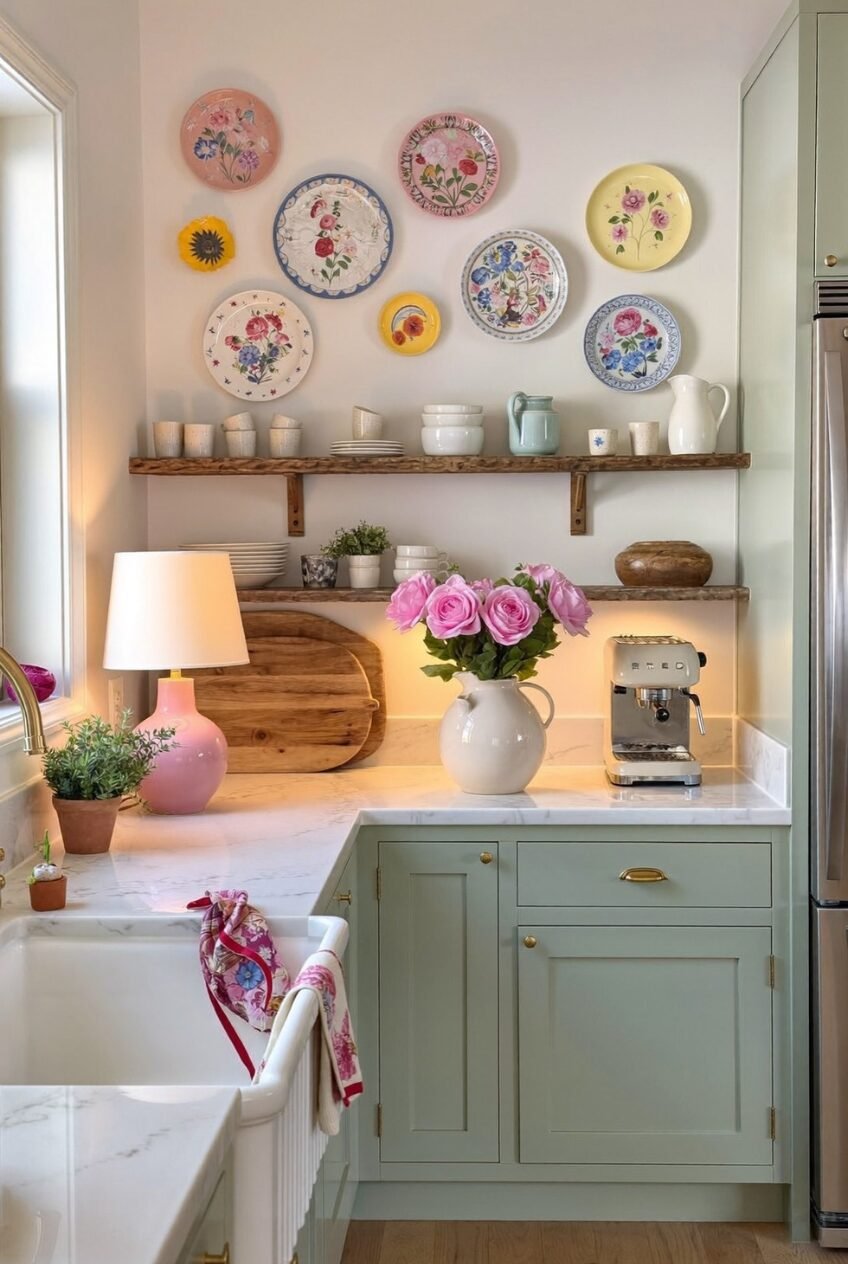
Start with the shelf, not the plates. A run of open shelving gives a plate cluster somewhere to land visually, so the wall above it doesn’t end up feeling like it’s floating in space with nothing underneath to anchor it down, which is the mistake a lot of kitchen walls make.
The patterns here are all florals, but no two share the same scale or color family, soft pink sits next to butter yellow next to a blue trellis print, and even the plate shapes themselves shift between round and square. Loose spacing, uneven gaps, and mismatched sizes are exactly what keep this from reading like a matching china set someone bought all at once.
This kind of arrangement works especially well behind a sink or stove, somewhere already getting looked at multiple times a day without much thought. Hang the largest plates first to set the outer edges, then fill in smaller ones by eye rather than measuring precisely, since a kitchen wall doesn’t need perfect symmetry to feel finished and lived-in.
Rustic Plates Echo The Sofa Pillows
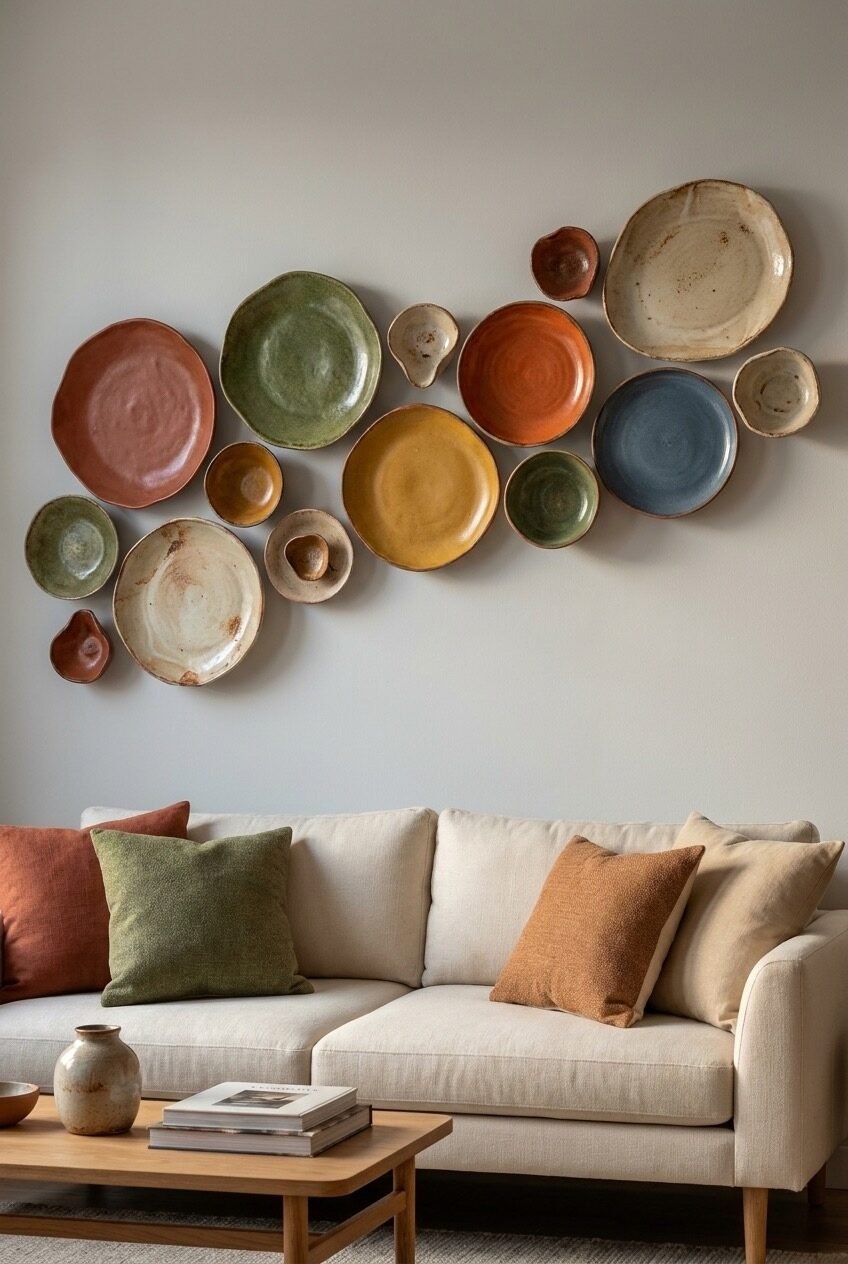
Notice how the plates on this wall aren’t perfectly round, and the smaller bowls tucked between them aren’t either. Some edges dip, some glazes pool unevenly near the bottom, the kind of detail that only shows up on handmade stoneware, and it’s exactly what keeps a plate wall from looking mass-produced or ordered straight out of a catalog.
Rust, olive, mustard, and a single dusty blue repeat both on the wall and in the pillows below it, tying the whole seating area together without anyone having to point it out or explain the decision out loud. The eye just connects the two areas on its own, the way a good rug ties a room together.
If you’re pulling this off above a sofa, raise the bottom row so it sits close to the top of the cushions rather than floating a foot above them, since that visual connection is what makes the wall and the furniture read as one composition instead of two separate decisions made years apart from each other.
Plates Climb The Staircase Wall Diagonally
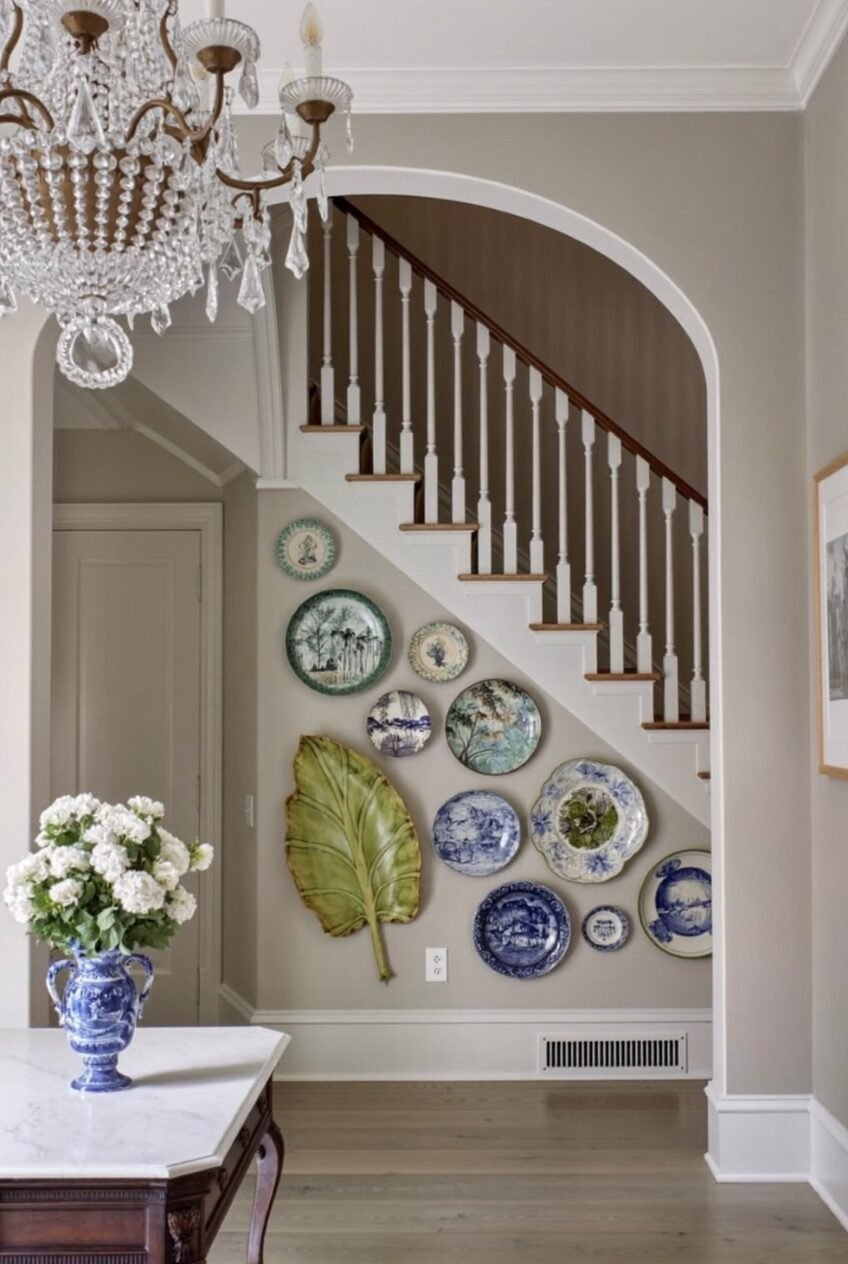
A staircase wall is oddly shaped, and most people just leave it blank because nothing seems to fit right against that awkward slope. Plates solve that problem better than framed art does, since they can be arranged in a diagonal line that actually follows the angle of the stairs above them instead of fighting that slope.
The single leaf-shaped plate breaks up what would otherwise be a wall of near-identical blue and white transferware stacked one after another. One plate that doesn’t match the rest, placed somewhere in the middle of the cluster, keeps the eye moving instead of skimming past a repeated pattern too quickly.
Measure the stair angle before hanging anything, since a rough diagonal line, not a perfectly straight one, is what makes this look natural rather than plotted out with a level and a ruler. Group the largest plates lower and let the sizes shrink slightly as the display climbs toward the ceiling above, following the same rhythm as the handrail beside it.
One Narrow Wall, Four Blue Plates
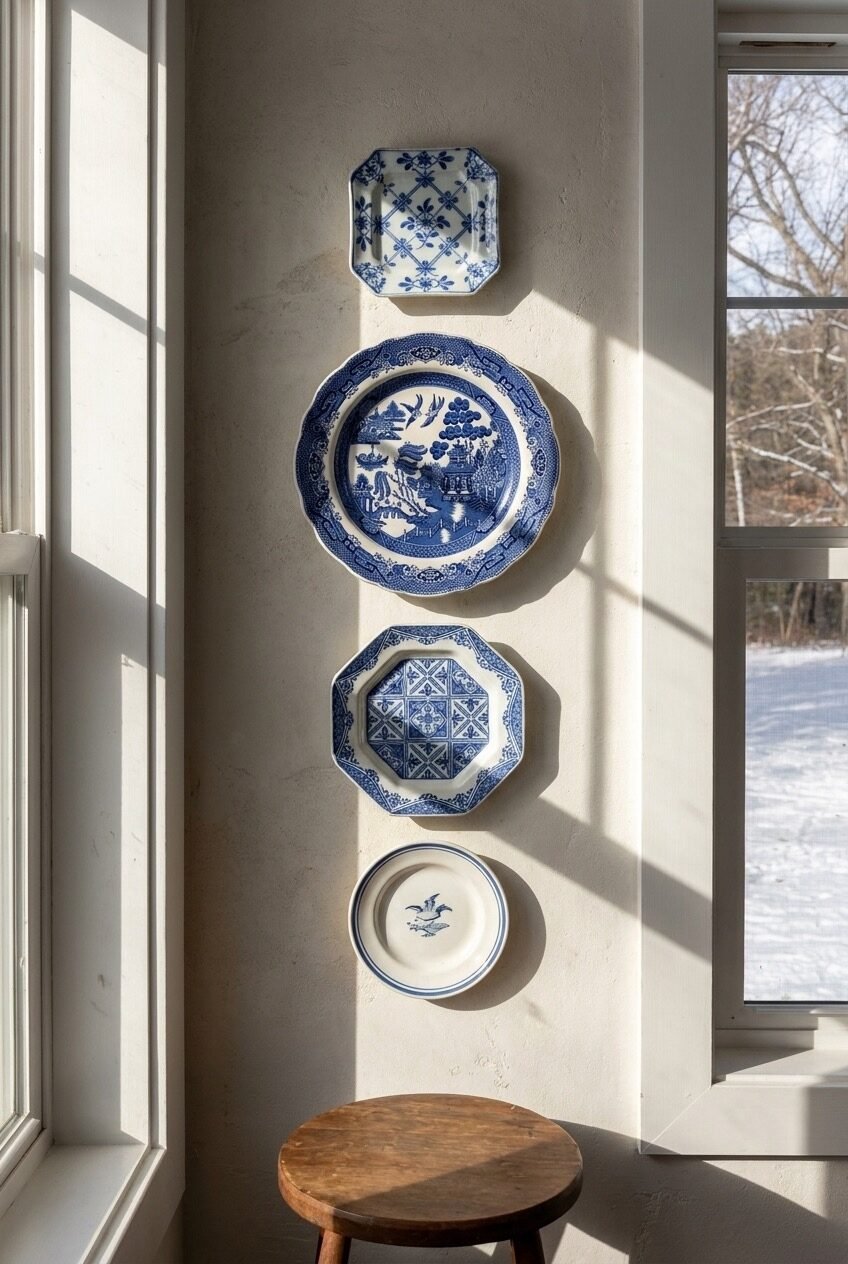
Most plate walls go wide, spreading out to fill as much horizontal space as they can find. This one goes narrow on purpose, stacking just four plates in a single vertical line down a tight strip of wall wedged between two sunlit windows, with a small stool sitting underneath.
Alternating round and angular shapes is doing a lot of the visual work, since the color story stays almost entirely blue and white all the way down the column. Without that shape variation, four plates in a row could easily look like a boring stack instead of an actual thoughtful arrangement someone sat down and planned out.
This is the move for awkward narrow walls, the kind next to a doorway or squeezed between windows that feel too small for a full gallery layout to fit comfortably. Keep the palette tight, alternate the plate shapes, and even a strip of wall under two feet wide can hold its own display without feeling cramped.
Bar Cart Walls Handle Bold Patterns
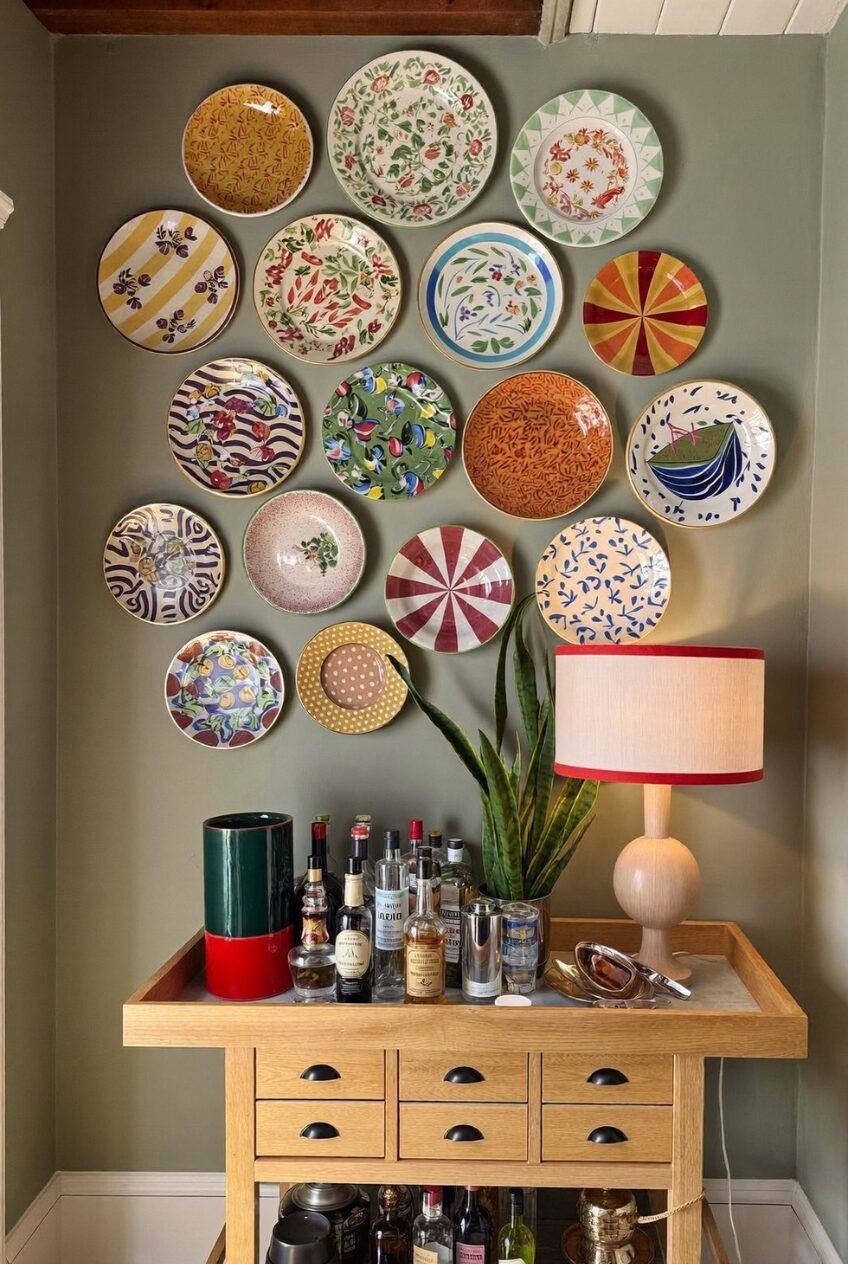
If a room is going to go loud with pattern, it should probably happen somewhere small and contained. This cluster crams stripes, florals, polka dots, and a hand-painted sailboat into one tight grid, and it only works because the space itself is compact, a narrow nook above a bar cart, not an entire living room wall.
The sage green wall behind the plates is what keeps that many different patterns from turning into visual noise nobody can actually process. Pick one calm wall color as a backdrop, and pattern-heavy plates suddenly have somewhere quiet to sit without competing against a busy paint choice too.
Fill a grid like this edge to edge with barely any gap between plates, since the density is really the whole point of the look. Save your boldest, most mismatched plates for a small wall like this one instead of spreading them across a bigger space where they’d need more breathing room to work properly.
Symmetry Turns Plates Into A Pattern
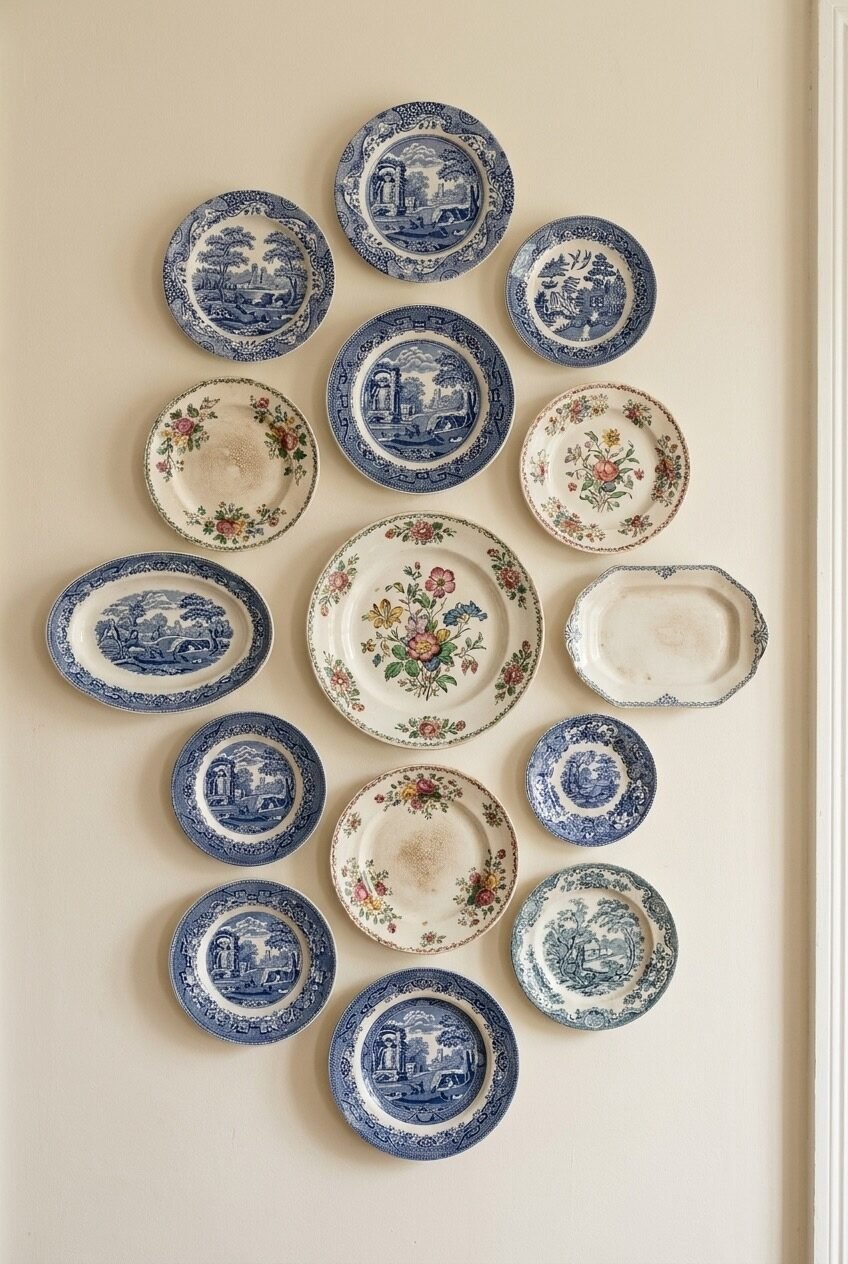
Every plate on this wall has a near-identical twin sitting on the opposite side, right down to matching sizes, and that mirroring is what turns a collection of separate objects into one continuous pattern, almost like wallpaper made out of actual china rather than paper.
A single floral plate sits dead center, breaking up what would otherwise be an entire wall of blue and white with no relief in sight. That one warm-toned plate in the middle gives the eye a place to land before it starts tracing the symmetry radiating out around it in every direction, pair by careful pair.
Getting this look right takes more patience than a loose cluster does, since you measure out from a center point and hang pairs at the same time so both sides stay level with each other throughout the process. It suits a formal dining room or entryway far better than a casual, thrown-together arrangement ever would manage to.
Wood Bowls Mix With China Plates
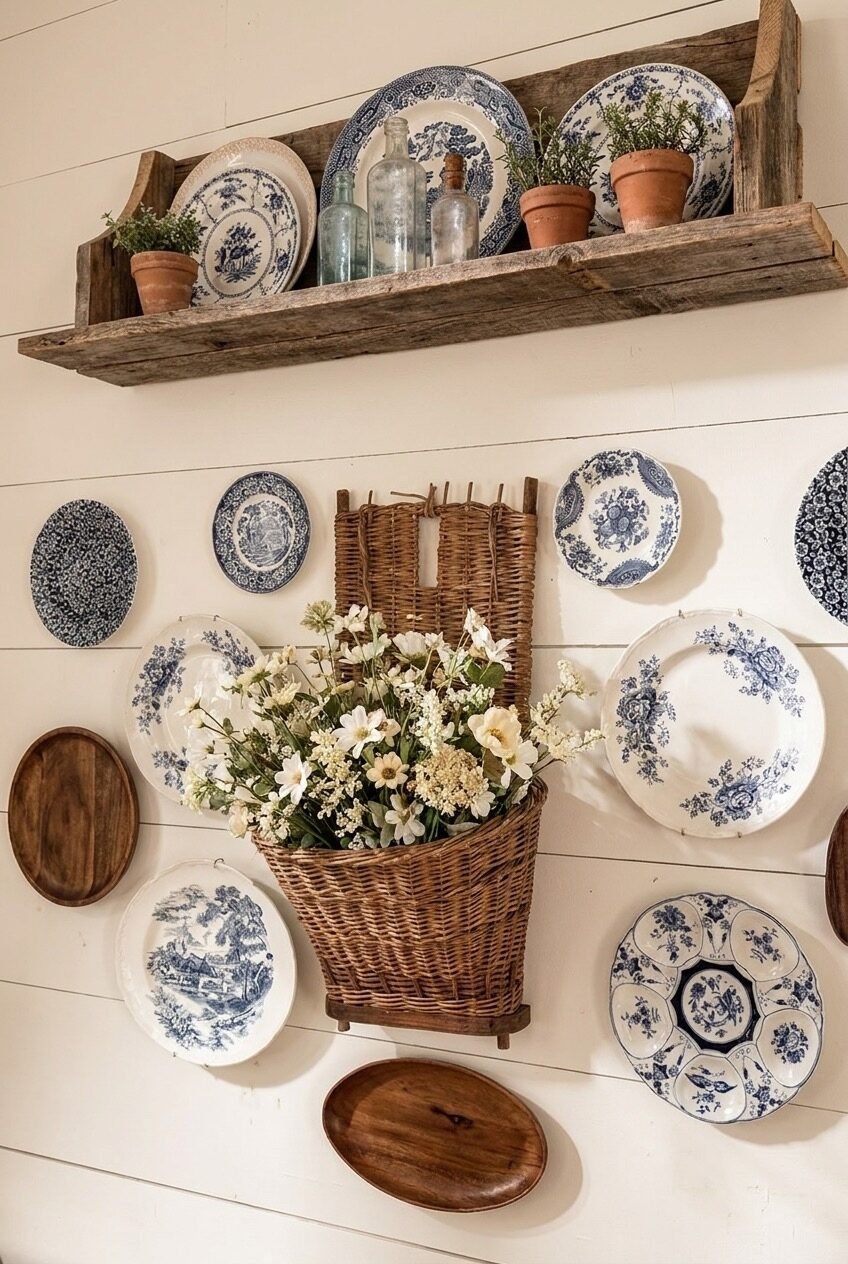
Skip the idea that a plate wall has to be all plates and nothing else. This one throws plain wood dough bowls right alongside patterned blue and white china, and the contrast in material does more for the display than another matching plate ever could on its own.
A wall basket stuffed with dried flowers works as a focal point in the middle of the arrangement, giving the eye somewhere soft to rest between all that hard ceramic and wood surrounding it. Above it, a reclaimed wood shelf holds a few more plates standing upright next to old glass bottles and small terracotta pots.
If a plate collection feels a little one-note, look for something with texture instead of pattern to mix in, a carved bowl, a woven basket, even a stack of old books works the same way this wood does here. Variety in material tends to read as more collected over time than variety in pattern alone.
Big Dining Walls Need Big Clusters
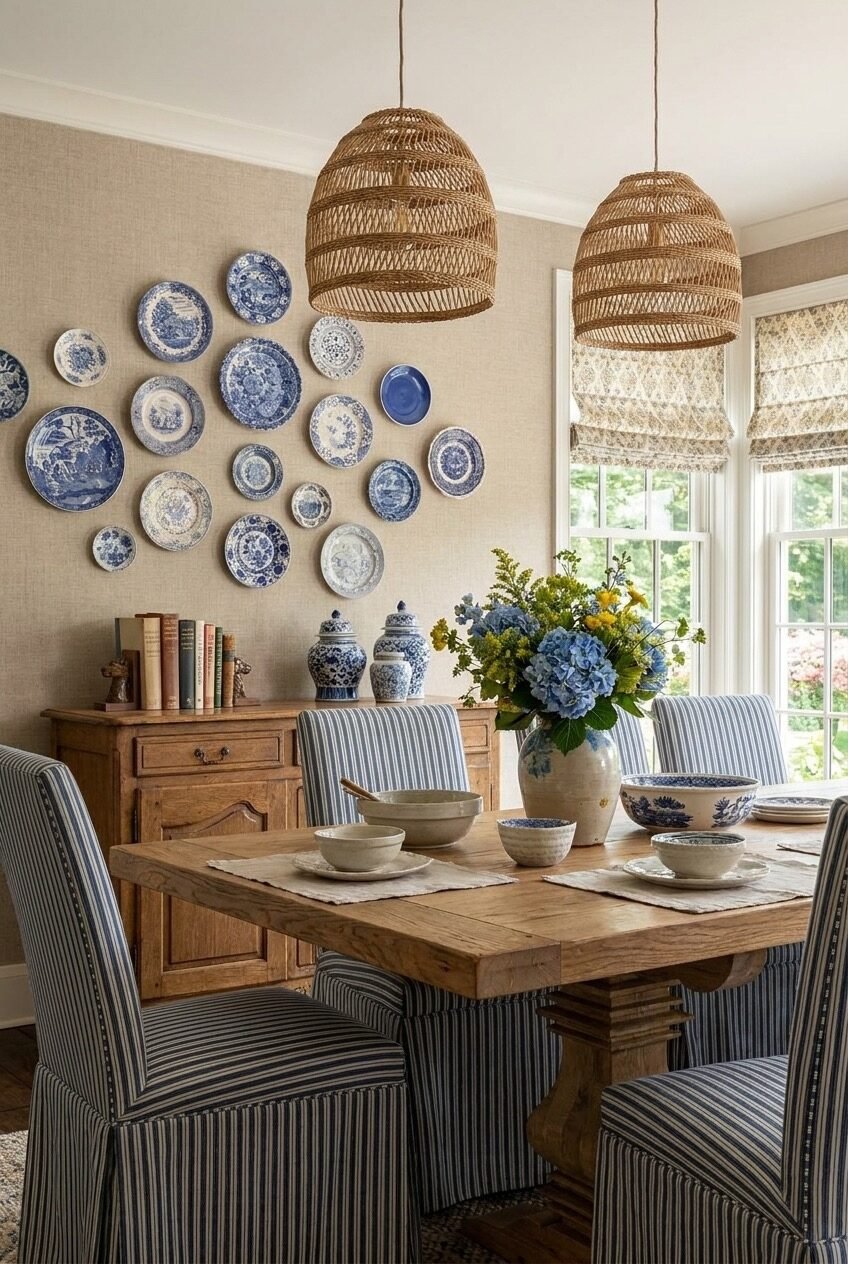
Scale is the whole story here. A dining room wall this large would swallow a small cluster of six or seven plates without much visual effect, so this one goes big instead, packing in close to twenty pieces to actually fill the space the way a large piece of art would.
Keeping almost every plate in the same blue and white family is what makes that many pieces feel manageable instead of overwhelming to look at all at once. Variety comes from the individual patterns and plate shapes rather than from mixing in a whole range of different colors.
Before hanging anything this size, lay the whole cluster out on the floor first and adjust the gaps until the shape feels balanced, then transfer it to the wall piece by piece from the outside in. Woven pendant lights and striped chair fabric nearby pick up the same blue and wood tones, so the whole room ends up feeling connected instead of decorated in separate pieces.
Every Blank Wall Is Just Waiting For Plates
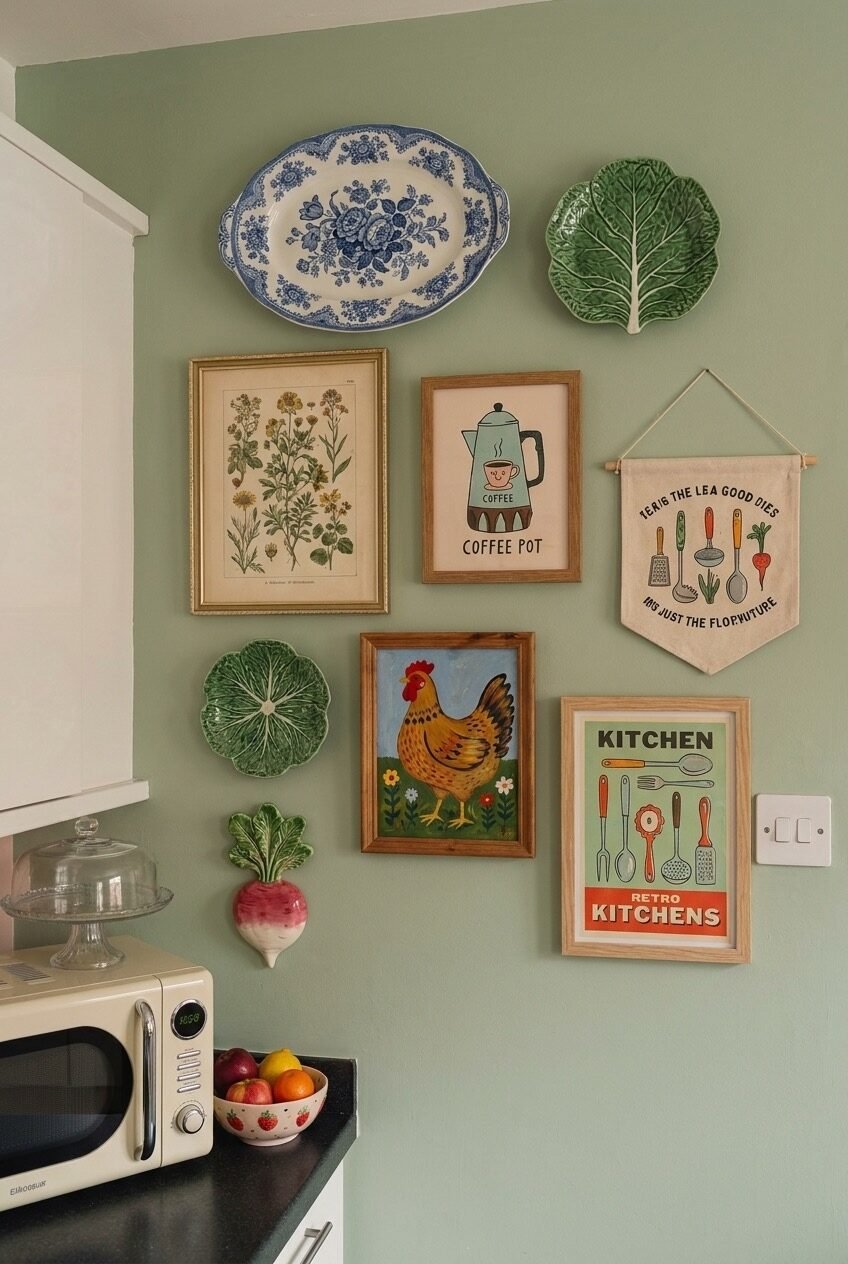
Ten walls, ten completely different results, and not one of them required buying a matching set from a store shelf. That’s really the whole point of decorating with plates instead of framed prints, since the mismatches are allowed, and honestly, they’re usually what makes the wall interesting in the first place.
None of this requires expensive pieces either. Thrift stores, estate sales, and the back of a cabinet already sitting in the house are usually a far better starting point than a store shelf full of identical brand-new plates waiting to be bought.
Pick whichever approach matches the wall and the patience level available right now, start with the biggest pieces first, and let the smaller ones fill in around them afterward. The rest tends to sort itself out once the hammer actually comes out and the first plate goes up.
 Steal Our Home Styling Secrets!