
The Quiet Confidence Behind Every Truly Whimsical Kitchen We Could Find
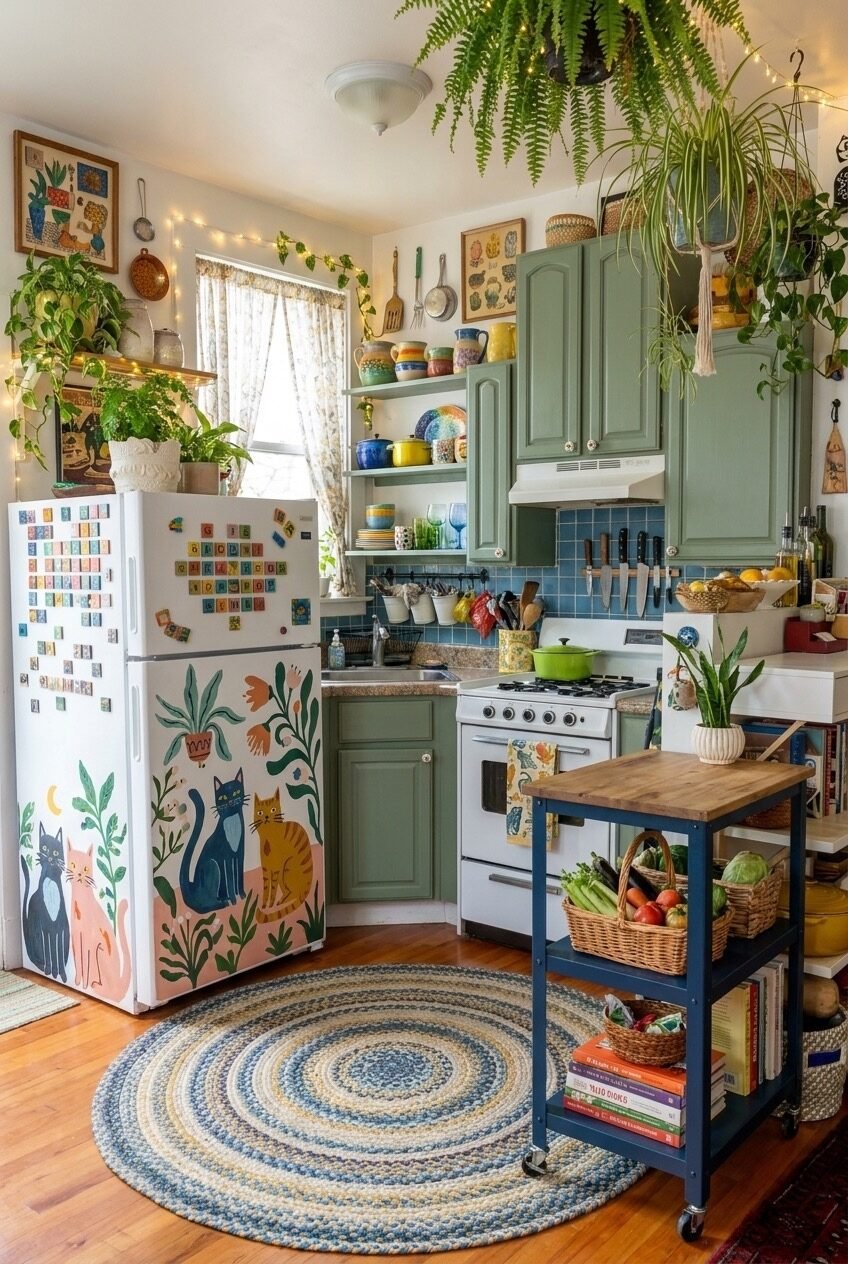
A kitchen doesn’t have to look like the one in every renovation reel. Somewhere between sterile minimalism and matchy farmhouse sits a category of rooms that just refuse to behave, and we’re fully on board. Painted cats on a fridge, mushroom barstools, stained glass turning afternoon light into a storybook. None of it reads as accidental. It reads as someone who actually likes their kitchen.
Whimsy in a kitchen is really confidence wearing a fun outfit. The rooms that pull it off lean on a few repeatable moves: a strong sense of color, texture that photographs oddly but feels wonderful in person, and one object with zero practical use.
Below, we’re walking through ten kitchens that lean into their own flavor of playful, from candlelit corners to storybook cottage to retro kitsch, breaking down what’s driving each look and how much you could realistically borrow.
Let Vintage Lighting Set The Mood
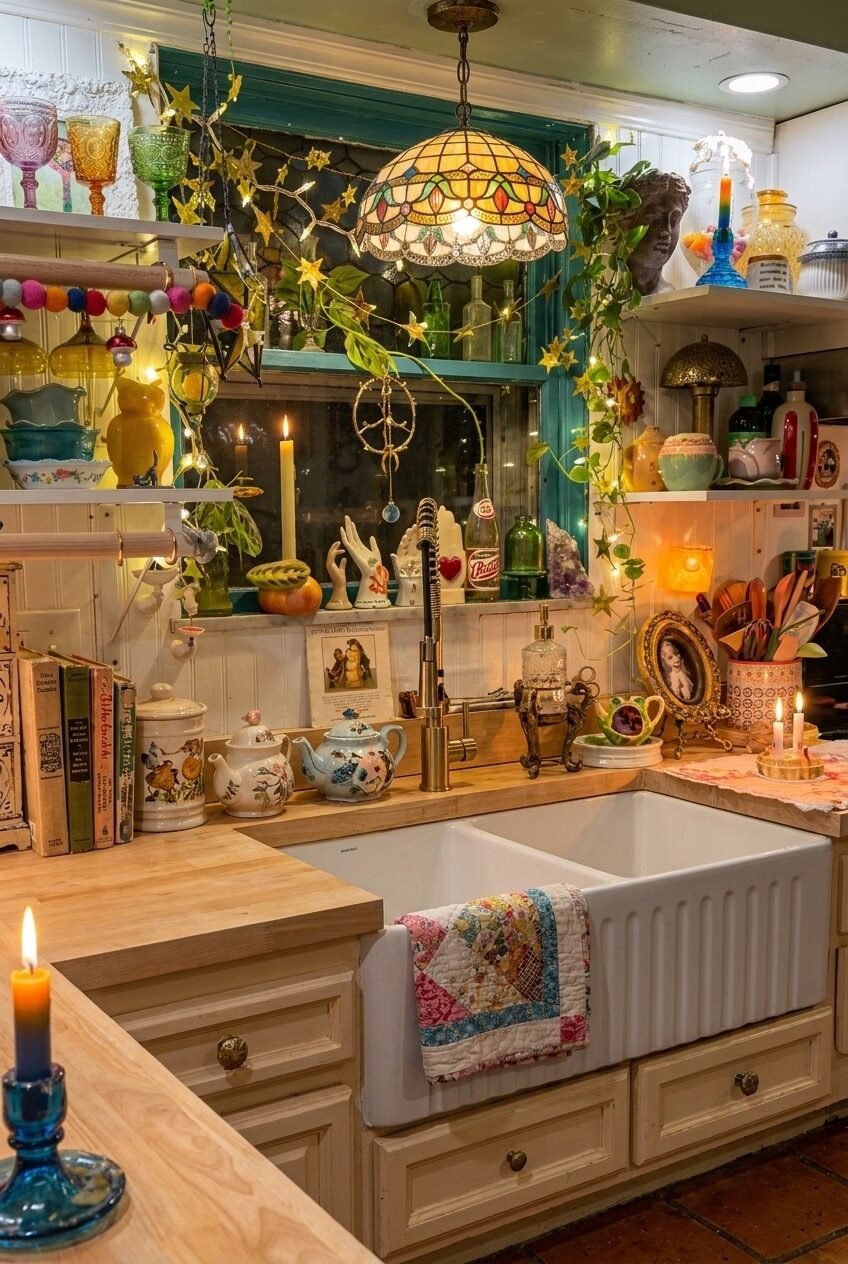
Start with the lamp. In this kitchen, a stained glass pendant does more heavy lifting than every other object in the room combined, warming the whole sink area into something closer to a den than a workspace. Layer that against a painted teal window frame and you’ve built a scene before a single dish is done.
From there, the rest of the room gets to be a little chaotic in a good way. Glass bottles line the windowsill, a marble bust watches over the sink, teacups sit in mismatched patterns, candles stay lit for no particular occasion. Nothing here is precious, and that looseness is exactly why the corner works.
If you want this in your own kitchen, hunt for a secondhand stained glass or Tiffany-style fixture before anything else, since it sets the color temperature for everything nearby. Swap your window trim for a saturated color, keep a few taper candles going on the counter, and let your odd little collectibles sit out in view.
Bring Back Some Playful Retro Kitsch
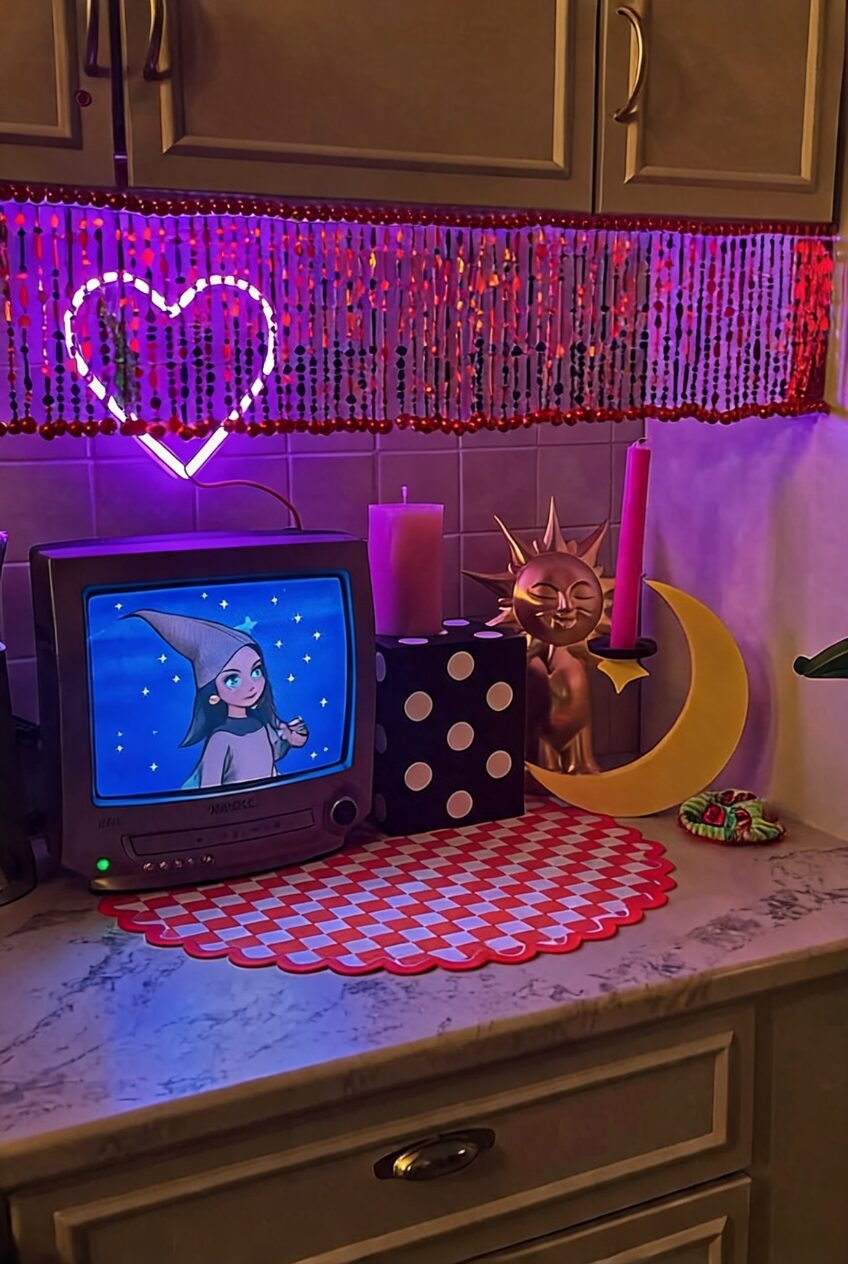
A neon heart light glowing above a beaded curtain. A tiny CRT television playing an old cartoon. A checkered placemat in cherry red, a gold sun, a crescent moon candle holder. This corner isn’t trying to be tasteful, and that’s precisely the point of nostalgic, kitschy kitchen styling done well.
We think this kind of vignette works best when it’s treated like a shrine to a specific era rather than scattered randomly around the room. Everything here references the same decade and mood, so even though each object is a little odd on its own, together they read as one clear, cohesive idea instead of clutter.
To recreate it, pick a theme year or aesthetic and commit fully instead of sprinkling references throughout the whole kitchen. A small secondhand TV, a neon sign, novelty candle holders shaped like dice or fruit. Group these pieces tightly in one corner so the effect concentrates instead of spreading thin across every countertop in the room.
Carve Your Story Into The Woodwork
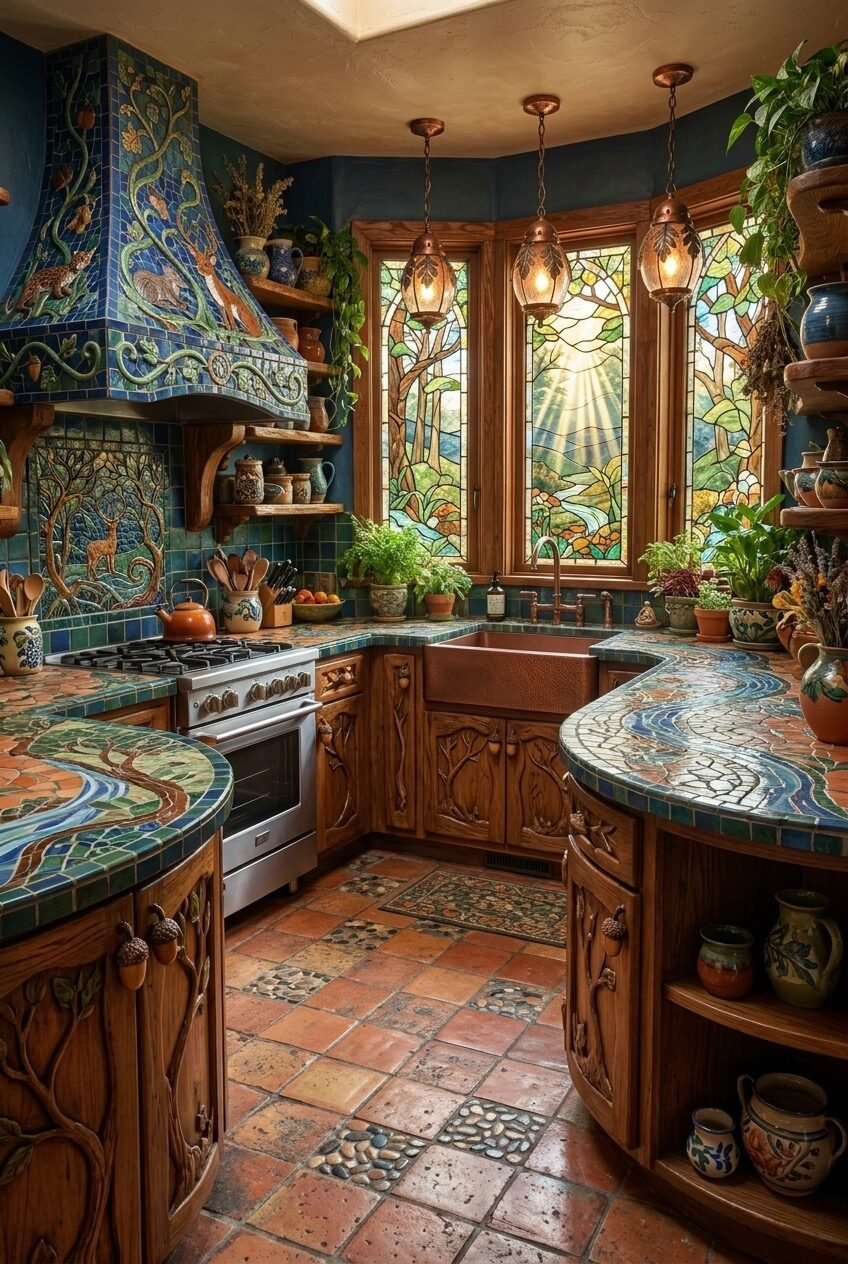
This kitchen barely leaves a surface untouched. Forest animals are carved directly into the cabinet fronts, mosaic countertops are shaped like winding rivers, and a range hood is painted with deer weaving between trees. It’s less a kitchen and more a fully illustrated storybook you happen to cook in every day.
The design principle underneath all that detail is narrative continuity. A fox on the cabinet door talks to a river motif on the counter, which talks to a forest scene in the stained glass window behind the sink. Every surface adds a sentence to the same story instead of competing for attention on its own.
You don’t need custom woodcarving to borrow this. Pick one recurring motif, maybe woodland creatures, birds, or botanicals, and repeat it across a tile mural, a set of dish towels, and one framed piece of art. Consistency across several small surfaces carries far more weight than a single large statement piece ever could on its own.
Let Open Shelving Tell The Story
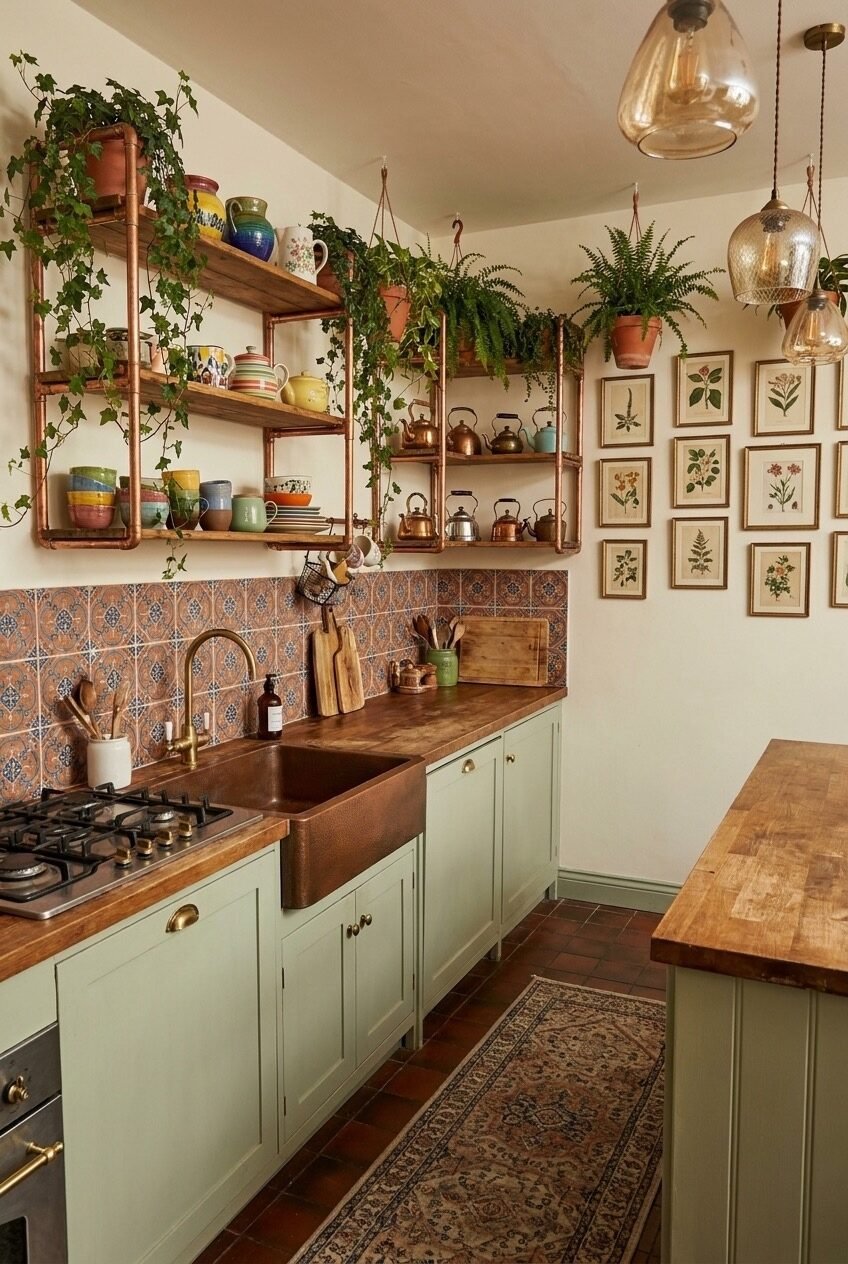
Open shelving gets a bad reputation for being high-maintenance, but this kitchen makes a strong case for why it’s worth the extra dusting. Copper pipe brackets hold mismatched mugs, ferns, and trailing plants at staggered heights, turning what could’ve been a plain stretch of wall into something closer to a curiosity cabinet you actually want to look at.
Underneath the sage green cabinetry and patterned terracotta tile, the real trick holding it together is restraint in the color story. Warm woods, copper, and greenery repeat throughout the room, so even a wall covered in trailing pothos and secondhand teapots ends up feeling calm rather than busy or overloaded.
To pull this off at home, pick one metal finish for your hardware and shelf brackets and stick with it everywhere, including your faucet and pendant lights. Then fill the shelves with plants at staggered heights, mixing trailing and upright varieties, and don’t be afraid to leave a few honest gaps between objects.
Pick One Motif And Commit Fully
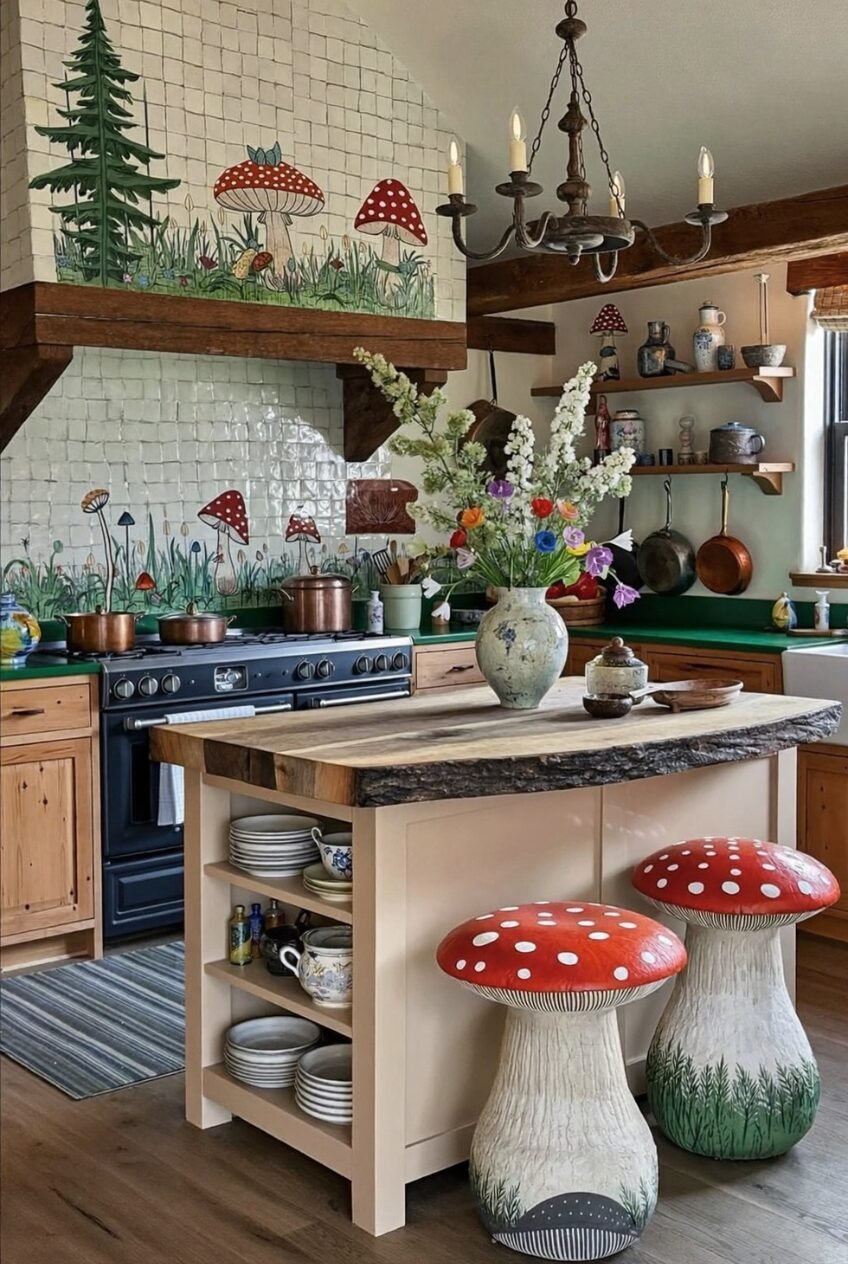
Mushroom stools with red spotted caps. A hand-painted toadstool mural above the range. Wildflowers spilling out of a stoneware vase on a live-edge wood island. This kitchen picked a single motif, mushrooms and forest florals, and let it show up in the furniture, the tile, and the accessories all at once instead of picking just one single spot to feature it.
What keeps it from feeling like a theme park is scale variation. The mural stays flat and quiet, the stools go sculptural and loud, and the flowers stay soft and temporary. Same idea, three completely different volumes, which is what makes a motif-heavy room still feel layered instead of one-note or costumey.
If a full mural feels like too much, start smaller. A pair of novelty stools, one hand-painted backsplash tile, or seasonal flowers in an earthy vase can introduce the same whimsical thread without requiring a full renovation or a big financial commitment up front.
Cover Every Surface In Pattern
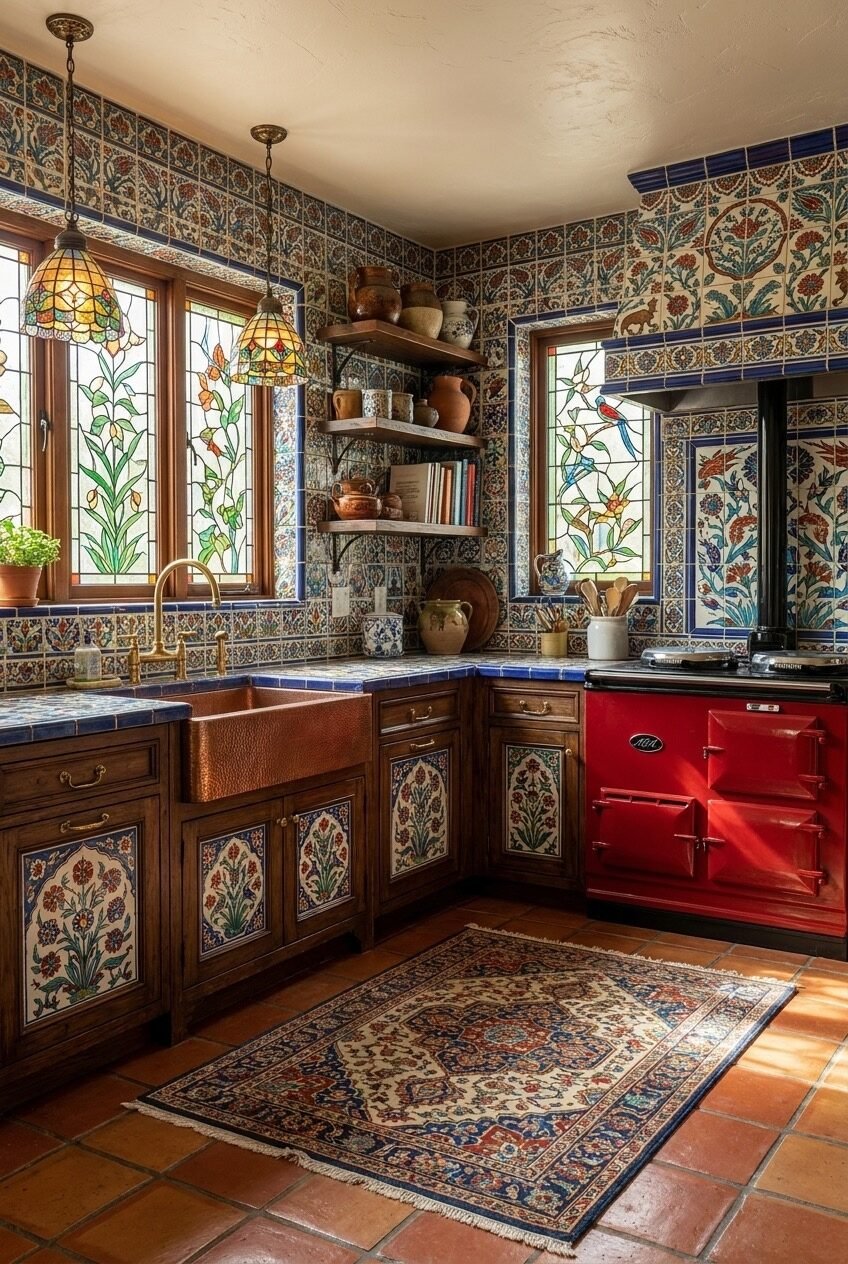
Most design advice tells you to give patterned tile room to breathe. This kitchen ignores that completely, running ornate Mediterranean-inspired tilework up the walls, across the hood, and around every window frame, and somehow it still feels grounded rather than overwhelming or busy in all the wrong ways.
The reason it holds together is a tightly controlled color family. Blues, terracottas, and creams repeat across every tile, the rug underfoot, and even the bold red range in the corner, so despite the sheer volume of pattern, your eye never has to process more than a handful of tones at once.
To try this without a full tile renovation, limit yourself to three or four colors before you even pick a single pattern, then let those colors show up in your backsplash, your rug, and one major appliance. The pattern itself can be as loud as you want, as long as the palette underneath stays disciplined.
Turn A Collection Into Decor
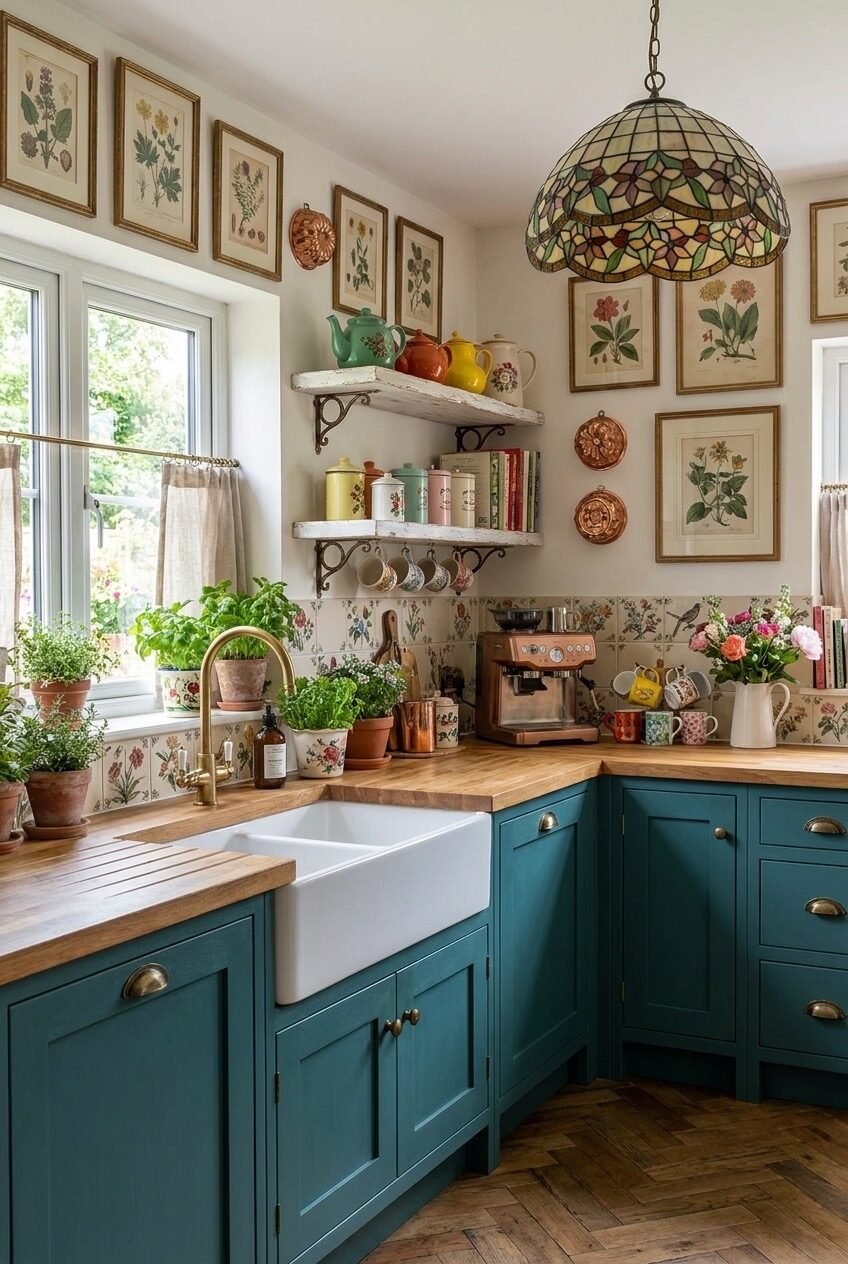
Deep teal cabinetry gives this kitchen a strong backdrop, but the real personality comes from the shelf of mismatched teapots and the gallery wall of botanical prints climbing toward the ceiling above the window. Neither collection is expensive on its own, but together they fill the room with more character than any single design purchase ever could.
We like this approach because it rewards accumulation over acquisition. Nobody bought this all at once, and it shows in the best possible way, since a slowly gathered collection almost always looks more considered than a matching set bought in a single trip to one store.
Start your own version with botanical prints in mismatched secondhand frames, hung salon-style above a low shelf near the sink. Add a small collection you already own somewhere, teapots, mugs, or little vases, and let it live out in the open instead of tucked away behind a cabinet door where nobody sees it.
Set The Scene With Light
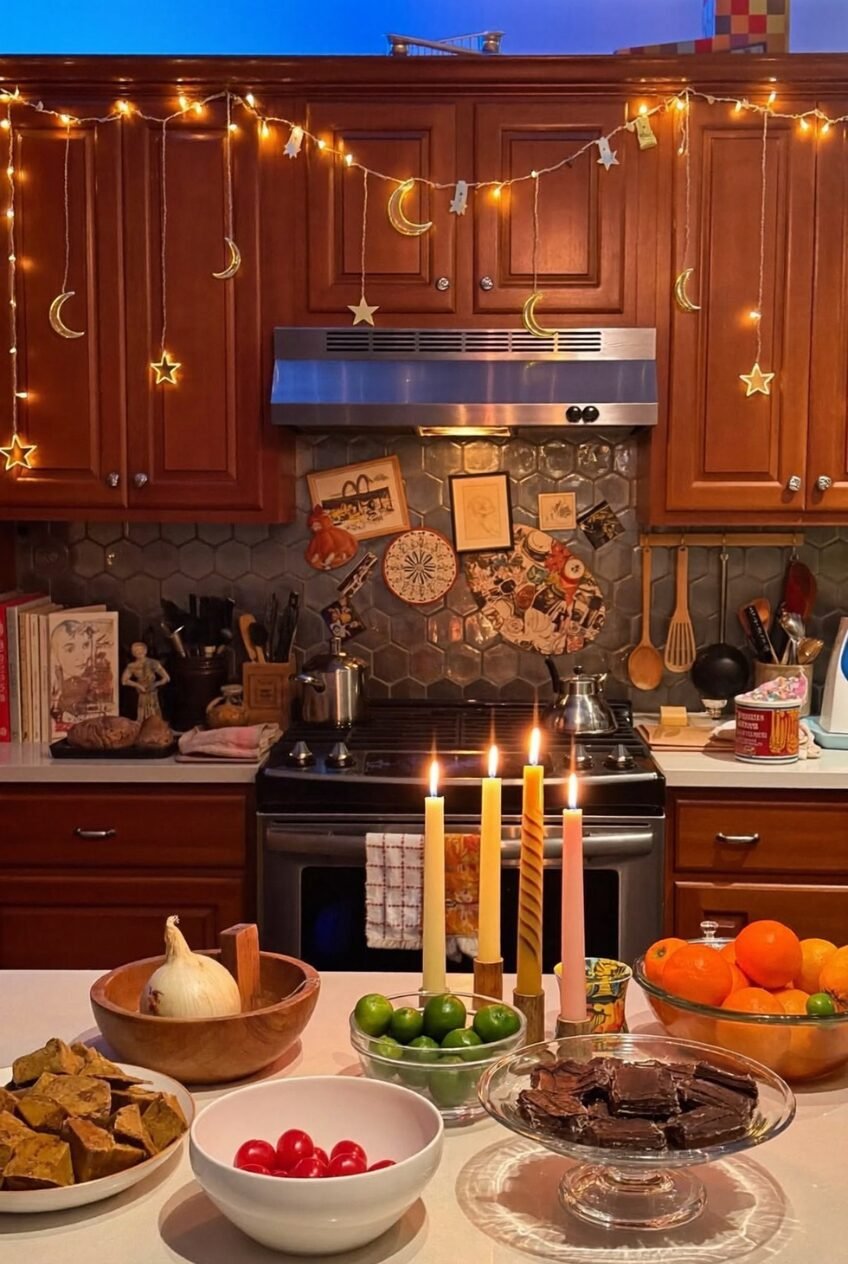
No new cabinetry, no tile mural, just string lights shaped like moons and stars draped along the upper cabinets and a row of taper candles glowing on the counter below. It’s proof that mood lighting alone can completely change how an entire kitchen feels once the sun goes down for the evening.
The celestial motif keeps the whole vignette from feeling like generic party decor. Moons and stars tie into a specific aesthetic rather than reading as leftover holiday lights, which is the difference between a themed kitchen corner and a kitchen that just happens to have string lights on it somewhere.
This one’s an easy weekend project. Pick a shape that fits an aesthetic you already like, drape it along your upper cabinets, and add a cluster of taper candles at counter height. Bowls of citrus or seasonal produce nearby round out the scene without adding any permanent decor at all to the room.
Paint A Mural Instead Of Tile
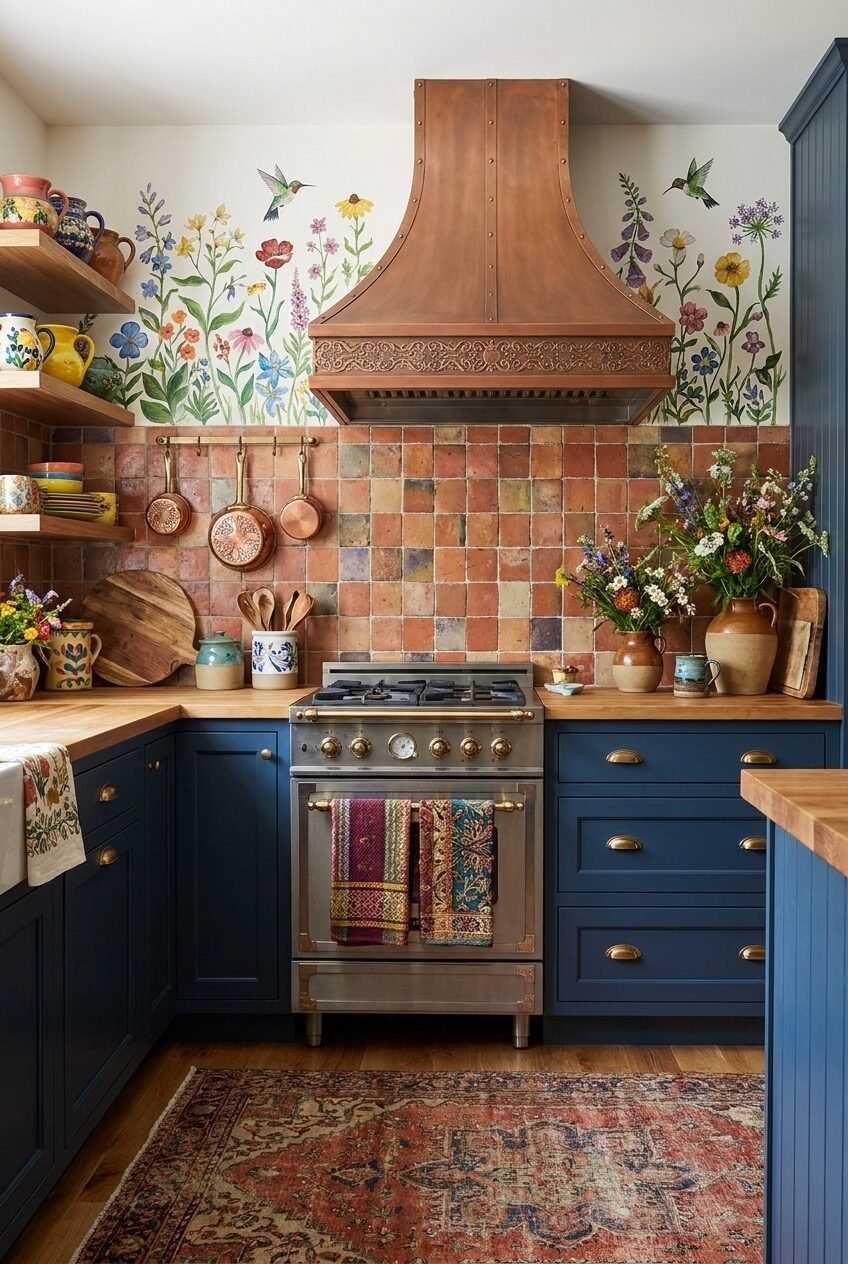
Instead of tile, this kitchen hands the space above its counters over to a hand-painted wildflower mural, complete with hummingbirds darting between the blooms and open shelves stacked with pottery below. Paired with a hammered copper range hood and deep navy cabinetry below, the mural becomes the room’s centerpiece rather than sitting in the background as a quiet detail.
Painted murals give you a flexibility that tile simply can’t match. You can size the design to fit an oddly shaped wall, adjust the color story to match your cabinetry exactly, and change the whole thing down the line without ripping anything out or hiring a tile crew.
If you’re drawn to this, look for a muralist or a wallpaper option with a botanical pattern, then pair it with one warm metal finish, copper or brass, on your hood and hardware. Keep your lower cabinets in a saturated, moody color so the mural has something grounded to sit against visually.
Build A Nook Worth Lingering In
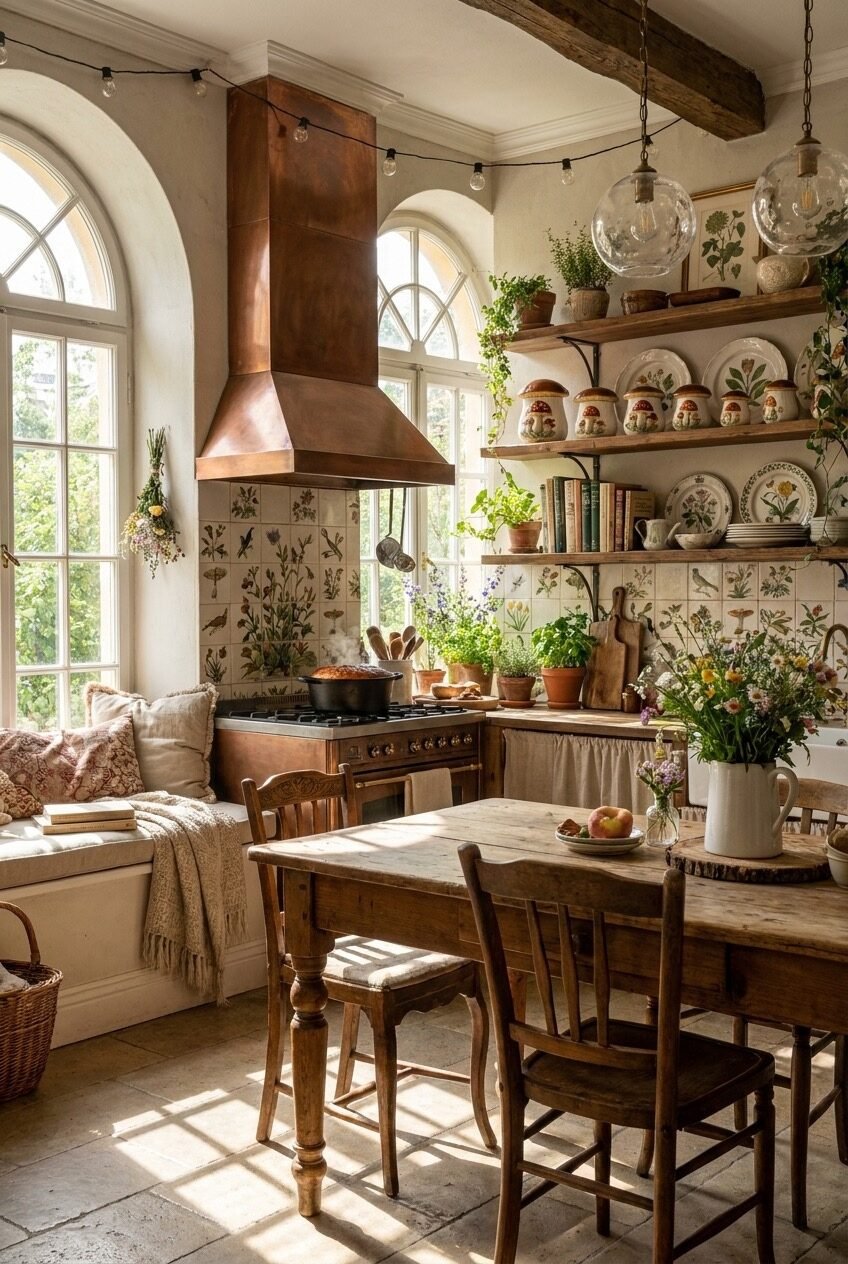
Arched windows flood this corner with the kind of light that makes a plain wooden table look like a whole event. Add a cushioned window seat, a stack of books, and a woven throw blanket, and suddenly the kitchen has a second job as the most comfortable seat in the entire house.
What makes it feel whimsical rather than just cozy is the layering of small collected objects, mushroom-motif canisters on open shelves, dried florals in a jug, string lights strung loosely along a wooden beam overhead. None of it is architectural, but all of it adds warmth to a space that could otherwise feel purely functional.
To borrow this, carve out even a small window nook with a bench or a couple of chairs pulled close together. Dress it with pillows, a soft throw, and a few open shelves nearby stocked with pieces that feel personal rather than purely practical or purchased just for show.
A Little Whimsy Makes Any Kitchen Worth Loving
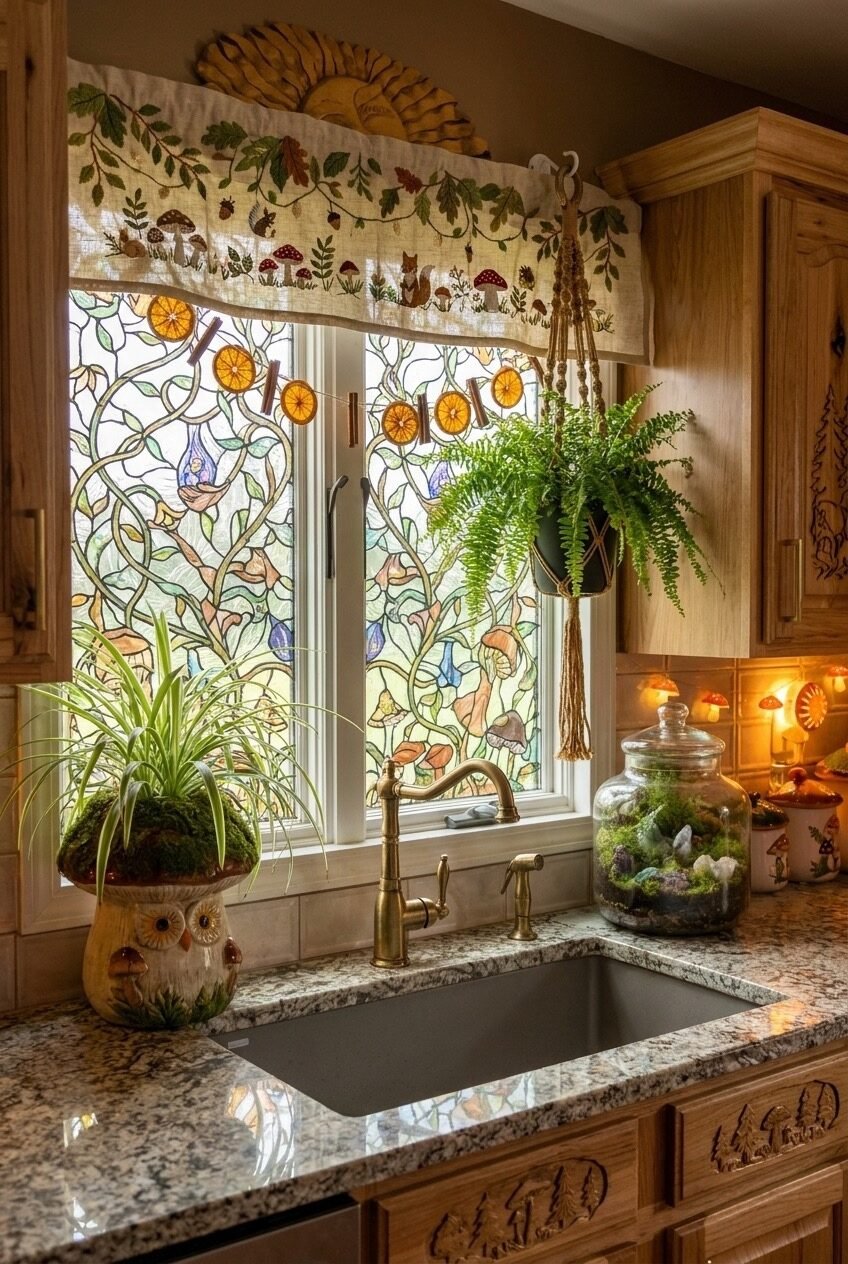
What ties these kitchens together isn’t a single trend or color palette. It’s permission. Permission to hang string lights indoors year-round, to let a mushroom motif take over a backsplash, to keep secondhand teapots because they make you happy every time you reach for a mug. None of it requires a full renovation.
If you’re staring at a kitchen that feels flat, you probably don’t need new cabinets. You need one specific thing with nothing to do with resale value. A hand-painted tile, a vintage lamp, a collection you’ve been hiding because it didn’t match. Bring it to the counter.
We’d rather live in a kitchen that tells you something about the person who cooks in it than one that could belong to anyone. Pick a detail from this list, or the one you kept scrolling back to, and let your kitchen have more character.
 Steal Our Home Styling Secrets!