
The Version of Boho Home Decor That Ages Well and Stays Interesting
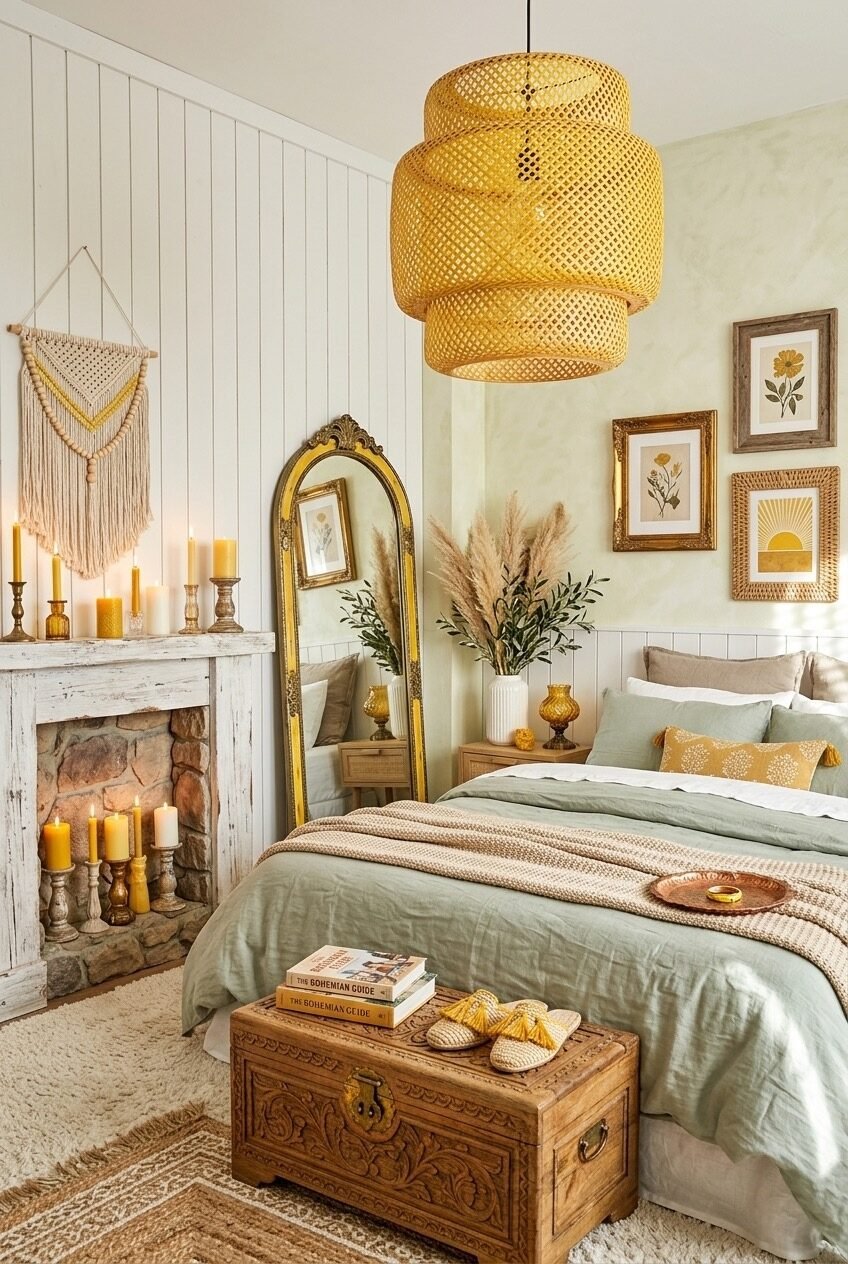
Bohemian decor has a reputation for being maximalist to the point of chaos — layers on layers, every surface occupied, patterns competing for attention. But the spaces that actually pull it off share something quieter underneath all that texture: a real point of view. Not a mood board executed to the letter, but a room that looks like someone genuinely lives there and genuinely loves the things they’ve collected.
What makes boho feel authentic rather than assembled is the mix of eras, origins, and materials that somehow agree with each other. A hand-carved wooden trunk next to sage linen bedding. Rattan alongside dried pampas. A gallery wall that isn’t perfectly spaced. These combinations work because they’re not trying too hard — and that’s the hardest thing to fake when you’re starting from scratch.
The ideas ahead cover a range of spaces and approaches, from sun-drenched dining corners to moody global-influenced living rooms to bathrooms that have no business looking that good. Each one has something worth borrowing, even if you’re only ready to commit to one or two details at a time.
Shelves, Plants, and Collected Color
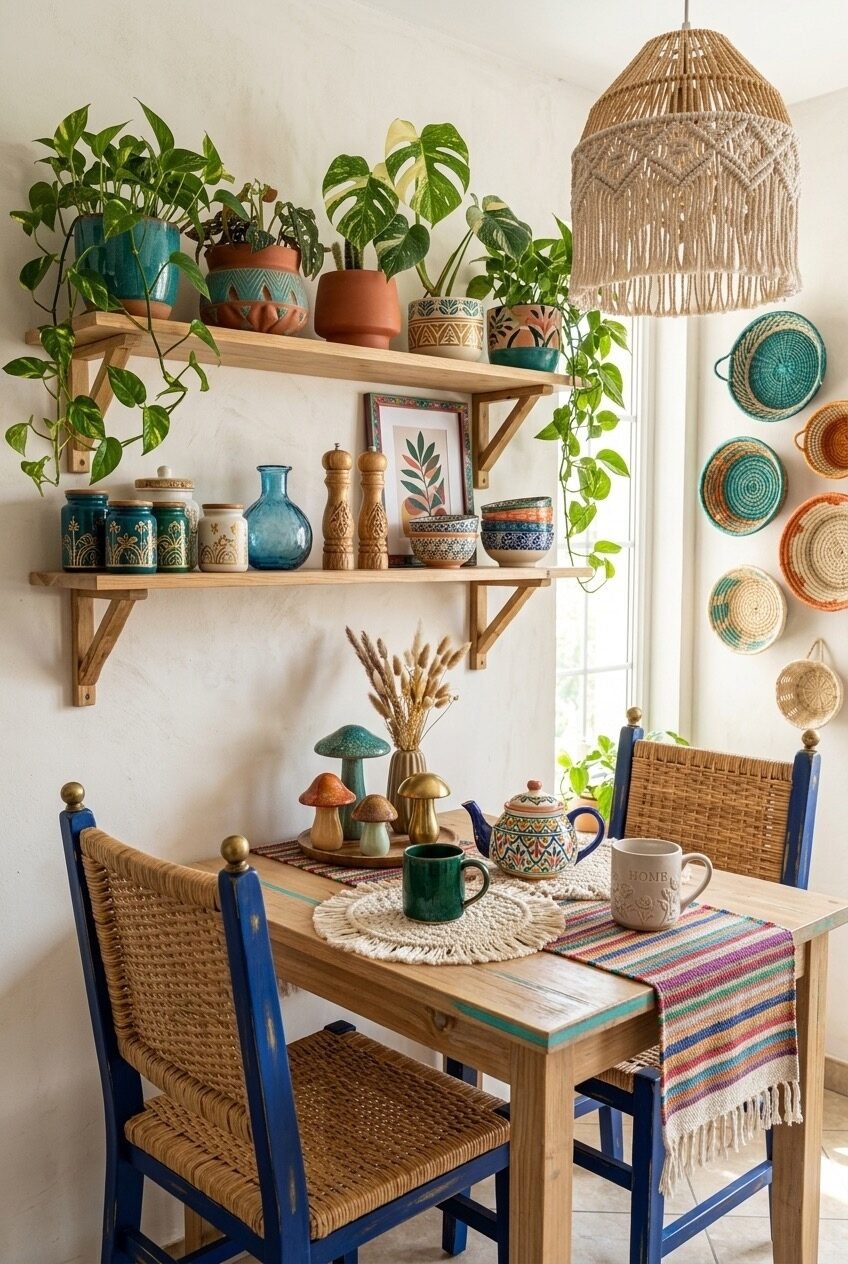
Start with the shelves. Two simple wooden brackets holding open shelving — nothing fancy — become the backbone of a whole room when you load them correctly. The key principle here is layering density: plants up top trailing downward, ceramics and vessels at mid-height, smaller objects and framed prints tucked between. The pothos and monstera trailing over the shelf edge are doing as much visual work as any single decor piece in the room. That movement, that spill of green over the edge, is what keeps a styled shelf from looking frozen.
The color story in this dining nook is a lesson in controlled eclecticism. Teal, terracotta, cobalt blue — all present, none shouting. The chairs with their blue-painted frames and woven rattan seats are the kind of mismatched-but-cohesive find that makes a space look genuinely collected rather than purchased as a set. A striped runner on the table, a macramé pendant above, woven baskets mounted on the side wall: every texture here reinforces the others without competing.
For anyone wanting to recreate this corner, the wall baskets deserve special attention. Hung in a loose cluster of five or six at varying sizes, they fill a wall the way art would — but with much more dimension and far less pressure to commit to a single piece. Mix teal, orange, and natural tones and keep the spacing irregular. The imperfection is the point.
The Arched Mirror Does Everything
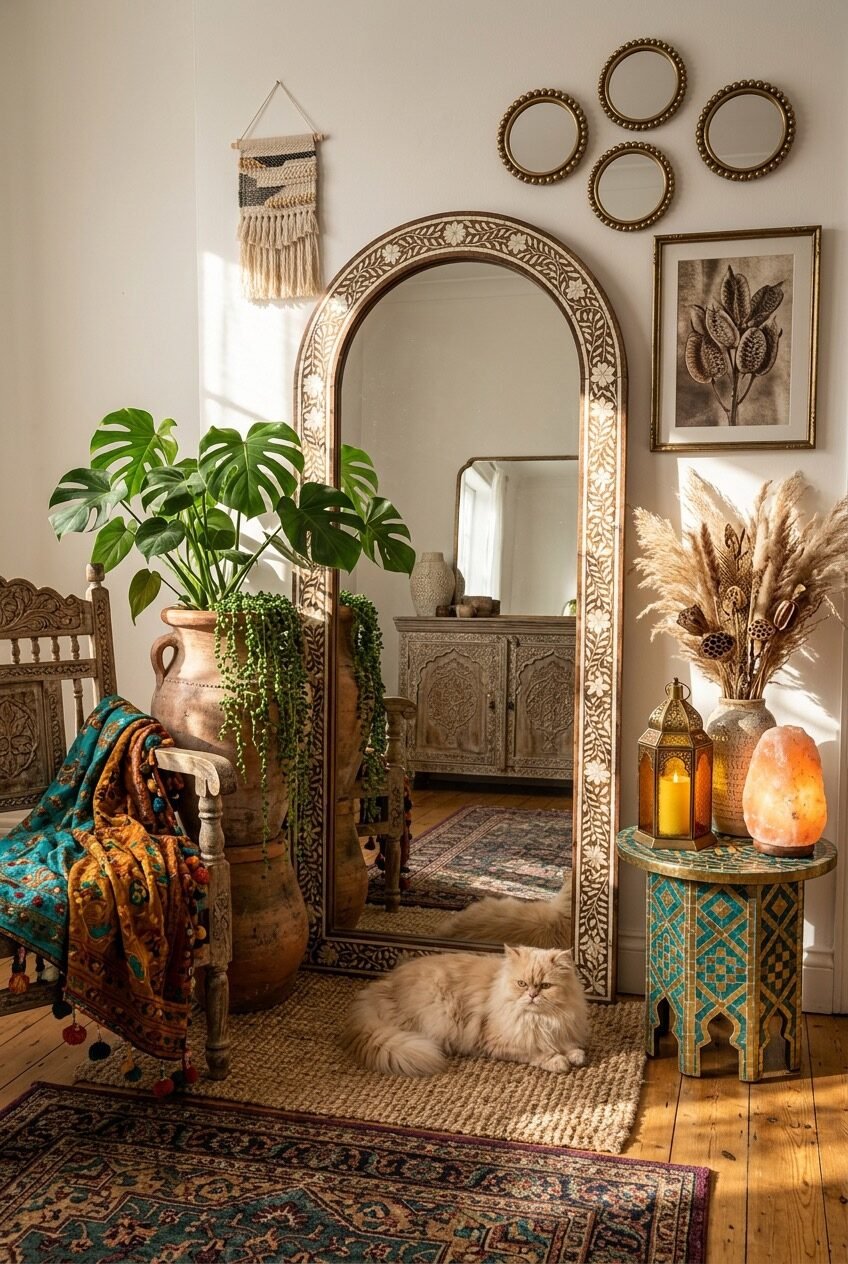
There’s a version of this room that doesn’t have the inlaid arch mirror and it’s just a nice corner. With it, the whole space becomes an event. The frame — white floral inlay on dark wood, a pattern that reads almost like bone inlay — is the anchor from which everything else radiates. The Moroccan side table in teal and gold, the salt lamp, the brass lantern, the patterned kilim rugs layered underfoot: all of it orbits that mirror.
Choosing one exceptional, artisan-quality statement piece and then building the rest of the room around its tones and material language is genuinely one of the most reliable principles in boho design. The mirror here isn’t expensive-looking in a sleek way — it’s expensive-looking in a found-something-real way, which is a different thing entirely. The terracotta urn holding the monstera adds vertical weight on the left to balance the dried pampas and lamp cluster on the right. Nothing is centered; everything is balanced.
The small round brass-beaded mirrors clustered on the wall above add rhythm without competing. Three identical frames grouped asymmetrically — it sounds like it would look random, but the uniformity of the frames keeps it cohesive. If you’re building a corner like this, start with the large mirror, find your Moroccan or painted side table, then let the smaller pieces accumulate over time. Rushing the layering always shows.
A Boho Balcony Built in Layers
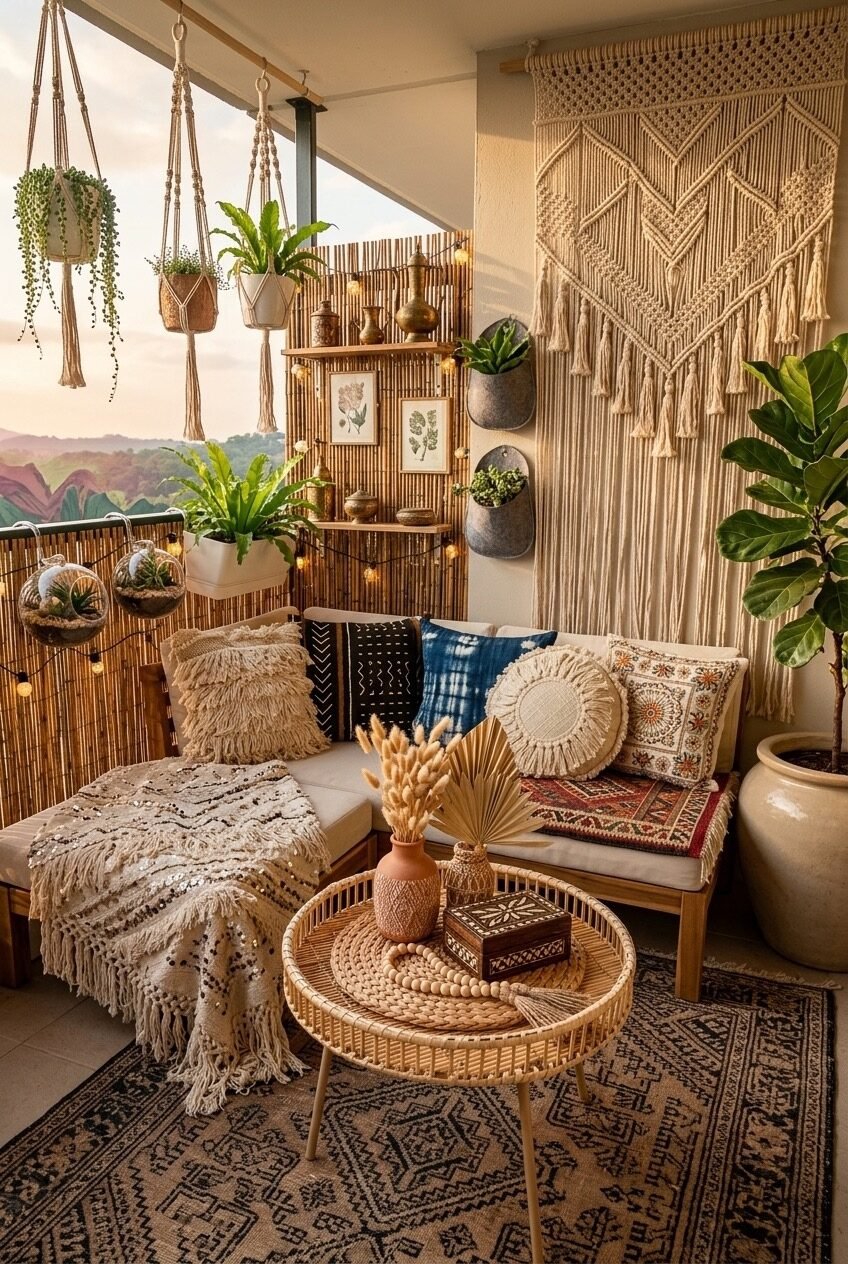
Bamboo fencing as a privacy screen is practical. Bamboo fencing as a backdrop for floating shelves, framed botanical prints, small brass vases, and string lights? That’s a different thing. This balcony uses the bamboo wall not just as a boundary but as a display surface — and the result is that the space reads as a room rather than a transition. The giant macramé wall hanging on the opposite side creates a soft enclosure effect, making the balcony feel sheltered even when it’s wide open to the sky.
The hanging planters deserve a close look. There are at least four or five suspended at different heights from what appears to be a ceiling rod — trailing pearl strings, ferns, a pothos. They create a curtain of green between the interior seating and the view outside, which softens the boundary between indoor comfort and outdoor openness. The rattan coffee table at center holds a dried palm frond arrangement, a wooden trinket box, and a string of beads — deliberately casual, like someone just set things down.
For a smaller balcony, the bamboo screen alone would be worth the effort. Mount it as a backdrop, add one or two small floating shelves, string lights across the top, and hang two or three macramé plant holders at varying heights. That’s 80% of the atmosphere here without needing every piece at once.
When Wallpaper Carries the Whole Room
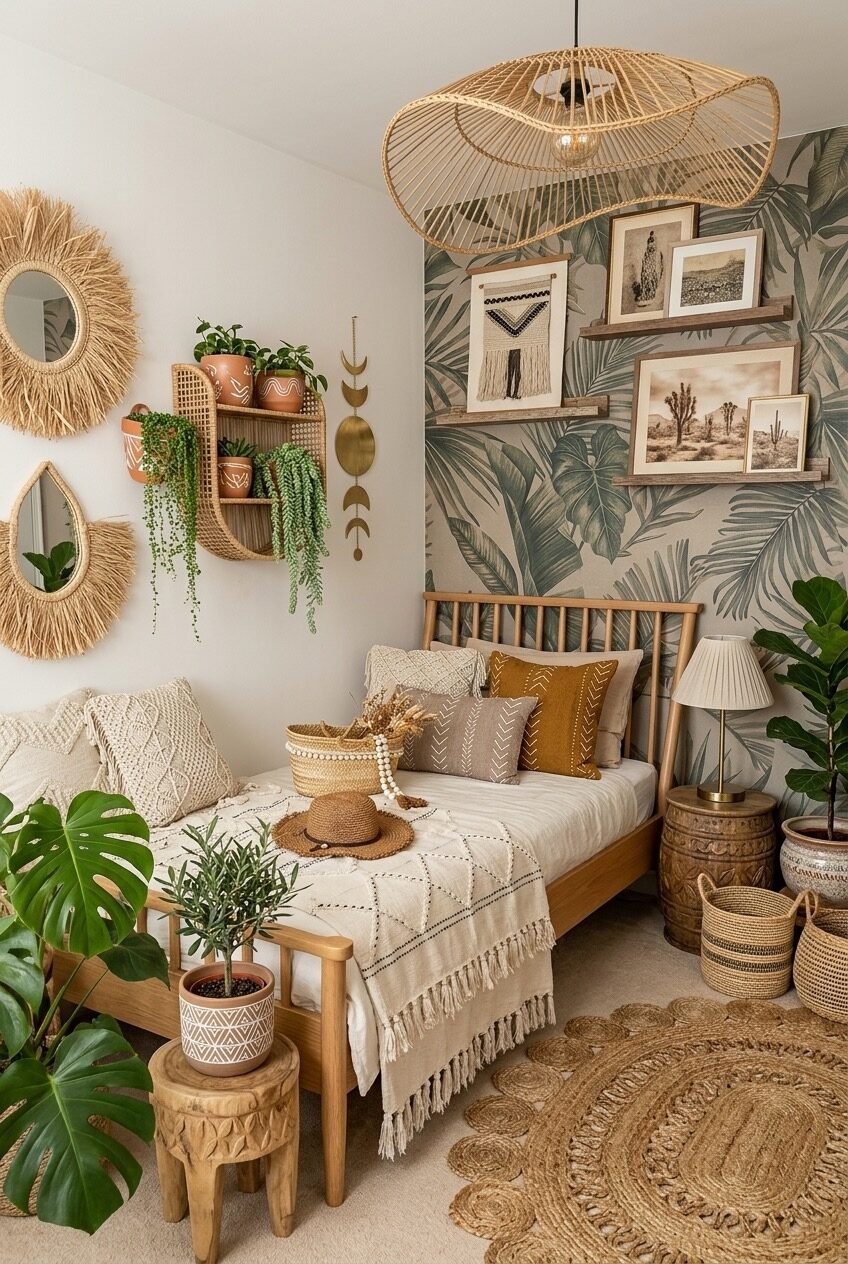
Tropical botanical wallpaper on one accent wall — a dense print of monstera, fan palms, and flamingos in pink and teal — and suddenly a rust velvet sofa that would read as heavy in a neutral room becomes exactly right. That’s what a bold wallpaper accent wall can do: it recontextualizes everything placed in front of it. The sofa doesn’t fight the pattern; it grounds it. The live-edge coffee table adds organic warmth at floor level.
The corner ladder shelf is genuinely clever here. Five asymmetric shelves of varying depth hold a cactus collection at the top, books mid-shelf, a woven basket, trailing ivy, and a brass accent piece — it’s essentially a vertical garden-library hybrid. The whitewashed carved mirror frame in front of the wallpaper reflects the hats hung on the wall behind and the macramé hanging in the window, layering the room’s own reflection back into the composition.
The flamingo wallpaper is a commitment — but it’s worth noting that this whole room works because the furniture and accessories are restrained enough in color to let the wall breathe. The rust sofa, raw wood table, and woven pendant light are all warm neutrals that read as background. If you’re choosing a statement wallpaper, the rest of the room needs to concede.
Natural Materials Doing Heavy Lifting
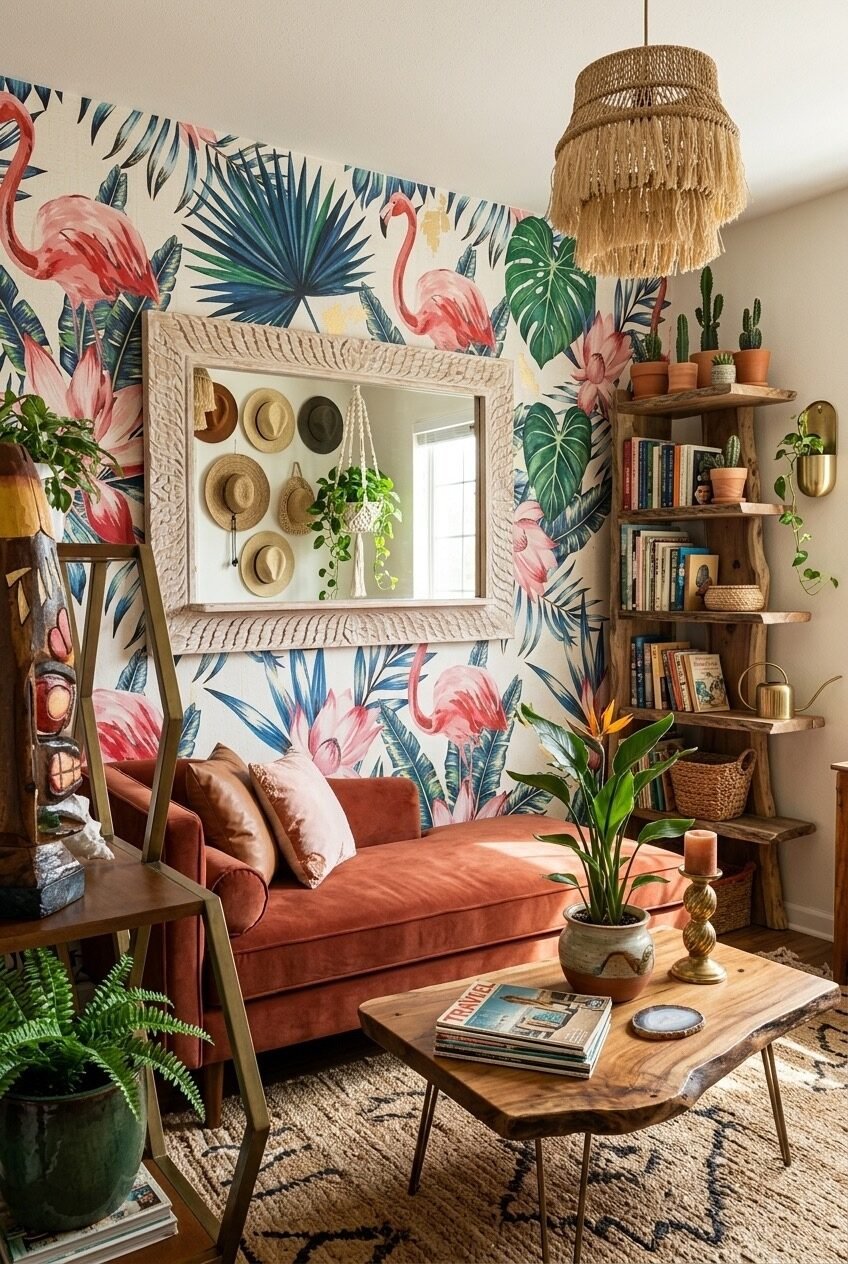
The tropical leaf wallpaper on the accent wall sets one register — organic, slightly wild — and then the rest of this bedroom answers back in natural materials: rattan shelf unit with terracotta pots, jute oval rug, woven pendant light with an open, parasol-like structure, wooden bed frame with spindle detailing. Nothing here is particularly unusual on its own, but together the consistency of material language — every single piece coming from the same planet of natural fiber and warm wood — creates a room that feels genuinely settled.
The wall to the left is doing interesting work: two rattan-framed mirrors of different shapes (one round sunburst, one teardrop), a crescent-shaped rattan wall shelf holding terracotta pots, and a small brass moon phase mobile hanging below. This kind of composition — assembled over time from individual pieces — is the boho approach at its most honest. You’d be hard-pressed to find a kit that would produce it.
The picture ledge shelves on the wallpapered wall are the practical move here, and worth copying. Instead of committing to hanging frames directly on wallpaper (which involves commitment, wall damage, and regret), picture ledges let you rearrange. Load them with frames of similar tones — sepia photography, macramé close-ups, desert landscapes — and let them lean slightly.
Neutral Boho for People Who Hesitate
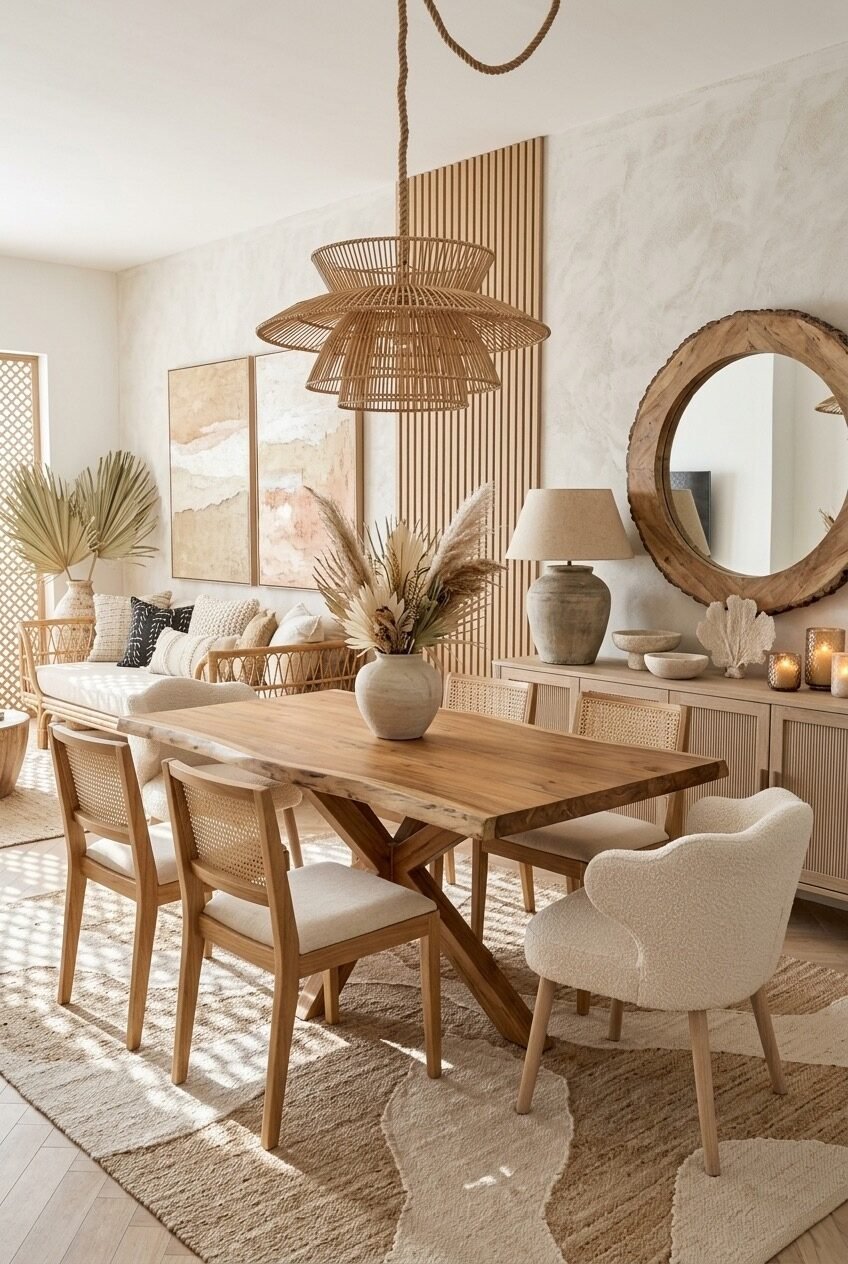
Everything in this dining room operates within the same warm sand-to-honey palette, and the result is a space that feels put-together without feeling decorated. The live-edge dining table is the hero — a slab with genuine character, irregular edges, natural grain variation — paired with cane-back dining chairs and a single boucle armchair that looks like it wandered in from the living room and decided to stay. That mismatch of chair styles around one table is a boho move that reads as relaxed confidence.
The double-tiered rattan pendant light hung on a thick rope cord is worth examining. The cord itself becomes a visual element, running up to the ceiling and adding a casual, almost industrial touch to what would otherwise be a very soft room. On the sideboard below: a stone-look ceramic lamp, a pampas arrangement in a ceramic vase, candles, and a rough wooden coral piece — objects that all belong to the same material conversation of organic, imperfect, found.
The vertical wood slat panel behind the sideboard acts as a subtle architectural detail, adding depth and texture without color — a technique worth stealing if your walls feel flat. The round live-edge mirror above ties back to the table below in material and spirit. A matching pair of abstracts in dusty pink and sand complete the wall without competing with the slat panel.
An African-Inspired Wall Gallery That Works
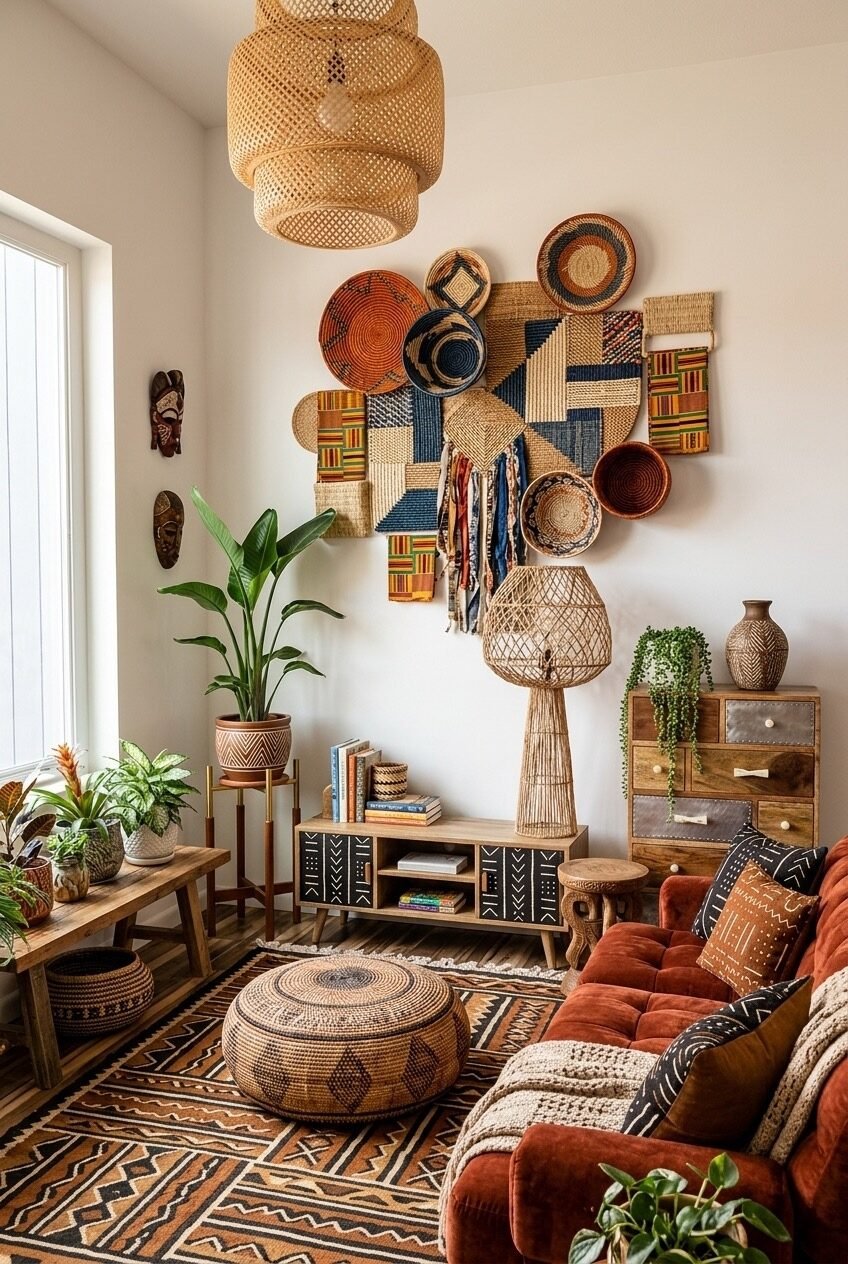
Most gallery walls involve frames, art prints, and a level. This one involves woven kente panels, Rwandan peace baskets, African masks, and a sculptural rattan floor lamp that is half furniture, half installation. The wall composition here is genuinely exceptional — flat woven textile panels create a background field of pattern, and then baskets of varying depths are hung on top of and around them, creating a layered, three-dimensional surface that changes depending on where you’re standing.
The rust velvet tufted sofa anchors the seating with a plushness that contrasts the rawness of the textile wall behind. Mud cloth cushions in black and white add graphic punch. The woven ottoman at center acts as coffee table and extra seating — practical, and true to the African craft tradition the room draws from. The tribal-patterned area rug beneath ties the whole floor plane together.
Building a wall like this takes patience and a willingness to buy single pieces over time. Start with two or three baskets of different sizes and hang them clustered together. Add a textile panel if you can source one — kente, mudcloth, or any handwoven African fabric stretched on a frame works. Build outward slowly. Hanging too many pieces at once is how it tips from collected to chaotic.
One Tapestry That Changes the Room
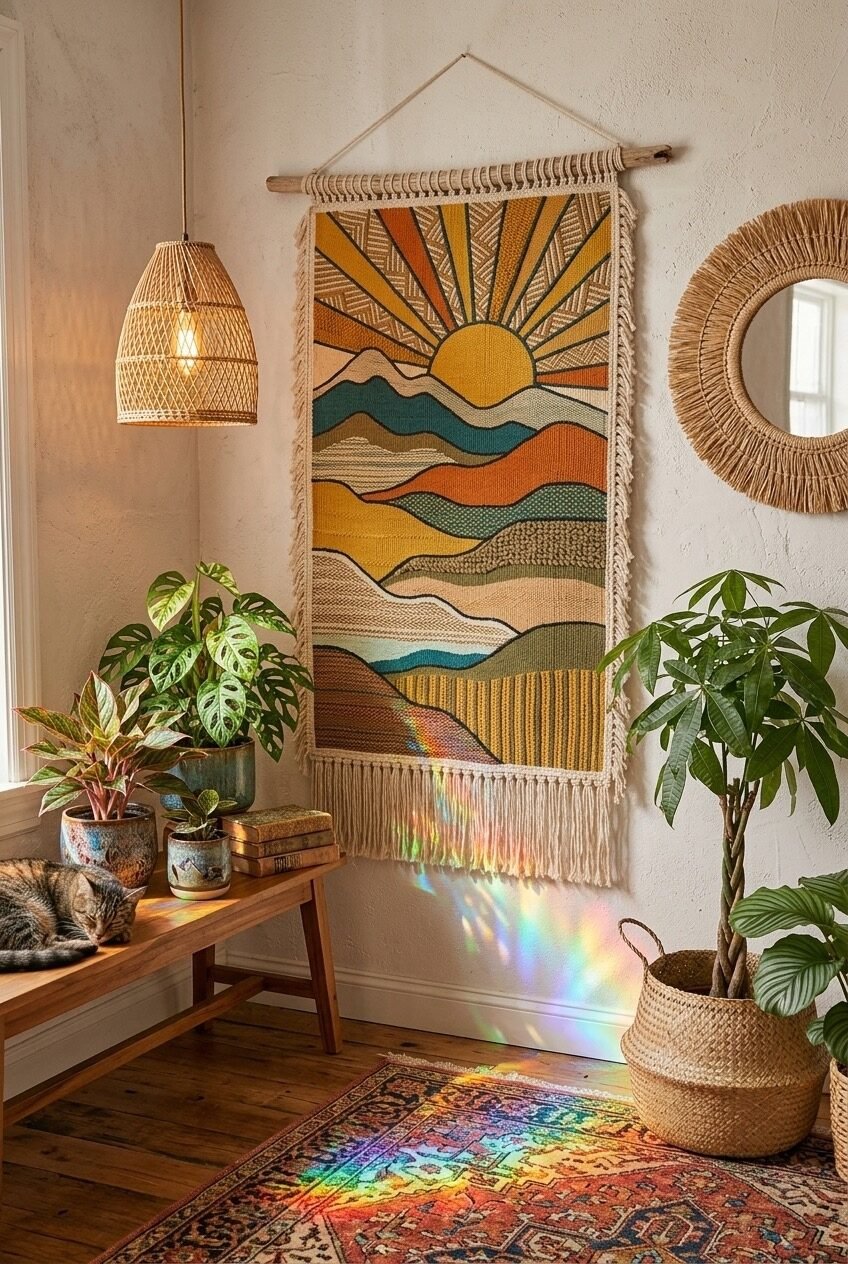
A large woven tapestry depicting a sunrise landscape — bands of teal, orange, gold, and cream in a retro graphic style, finished with a long macramé fringe — is the kind of piece that makes everything around it feel more considered. The composition in this corner is beautifully simple: tapestry as the wall’s entire personality, small woven pendant light to the left, round rattan fringe mirror to the right. The plants on the bench below add life at a lower register.
What makes this work as a room rather than just a styled corner is what’s on the floor. A richly patterned vintage Persian or Turkish-style rug anchors the space and adds the depth that the otherwise white walls don’t provide. On the bench: a sleeping cat, glazed ceramic pots, a couple of stacked books. The objects are minimal but chosen. The rainbow light prism casting across the rug and floor — presumably from a crystal or prism hung in the window — is a detail that costs almost nothing and adds something photos can’t quite capture.
For anyone who wants to build a corner like this, the tapestry is non-negotiable — it has to be large, substantial, and genuinely interesting up close. Budget accordingly. Once you have the tapestry, the rest is just plants, a pendant you love, and a rug that can hold its own.
The Boho Bathroom Nobody Expects
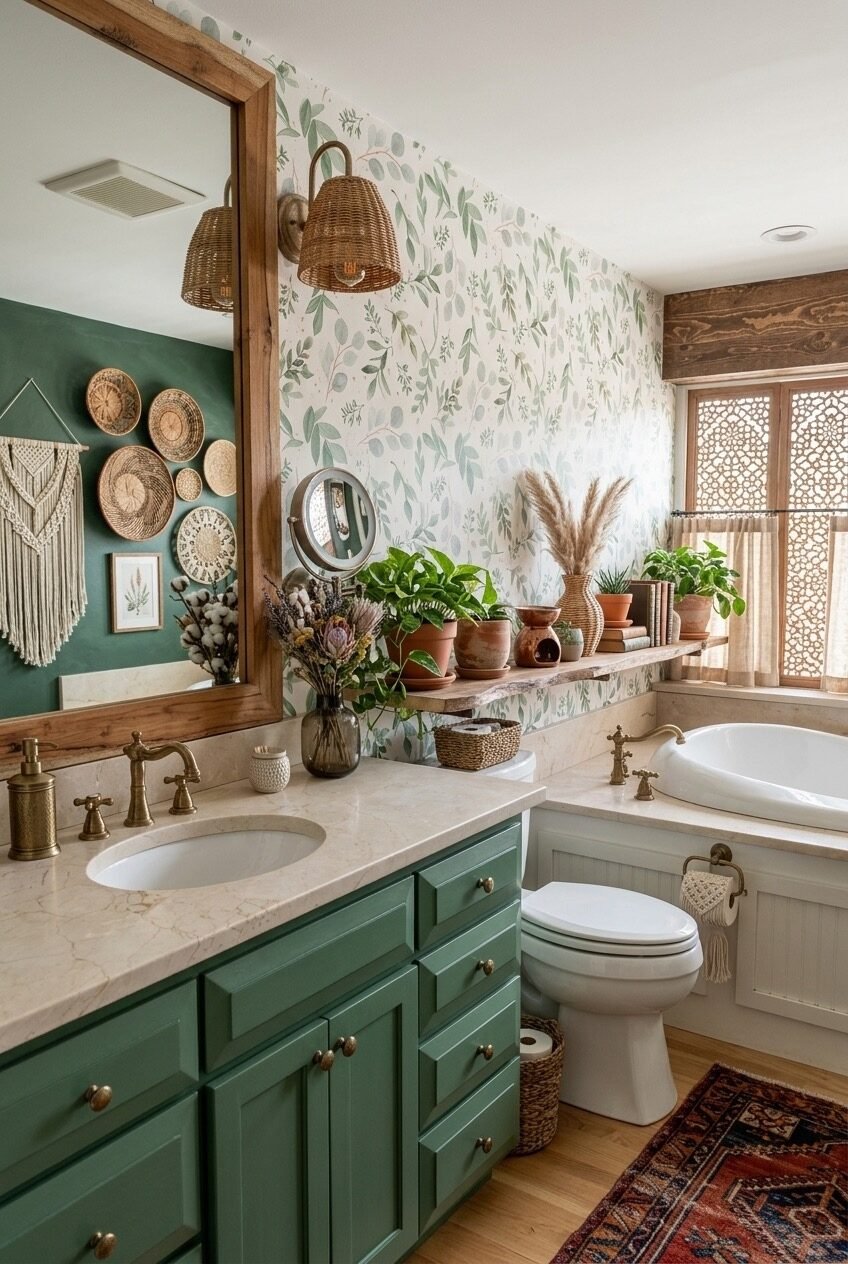
Painting a vanity cabinet sage green is a small decision that completely changes what a bathroom can be. Paired with brass hardware and faucets, a wood-framed oversized mirror, and a rattan wall sconce, it shifts the room out of standard bathroom territory and into something that feels like it was designed rather than installed. The botanical wallpaper on the adjacent wall continues the garden theme without overwhelming — soft watercolor leaves on white, not a tropical statement wallpaper, which keeps the overall feel light.
The live-edge wooden shelf running above the tub is genuinely practical and genuinely beautiful. It holds a row of terracotta and glazed ceramic plant pots — pothos, succulents, a small leafy green — plus a few dried florals and books. That shelf, more than anything else in this bathroom, signals that the person who designed this space actually spends time in here and treats it like a real room. The carved wooden lattice window screen visible through the glass adds an architectural detail that would be worth sourcing if you’re doing a full renovation.
The dark green accent wall behind the mirror — visible as a partial field on the left — is bold but contained. Rather than painting all four walls, keeping the color to one partial wall lets the sage vanity, the botanical wallpaper, and the wooden elements breathe. On that green wall: woven baskets, a small macramé hanging, a framed botanical print. It’s a micro gallery wall inside a bathroom, and it absolutely works.
The Dresser Corner Done Right
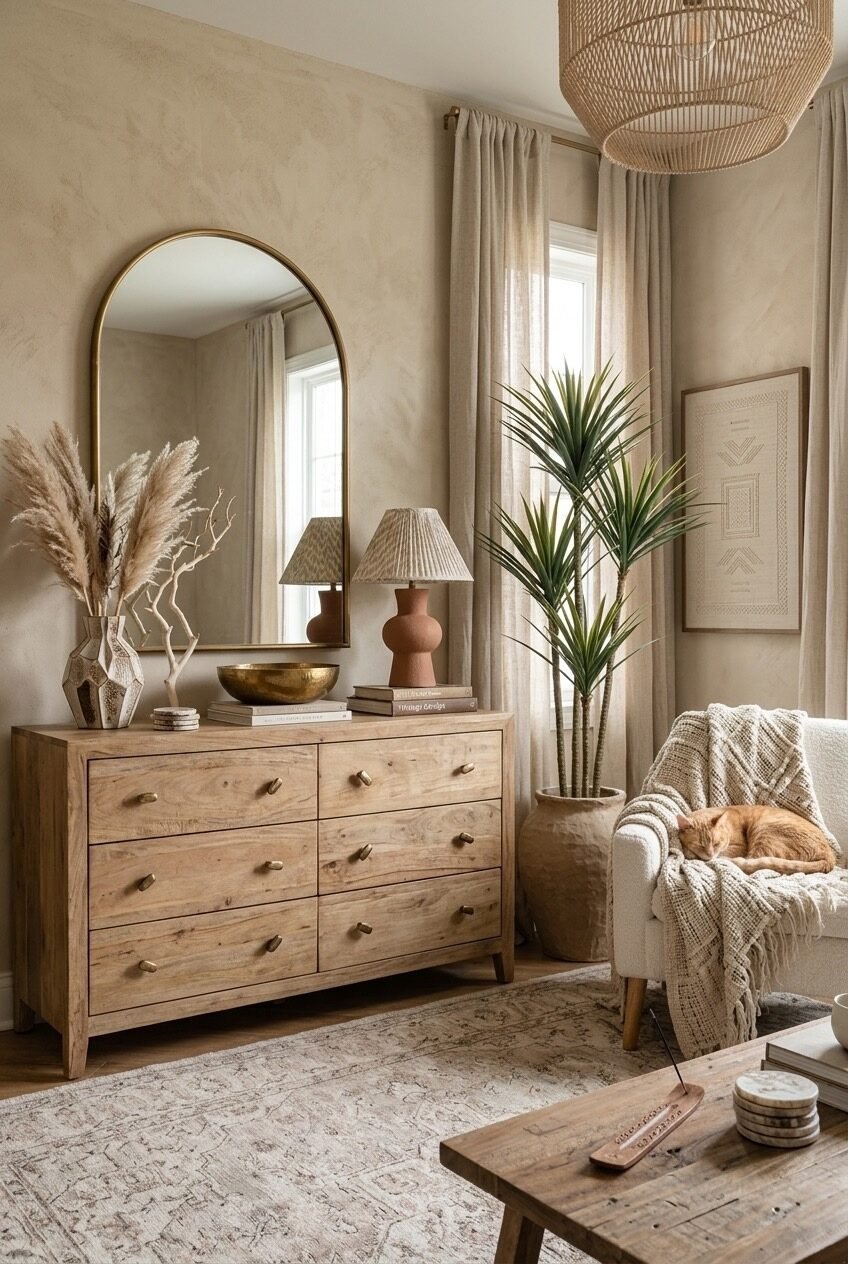
Light mango wood with visible grain and simple brass tab pulls — the dresser in this room is the kind of piece that looks better as it ages. Styled with pampas grass in a textured vase, a terracotta lamp with pleated shade, a small gold bowl, stacked coffee table books, and a few coasters, it hits the balance between purposeful and unhurried. The arched brass mirror above is a current-moment silhouette that still feels genuinely boho, particularly in this palette.
The room’s overall color story is worth noting: plaster-effect walls in warm greige, linen curtains in the same register, a woven pendant overhead, a faded printed rug underfoot. The entire room operates in a narrow tonal bandwidth — warm beige, sand, honey, soft brass — and the restraint is what makes individual pieces stand out. The tall dracaena in the concrete planter introduces the only vertical green element and its spiky form adds needed contrast to all the softness.
The orange tabby sleeping on the boucle chair is decoration. Beyond that, the chair itself — loose, white, slightly rumpled with a knitted throw across the arm — communicates that this is a room for actually sitting in. A small incense tray on the coffee table in the foreground, marble coasters, a few stacked books: nothing elaborate, nothing performed. Rooms that feel genuinely lived-in tend to have objects that serve a purpose.
Boho Is a Direction, Not a Destination You Reach
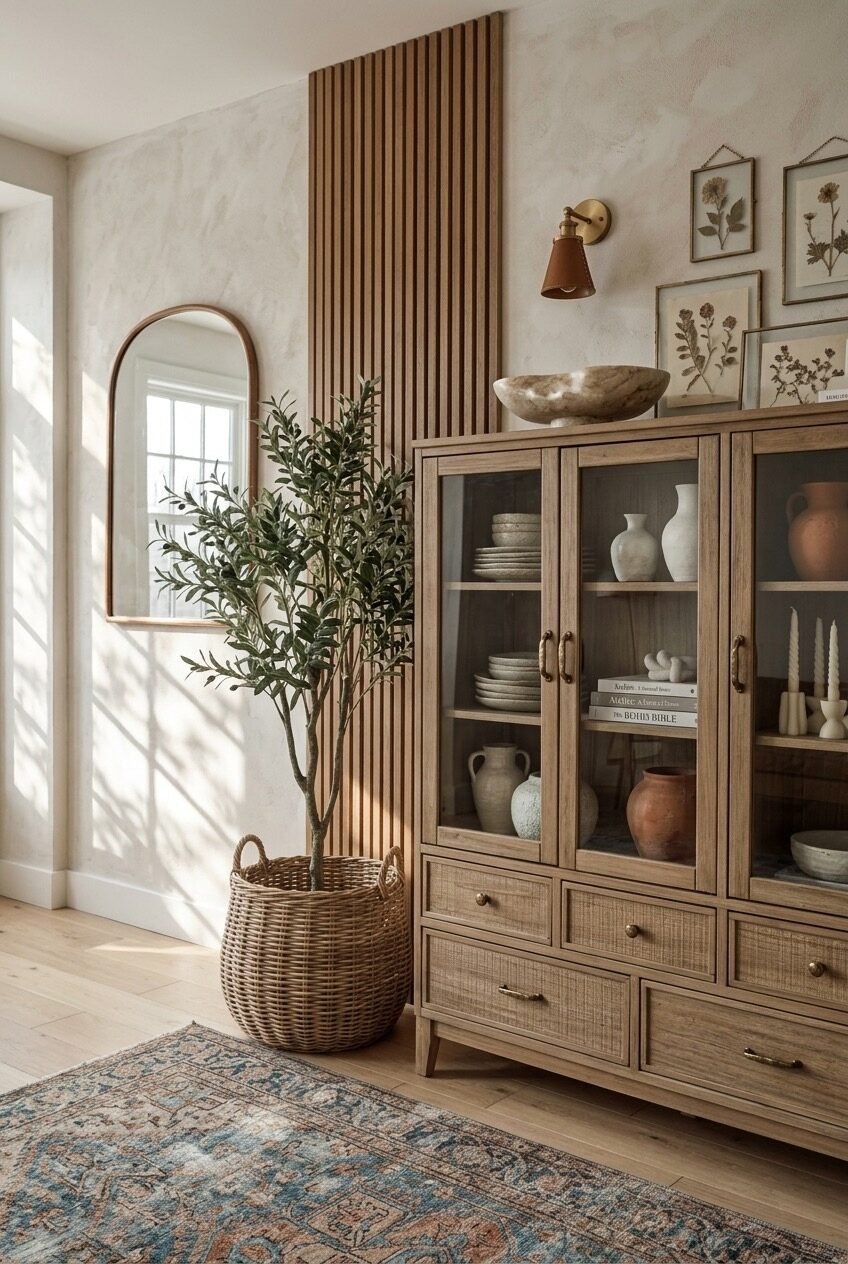
If there’s a thread running through all of these spaces, it’s that the best boho rooms look like they’ve been added to rather than decorated all at once. A mirror found at a flea market, a plant that finally got big enough to earn its own corner, a rug brought back from somewhere — that accumulation is the real technique, and it takes time to develop honestly.
The practical version of that is to start with one or two anchors — a statement textile, a piece of furniture with actual craft behind it, a pendant light that means something — and then let the rest build around those decisions rather than trying to complete a room in a single shopping session. Spaces that feel genuinely boho almost always have at least one thing that was hard to find or took patience to source.
We find that the most interesting boho rooms borrow from multiple traditions without treating any of them as costumes. African weaving, Moroccan tile, Indian inlay, Mexican ceramics — these craft traditions are worth engaging with seriously, and the rooms that do so tend to feel richer for it. Buy the real thing when you can. Let the imperfections stay visible. That’s what makes a room worth photographing — and more importantly, worth living in.
 Steal Our Home Styling Secrets!